
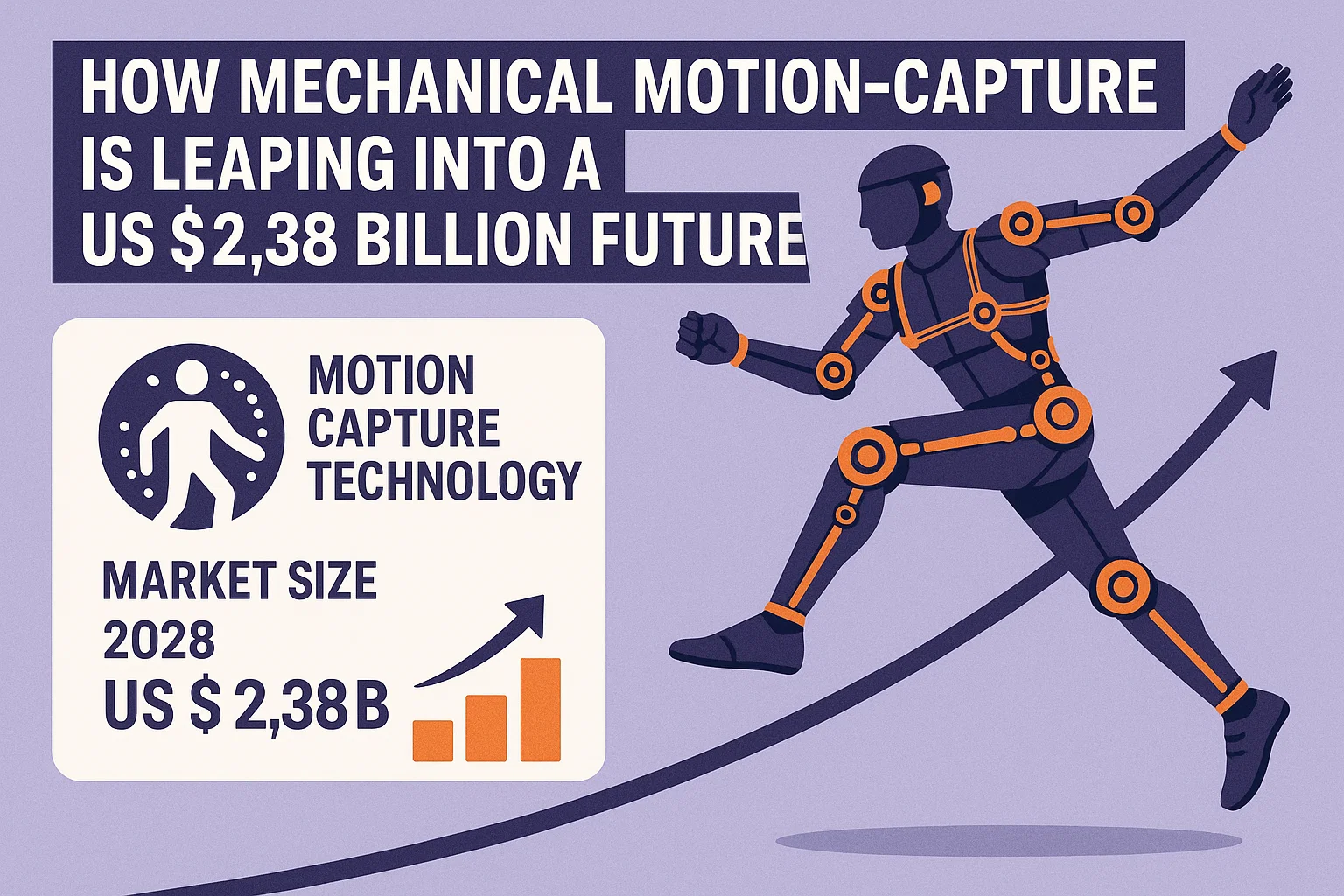
How Mechanical Motion‑Capture Is Leaping Into a US $2.38 Billion Future
Mechanical (i.e., hardware‑based) motion‑capture systems—optical rigs, active‑marker setups, inertial suits and emerging hybrid platforms—were worth roughly US $1.27 billion in 2024. By 2032 they are projected to hit US $2.38 billion, growing at a robust 9.2 % CAGR. Three forces sit behind that curve:
- Democratisation: consumer sensors and AI cut entry costs.
- Diversification: new verticals—healthtech, sports analytics, robotics—add demand beyond film and games.
- Deep integration: mocap data is becoming a “first‑class citizen” inside real‑time engines, digital twins and AI pipelines.
Those macro factors set the stage for 2024‑25’s burst of newsworthy activity—our focus for the rest of this piece.
Access Your Free Sample Report- Mechanical Motion Capture System Market
Why 2024‑25 feels like an inflection point
Five years ago the big headlines were about blockbuster VFX budgets. Today the most interesting stories involve clinicians running gait studies with nothing but an iPhone, or aerospace engineers dropping Hollywood‑grade cameras into satellite testbeds. Hardware and software lines are blurring; so are the boundaries between entertainment and engineering. The latest news cycle captures that evolution better than any analyst report.
Pocket‑sized mocap: the MobilePoser breakthrough
Last October, researchers at Northwestern University unveiled MobilePoser, a full‑body capture pipeline that runs in real time on everyday devices—phones, smartwatches and even earbuds. The team fused low‑cost IMU data with machine‑learning pose estimation and a physics optimiser, hitting 8‑10 cm joint‑position error (close to early Kinect accuracy) without a single retro‑reflective marker or depth camera.
Why it matters:
- Accessibility: Motion study sessions no longer need a studio; a physical‑therapy patient can record rehab progress in the living room.
- Data volume: Billions of sensor‑equipped devices translate into oceans of motion data—perfect fuel for self‑supervised AI models that crave scale.
- Form‑factor convergence: The same inertial chips driving AR/VR headsets now underpin mocap, hinting at seamless cross‑device experiences.
Industry takeaway: Expect a wave of “SDK‑first” startups bundling mobile mocap APIs for fitness, navigation and consumer XR.
Markerless labs go ‘into the wild’
In December, the University of Bath’s CAMERA lab open‑sourced a pipeline that reconstructs 3D biomechanics from ordinary 2D video, then validates those results against traditional marker rigs. The paper shows near‑parity on common sports motions, and the dataset is public for benchmarking.
Key implications:
- Clinical scale‑out: Rehab clinics can record hundreds of patients per day without suit‑up downtime.
- Athlete monitoring: Coaches gain unobtrusive tools for load management on actual courts and tracks, not just in motion labs.
- Open science: Freely available code flattens the research playing field, accelerating algorithmic innovation.
Together, MobilePoser and CAMERA mark a shift from high‑friction capture toward invisible sensing woven into daily life.
Productisation at studio scale
Consumer‑grade experiments grab attention, but the professional market is hardly standing still. Two launches underscore how vendors are tuning hardware for reliability and workflow speed:
Vicon’s Active Crown
- Launch date: 21 May 2025
- What it is: A purpose‑built camera‑tracking crown for virtual‑production stages, designed to slash occlusion noise and support multi‑camera setups across complex LED volumes.
- Why it matters: Virtual production deadlines leave no room for dropped frames. By hardening tracking against interference, Vicon keeps optical systems relevant even as markerless software improves.
Download Sample Report PDF- Mechanical Motion Capture System Market
Xsens Animate 2025
- Launch date: 13 May 2025
- Highlights: First inertial engine to ship with native male & female anatomical rigs, automated sensor mapping, and a UI overhaul (including dark mode).
- Impact:
- Faster setups mean indie studios can rent suits for a weekend shoot without a dedicated mocap TD.
- Higher realism via spine and shoulder refinements reduces cleanup—a cost sink on previous generations.
- Cross‑pipeline integration with Unreal, Unity and Maya keeps inertial data competitive with optical workflows.
Collectively, these releases show how mature vendors are doubling down on ergonomics and reliability, not just pure accuracy.
Mocap leaves Earth: robotics & space servicing
Mechanical mocap is proving invaluable far beyond entertainment. One compelling example comes from the IOSM Yard at the UK’s Satellite Applications Catapult. Engineers there track two industrial robots with a 33‑camera Vicon array in a 27 × 7 × 8 m volume, simulating docking manoeuvres, refuelling, debris capture and more—operations that will one day unfold hundreds of kilometres above Earth.
Why motion capture here?
- Ground‑truth pose: Robotic navigation sensors (lidar, stereo, star‑trackers) need benchmarking against centimetre‑level reality.
- Tumble modelling: Virtualising uncontrolled, spinning satellites is safer on the ground than in orbit.
- Certification pathways: Agencies and insurers increasingly require hardware‑in‑the‑loop validation before launch.
Takeaway: As space‑servicing markets open, mocap providers find a lucrative, mission‑critical niche—mirroring how automotive ADAS validated sensors in simulators a decade ago.
Growth drivers and headwinds (2025‑2032)
| Driver | How it fuels the 9.2 % CAGR | Counter‑force / risk |
| AI democratisation (edge ML on phones) | Turns billions of devices into capture nodes → new SaaS models | Data‑privacy regulation could throttle raw‑motion sharing |
| Hybrid workflows (optical + inertial + vision) | Vendors can upsell combined kits, boosting ASPs | Integration complexity pushes smaller studios back to turnkey solutions |
| XR & virtual production boom | LED‑volume stages require centimetre‑perfect tracking | Macro content cycles: a streaming downturn may pause capex |
| Space & industrial robotics | High‑value, safety‑critical use cases justify premium hardware | Conservative procurement; long qualification cycles |
| Sports / health reimbursement | Clinical CPT codes for digital gait analysis unlock insurance coverage | Validation studies must meet medical‑device standards |
Strategic take‑aways
For hardware vendors
- Bundle software smarts. CAMERA’s open pipeline and MobilePoser show that algorithms—not just cameras—drive value perception.
- Target specialised niches. Space robotics, elite sports and surgical robotics crave sub‑millimetre accuracy and will pay for it.
For content studios
- Invest in interoperability. Mixed optical–inertial pipelines reduce risk; choose vendors with robust SDKs and open file standards.
- Exploit markerless for previz. Early blocking passes can be shot on location with phones, reserving high‑end capture days for hero shots.
For investors & analysts
- Watch service layers. As capture commoditises, annotation, biomechanics insights and real‑time retargeting engines may out‑earn hardware margins.
- Regulation is a sleeper issue. EU AI Act–style legislation could restrict biometric data collection; firms with on‑device or federated solutions will have an edge.
Click Here To Download Full Sample Report- Mechanical Motion Capture System Market
If the 2010s were about cinematic spectacle—digital Gollums and Na’vi—the mid‑2020s are about ubiquity. Motion capture is shrinking from warehouse rigs to wrist‑watch chips, expanding from studios to satellite yards, and weaving itself into the daily feedback loops of athletes, patients and factory robots alike. That breadth underpins the forecast leap to US $2.38 billion by 2032.
But the numbers only tell half the story. The more profound shift is cultural: movement data is becoming an ordinary part of how we understand the world, the body and even machines in orbit. The companies and creators who embrace that paradigm—blending precision hardware with open, AI‑driven software—will define the next chapter of mechanical motion capture.

Comments (0)