
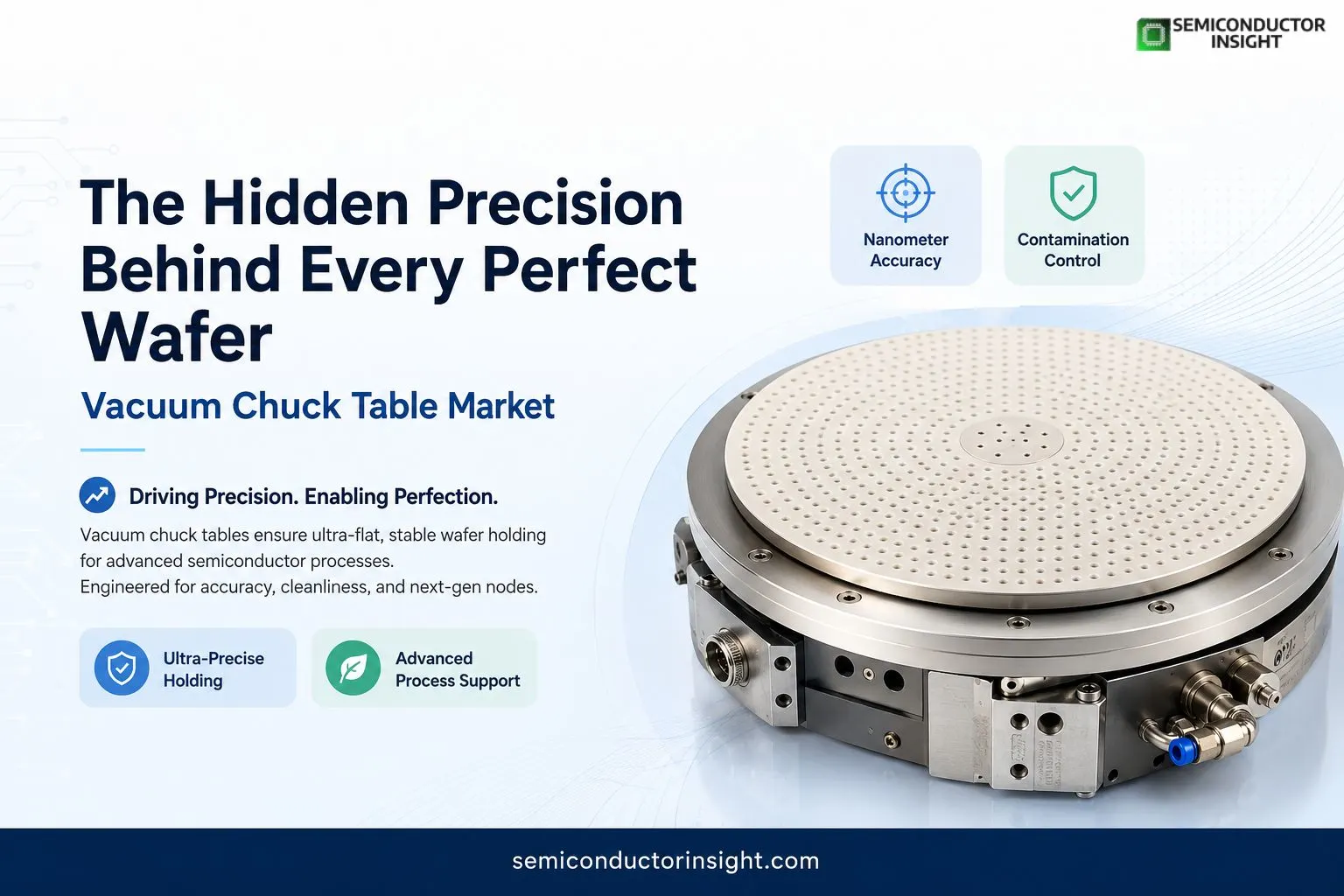
How Do Vacuum Chuck Tables Maintain Wafer Position during High Speed Lithography?
Vacuum chuck tables form the precision interface that holds silicon wafers firmly in place during critical semiconductor process steps. They rely on controlled vacuum pressure distributed across a carefully engineered surface so that the wafer remains flat and immobile without mechanical clamps that could generate particles or stress.
Precision Holding Surfaces in Lithography Stages
In modern photolithography scanners the wafer must remain stable to within a few nanometers while the stage moves at high acceleration. Vacuum chuck tables supply the necessary holding force through an array of small orifices or a continuous porous ceramic face.
The design ensures uniform suction that corrects minor wafer warp while preserving the extreme flatness required for sub-3 nanometer patterning. Equipment builders integrate these tables directly into the wafer stage so that focus and overlay control remain within process windows even during continuous scanning motion.
Stay connected for additional in-depth information right here: https://semiconductorinsight.com/report/vacuum-chuck-table-market/
Material Selections for Surface Integrity and Cleanliness
- Porous ceramics based on high-purity alumina or silicon carbide remain the preferred choice for demanding front-end applications.
- These materials offer an exceptional combination of mechanical hardness, chemical inertness, and moderate thermal conductivity that allows heat to spread evenly while the porous structure itself creates a dense network of microscopic vacuum pathways.
- Manufacturers form the ceramic body through controlled sintering so that the open porosity is uniform and interconnected, then machine and polish the working surface to optical flatness, often achieving peak-to-valley deviations measured in tens of nanometers across a full 300 mm diameter.
- Additional surface treatments such as plasma cleaning, thin inert coatings, or specialized edge sealing further reduce the risk of particle generation or outgassing.
- Aluminum alloy tables continue to serve well in backend or less contamination-sensitive stations.
- They are lighter, easier to machine into complex shapes, and possess higher thermal mass that can help stabilize temperature during short process cycles.
- However, aluminum requires careful surface finishing and sometimes hard anodizing or other protective layers to limit particle shedding and chemical attack.
- Regardless of the base material, every chuck must endure hundreds or thousands of thermal cycles, repeated exposure to cleaning solvents or plasma, and continuous mechanical contact with wafers without losing flatness, porosity integrity, or vacuum sealing performance.
- Material qualification therefore includes long-term dimensional stability tests, particle count measurements under simulated process conditions, and verification that vacuum holding force remains consistent after extended use.
Support for Warped and Ultra-Thin Substrates
Modern process flows increasingly deliver wafers that deviate significantly from ideal flatness. Temporary bonding, grinding, and backside metallization can leave substrates with bows of several hundred micrometers or thicknesses reduced below 100 micrometers, sometimes approaching 50 micrometers or less. A conventional single-zone rigid chuck tends to either leave portions of the wafer unsupported or apply excessive localized force that risks fracture or residual stress.
Multi-zone vacuum architectures address this challenge by dividing the chuck surface into independently controlled concentric rings, radial sectors, or a combination of both. Each zone can be activated or modulated in pressure so that the holding force matches the local topography of the wafer. In practice the system may first apply gentle vacuum to the outer zones to settle the edges, then progressively engage inner zones once initial contact is established.
The same zonal control also improves release: by sequencing the venting of vacuum channels, the wafer can be freed gradually rather than experiencing a sudden pressure equalization that might cause it to flex or crack. These capabilities have become essential for handling the thin, often fragile wafers used in advanced packaging, three-dimensional stacking, and power device fabrication.
Thermal Management Integration during Processing
Many lithography, deposition, etch, and bonding steps require the wafer to be held at a precise elevated temperature or to follow a tightly controlled thermal profile. Vacuum chuck tables therefore frequently incorporate embedded resistive heaters, fluid cooling channels, or dual-function systems that can both heat and cool. The goal is uniform heat transfer across the entire 300 mm surface so that radial or azimuthal temperature differences remain well below one degree Celsius; larger gradients would produce differential expansion and shift critical pattern placement or film stress.
Temperature sensors, typically resistance temperature detectors or thermocouples, are distributed at multiple points beneath the working surface to provide real-time feedback. The control system continuously adjusts heater power or coolant flow to correct any detected nonuniformity. In high-performance designs the thermal response must be rapid enough to support short process cycles yet stable enough to avoid overshoot. Material selection again plays a role: ceramics with appropriate thermal conductivity help spread heat laterally, while the vacuum interface itself influences thermal contact resistance between the wafer and the chuck. Careful engineering of these thermal pathways ensures that the chuck contributes to process capability rather than introducing an additional source of variation.
Particle and Contamination Control Measures
Any contact surface risks transferring particles onto the wafer backside. Chuck tables therefore use low-outgassing materials, precision edge seals, and sometimes electrostatic assist in combination with vacuum. In high-vacuum process chambers the chuck must maintain holding force while the surrounding environment drops to pressures far below atmospheric. Surface textures and coating choices are continually refined to keep defect densities compatible with leading-edge yield targets.
Application across Metrology Inspection and Backend Steps
Beyond lithography the same vacuum chuck technology appears in optical and electron-beam inspection tools, film thickness metrology stations, wafer grinders, and temporary bonding systems. In each case the requirement is identical: hold the substrate flat, motionless, and free of added contamination while the tool performs its measurement or material removal task. The ability to handle both standard thickness and ultra-thin wafers on the same platform improves tool utilization in mixed-product fabs.
These engineering details illustrate how vacuum chuck tables have evolved from simple holding plates into highly specialized subsystems that directly influence process capability at every advanced node. Their performance continues to track the tightening tolerances of lithography, packaging, and inspection equipment worldwide.

Comments (0)