
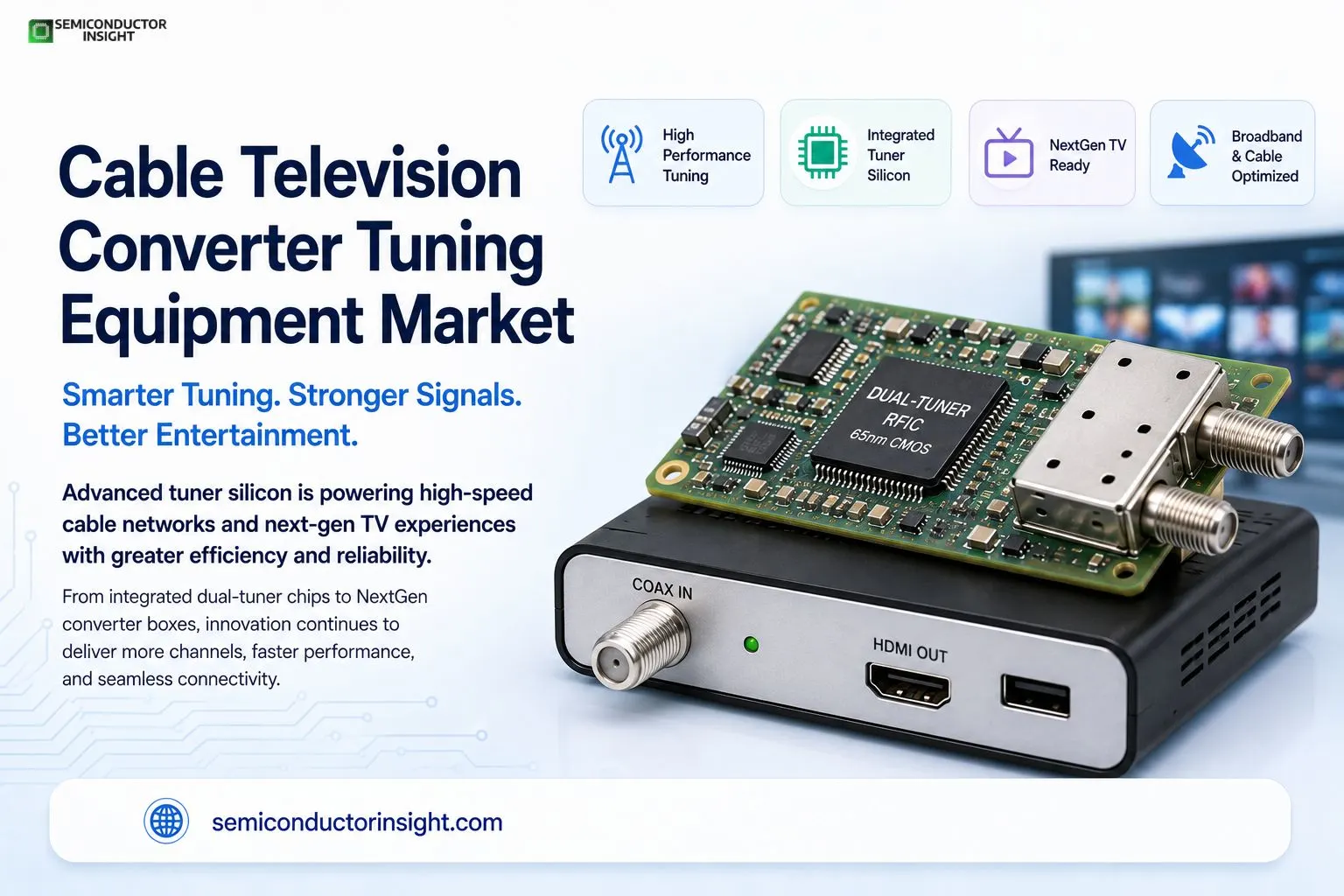
How Big Is the Cable TV Converter Tuning Equipment Market in 2026? Complete Volume Breakdown
Cable television converter tuning equipment sits at the radio frequency front end of set-top boxes and external converters that translate the dense channel plan delivered over coaxial plant into a usable intermediate frequency or baseband stream.
Modern solutions have largely moved from discrete metal can assemblies containing dozens of discrete transistors, inductors and varactors to single-chip silicon or silicon-germanium implementations that integrate the low-noise amplifier, mixer, phase-locked loop and intermediate-frequency stages on one die.
Historical Production Scale and Cable-Specific Demands
- There used to be a steady need for tuner silicon that could handle both terrestrial and cable spectra due to historical production volumes for television receivers of various kinds reaching several hundred million units annually.
- Cable-specific designs must contend with a relatively flat channel power profile across the plant yet still meet stringent adjacent-channel interference and composite triple-beat specifications.
- Dual-tuner cores have become common in higher-tier boxes so that one path can deliver the primary viewing channel while the second simultaneously captures a second program for recording or picture-in-picture.
Measured Performance in Dual-Tuner Silicon
A concrete illustration appears in 65-nanometer CMOS dual-tuner silicon developed for DOCSIS 3.0 cable modems and set-top applications.
Each core occupies roughly five square millimeters and together the pair can down-convert up to ten 6-megahertz Annex B channels or eight 8-megahertz Annex A channels, delivering aggregate data rates approaching 320 to 400 megabits per second under full loading.
Measured 256-QAM slicer signal-to-noise ratios remain high even when the plant carries a complete complement of carriers.
NextGen External Converter Activity
Next-generation terrestrial standards are now influencing the external converter segment. At industry gatherings in 2026 organizers displayed prototype ATSC 3.0 converter boxes intended to retail near or below sixty dollars so that households with older displays can receive the higher-resolution and interactive features of NextGen television without replacing the entire set.
Consumer technology association tallies through 2025 recorded roughly 18.6 million NextGen-capable televisions sold and several hundred thousand external tuners already in the field, with further unit volumes projected for the current year.
Power Size and Settling Improvements
Power and size constraints continue to tighten. Early single-chip hybrid tuners operated from 1.8- and 3.3-volt rails and dissipated under one watt while eliminating more than one hundred discrete components that formerly required manual alignment.
Settling times for channel changes have dropped below ten milliseconds in several published designs, allowing rapid surfing across the cable lineup. Frequency coverage typically spans 42 to 862 megahertz for traditional cable and terrestrial services while satellite-oriented variants extend into the L-band.
Persistent Out-of-Band Receiver Role
- Out-of-band receivers remain a quiet but essential part of many cable architectures.
- A separate low-data-rate tuner continuously monitors the out-of-band channel that carries system information, electronic program guide data and firmware updates so that the main viewing path is never interrupted.
- This dual-path arrangement has persisted even as main-channel demodulation moved to higher-order QAM and later to DOCSIS full-band capture techniques.
To find out more, feel free to browse our latest updated report: https://semiconductorinsight.com/report/cable-tv-converter-tuning-equipment-market/
Full-Plant Loading Acceptance Criteria
Laboratory and field testing under full plant loading still forms the acceptance gate for any new tuning silicon. Designs must maintain adequate dynamic range when the input power sits at typical levels around 12 to 15 dBmV while dozens of adjacent carriers are present. Silicon solutions that once required external surface-acoustic-wave filters now perform the bulk of the filtering on chip, further reducing board area and inventory complexity.
Across these technical threads the equipment continues to evolve from a discrete assembly that needed individual alignment toward a highly integrated mixed-signal system that can be drop-shipped into high-volume set-top and external converter lines with minimal additional calibration.

Comments (0)