
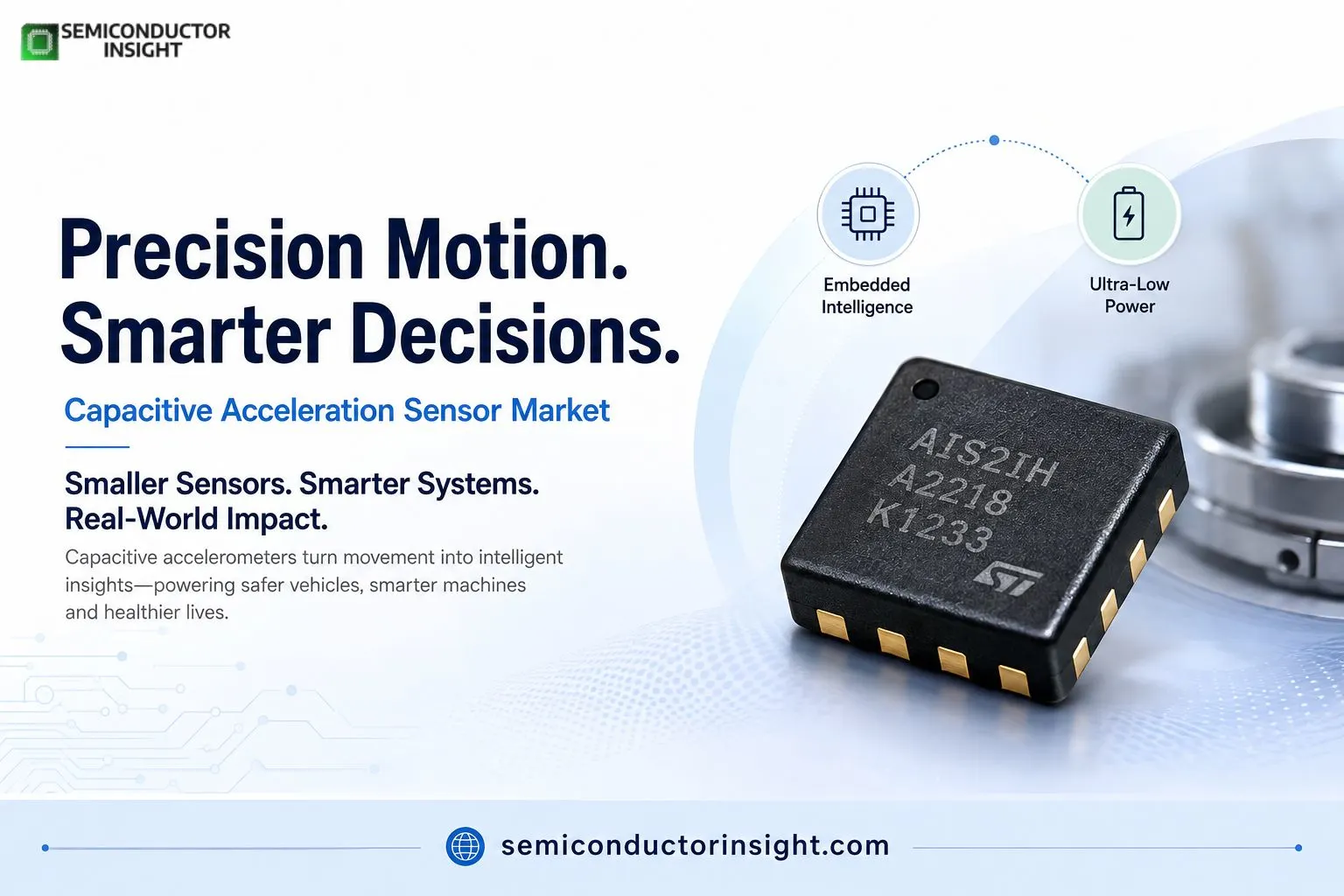
How Big Is Capacitive Acceleration Sensor Market in 2026? Technology and Application View
A capacitive acceleration sensor converts physical movement into an electrical signal by detecting changes in capacitance. In a typical MEMS structure, a microscopic proof mass moves when acceleration occurs, changing the spacing between conductive elements. Electronics then translate that capacitance variation into usable motion data.
That basic principle has become remarkably versatile. Modern accelerometers can measure orientation, vibration, impact, free fall and movement while occupying only a few millimeters of board space. Bosch Sensortec describes capacitive detection as the sensing principle used across its MEMS accelerometer family, while its current BMA580 measures only 1.2 × 0.8 × 0.55 mm³.
A Semiconductor Component with Multiple Personalities
The same underlying sensing architecture can behave very differently depending on its application.
Smartphone → orientation → stabilization → activity recognition
Vehicle → acceleration → safety decision → control response
Industrial machine → vibration → anomaly detection → maintenance action
Wearable → motion → activity classification → health or fitness feature
This versatility is one reason accelerometers have progressed from individual sensing components toward intelligent motion-processing platforms.
The Numbers behind Modern Sensor Design
- Current commercial devices demonstrate how quickly performance requirements have expanded.
- STMicroelectronics’ AIS2IH automotive accelerometer supports selectable ranges from ±2g to ±16g and output data rates reaching 1,600 Hz.
- Its design also incorporates a 32-level FIFO, allowing motion data to be temporarily stored without continuous intervention from the host processor.
- For ultra-low-power consumer applications, ST’s MIS2DU12 can operate at only 0.47 μA in its ultra-low-power mode at 1.6 Hz, while supporting output data rates up to 800 Hz and selectable ranges of ±2g, ±4g, ±8g and ±16g.
- These figures show that sensor development is no longer simply about measuring acceleration.
- Designers are balancing power, sampling frequency, dynamic range, package size, latency and processing capability simultaneously.
Where the Sensor Actually Makes a Difference
Automotive electronics remain a particularly demanding application environment. Accelerometers contribute to airbag deployment, vehicle dynamics, navigation, driver assistance and motion monitoring. Bosch states that its MEMS portfolio has surpassed 26 billion sensors produced, while its automotive material notes that a new vehicle contains around 20 MEMS sensors on average.
The technology is also moving deeper into electrified and software-defined vehicles. ST’s current automotive portfolio includes 3-axis accelerometers and 6-axis IMUs designed for applications involving safety, connectivity, electrification and ADAS. One current ST automotive IMU supports operation up to +125°C, reflecting the environmental demands placed on automotive sensing hardware.
When the Sensor Starts Thinking
One of the most important developments in Capacitive Acceleration Sensor Market is the movement toward in-sensor processing.
Traditional architecture:
Sensor → MCU → Algorithm → Decision
Emerging architecture:
Sensor → Embedded Processing → Motion Classification → MCU/System
ST now incorporates machine-learning cores and finite-state machines into selected accelerometer platforms, allowing functions such as activity recognition and event detection to occur closer to the sensor. It’s IIS2DULPX, for example, provides embedded processing for free-fall, wake-up, tap recognition, activity/inactivity and orientation detection.
This reduces unnecessary data transfers and can lower the processing burden on the main application processor.
You Can Freely Surf Our Latest Updated Report Here: https://semiconductorinsight.com/report/capacitive-acceleration-sensor-market/
Industrial Machines Are Turning Vibration into Semiconductor Intelligence
- Factories represent another important development area. Instead of using an accelerometer only to detect whether equipment is moving, modern systems can analyze vibration patterns to identify unusual operating behavior.
- ST’s current sensor portfolio includes devices specifically positioned for vibration monitoring and predictive maintenance, including the IIS3DWB10IS, which combines high-precision vibration sensing with embedded processing capabilities.
Continuous vibration capture → Local filtering → Feature extraction → Anomaly identification → Maintenance notification
- This architecture is particularly relevant to motors, pumps, rotating machinery and automated production equipment where unexpected mechanical behavior can result in costly downtime.
Why Package Size Is Becoming a Design Variable?
Miniaturization is influencing sensor placement as much as semiconductor performance. A smaller package allows accelerometers to be positioned closer to the mechanical source of motion, incorporated into compact wearables or installed in increasingly crowded automotive electronics modules.
Bosch’s latest BMA580 demonstrates this direction with a footprint measuring only 1.2 × 0.8 mm and a height of 0.55 mm, while its broader accelerometer family targets smartphones and wearable devices.
The New Buying Question Is More than Sensitivity
For semiconductor designers, the evaluation criteria are becoming broader. A modern capacitive accelerometer may be selected according to:
- Resolution and noise performance
- Selectable acceleration range
- Sampling or output data rate
- Current consumption
- Temperature tolerance
- Embedded intelligence
- Interface architecture
- Package dimensions
- Automotive qualification requirements
ST’s automotive AIS25BA, for example, combines a wide-bandwidth 3-axis architecture with a TDM interface, ±3.85g/±7.7g selectable ranges and an operating range extending from -40°C to +125°C.
The Direction of Motion Sensing Is Becoming Clearer
Capacitive Acceleration Sensor Market is increasingly positioned at the intersection of MEMS, semiconductor miniaturization and edge computing. The sensor is evolving from a passive measurement element into a compact source of interpreted motion data.
As vehicles become more automated, machines become more connected and wearable electronics demand longer battery life, the commercial value of acceleration sensing increasingly depends on what happens inside and immediately around the sensor. The strongest developments in 2026 are therefore centered on lower power, smaller silicon footprints, higher-quality vibration information and embedded intelligence rather than acceleration measurement alone.

Comments (0)