

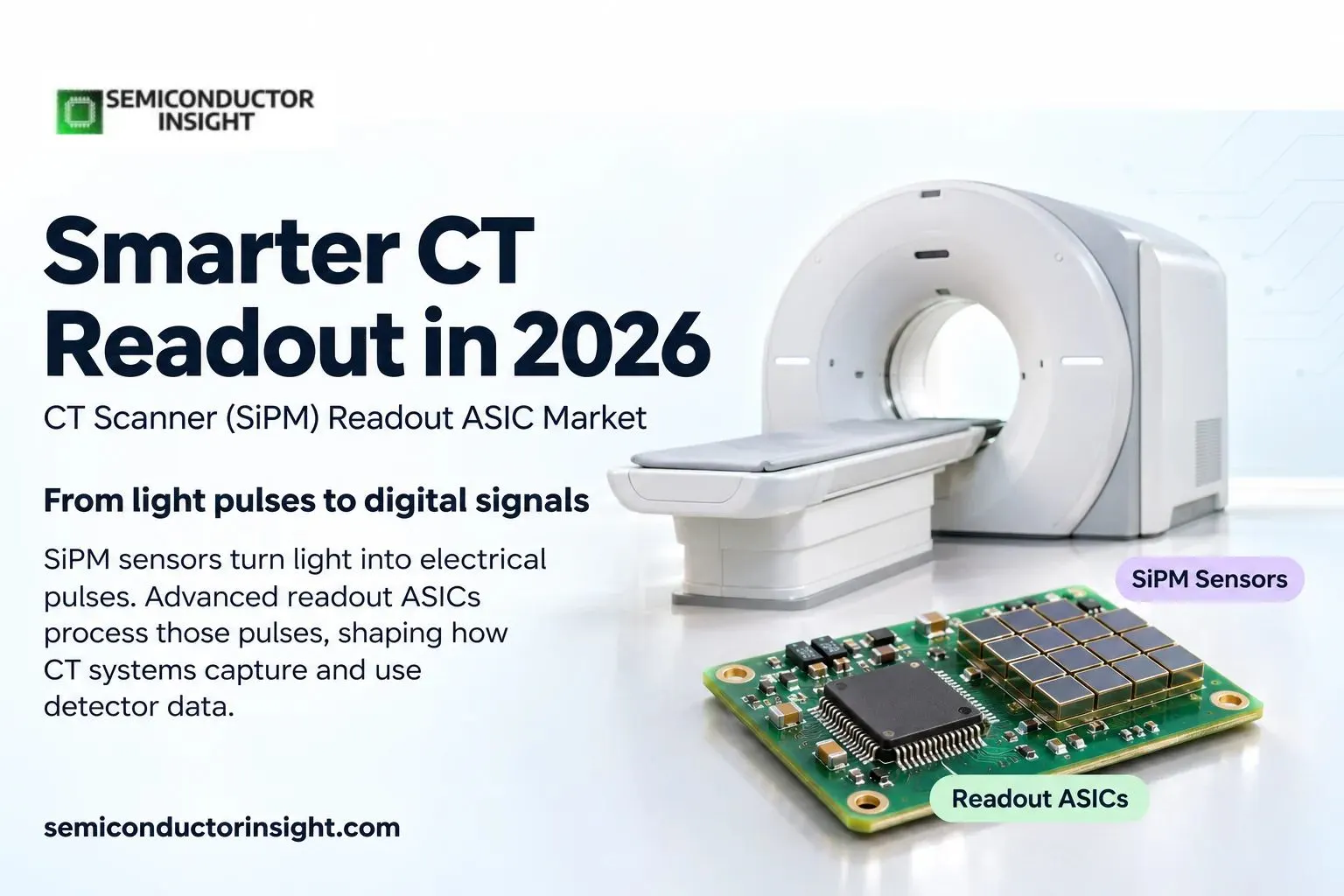
How Are SiPM Sensors and Advanced Readout Circuits Changing CT Scanner (SiPM) Readout ASIC Market in 2026?
Medical imaging is becoming increasingly dependent on semiconductor architectures capable of capturing, processing and transferring extremely small signals with high precision. Among the technologies attracting engineering attention are silicon photomultipliers (SiPMs) and application-specific integrated circuits (ASICs), which work together to convert individual light-detection events into usable digital information. CT Scanner (SiPM) Readout ASIC Market sits within this specialized detector-electronics ecosystem, particularly where PET/CT imaging, scintillation-based detection and advanced photon-processing architectures intersect.
An important distinction is that SiPM-based readout is predominantly established in PET detector systems integrated into hybrid PET/CT scanners. Conventional CT detectors and photon-counting CT systems use different detector architectures, although their semiconductor readout technologies share several engineering requirements.
The Detector Electronics Revolution Is Moving Towards Greater Integration
SiPMs consist of arrays of avalanche photodiode microcells operating in Geiger mode. When scintillation light reaches these sensors, they generate electrical pulses that must be amplified, measured and digitized.
ASICs perform these operations within compact semiconductor packages, reducing dependence on bulky external electronics. This is particularly important for PET/CT systems, where thousands of detector channels must operate within restricted gantry space.
A 2025 review published in EJNMMI Physics, titled ASICs in PET – What We Have and What We Need, examines developments in channel density, power consumption, signal digitization and time-of-flight performance. It identifies scalable electronics and improved timing resolution as important requirements for next-generation PET detector systems.
Picosecond Timing Is Becoming a Critical Design Benchmark
Time-of-flight (TOF) PET imaging depends on accurately measuring the arrival-time difference between two gamma photons generated during positron annihilation. Each photon carries an energy of 511 keV, making accurate timing measurements essential for determining the probable location of the radioactive event.
The semiconductor readout circuit must capture the initial signal, discriminate its timing and convert it into digital information without introducing excessive noise or delay.
A particularly interesting development appeared in a July 2024 study published in Nuclear Instruments and Methods in Physics Research A. Researchers reported a 55 nm CMOS-based picosecond timing chip that achieved an intrinsic timing resolution of 4.76 ± 0.09 ps. The associated SiPM readout system demonstrated approximately 30 ps timing resolution for signals corresponding to 200 photoelectrons.
These results demonstrate the level of precision that specialized semiconductor engineering can achieve in research detector systems.
You Can Go Through Our Latest Updated Insights Here: https://semiconductorinsight.com/report/ct-scanner-sipm-readout-asic-market/
Multi-Channel Architecture Is Changing Chip Design Priorities
One of the biggest engineering considerations is the number of SiPM channels that a single ASIC can support. Increasing channel density can reduce circuit-board complexity, interconnections and overall detector-module size.
Earlier research documented system-grade TOF-PET ASIC architectures commonly supporting 32–64 channels, with power consumption typically ranging from 10–30 mW per channel.
More recent research has explored higher integration levels, digital signal processing and improved channel multiplexing. The objective is to handle thousands of detector signals within the limited physical space and thermal budget of medical imaging equipment.
Photon-Counting CT Is Creating a Parallel Semiconductor Opportunity
March 2026 brought an important development when GE HealthCare received FDA 510(k) clearance for its Photonova Spectra photon-counting CT system.
The platform introduces eight-bin energy resolution using its proprietary Deep Silicon detector technology. It also supports a 0.23-second gantry rotation, enabling detailed spectral and spatial imaging.
Separately, a January 2026 study in Microelectronics Journal presented a 0.18 μm CMOS photon-counting readout chip featuring a 16 × 16 pixel array, programmable multi-threshold discrimination and digital time-division multiplexing.
These developments should not be confused with SiPM-based PET readout. However, they demonstrate how semiconductor integration is becoming increasingly important in advanced CT detector electronics.
CERN Research Is Expanding the SiPM Readout Knowledge Base
The high-energy physics sector is another important source of semiconductor innovation. In February 2026, research presented at CERN’s TIPP conference described an SiPM readout architecture based on the ALCOR ASIC, with single-photon timing performance approaching 100 ps.
Although this development targets particle detection rather than clinical CT scanners, its timing, signal-processing and integration techniques offer relevant engineering insights for specialized photon-detection electronics.
Where Semiconductor Manufacturers Are Concentrating Their Engineering Efforts
The next generation of readout ASICs is being shaped by requirements extending beyond basic signal amplification. Circuit designers are increasingly examining:
- Low-noise CMOS front-end amplifiers for weak optical signals.
- High-resolution time-to-digital converters for precise event timing.
- Multi-channel multiplexing for compact detector modules.
- Integrated temperature compensation and SiPM bias management.
- Low-power architectures for thermal stability and equipment reliability.
The commercial relevance of these developments will depend on how successfully semiconductor manufacturers translate laboratory performance into scalable, qualified components for medical imaging equipment.
The Convergence of Detector Physics and Semiconductor Manufacturing
CT Scanner (SiPM) Readout ASIC Market represents a highly specialized intersection of photodetection, analog semiconductor design, digital processing and medical imaging. Developments in TOF-PET, hybrid PET/CT platforms and photon-counting CT are creating different but technically related pathways for detector-electronics innovation. As manufacturers prioritize higher channel density, lower noise and faster signal acquisition, ASIC architecture will remain an important part of the next generation of precision imaging systems.

Comments (0)