
How Advanced Semiconductors Are Transforming Data Centre Cooling Market?
The data Centre cooling market has undergone a seismic shift in the last few years. With exponential data growth, AI workloads, and edge computing pushing thermal limits, traditional air cooling no longer suffices.
Cutting-edge semiconductor innovation is now leading the charge in cooling technologies, reshaping how data Centres stay efficient, sustainable, and future-ready.
Why Cooling Matters More Than Ever?
Modern data Centres are power densification engines. A single rack can generate heat comparable to a small apartment, and inefficient cooling can cripple performance, inflate energy bills, and shorten equipment life. Traditional cooling strategies that worked in the early 2000s are now being outpaced by the heat density of today’s processors, especially those built for AI, big data, and cloud workloads.
Semiconductors are not just heat sources they are also part of the solution. Engineers are now designing chips and systems that communicate with cooling infrastructure in real time, enabling smarter thermal management at the micro level.
From Air to Liquid Cooling Driven by Chip Demand
Air cooling has long been the backbone of data Centre thermal management. However, the rise of high-performance GPUs and ASICs used in machine learning and analytics has shifted demand toward liquid cooling. Liquid absorbs and transports heat far more effectively than air, especially for chips operating at high frequencies under heavy loads.
For example, in 2024 several hyperscale operators transitioned entire clusters to direct liquid cooling, placing coolant channels close to the hottest parts of the processor. This reduced operating temperatures by up to 40 percent while lowering facility power draw. These installations are becoming commonplace in environments where every watt counts.
Semiconductor Designs That Think About Heat
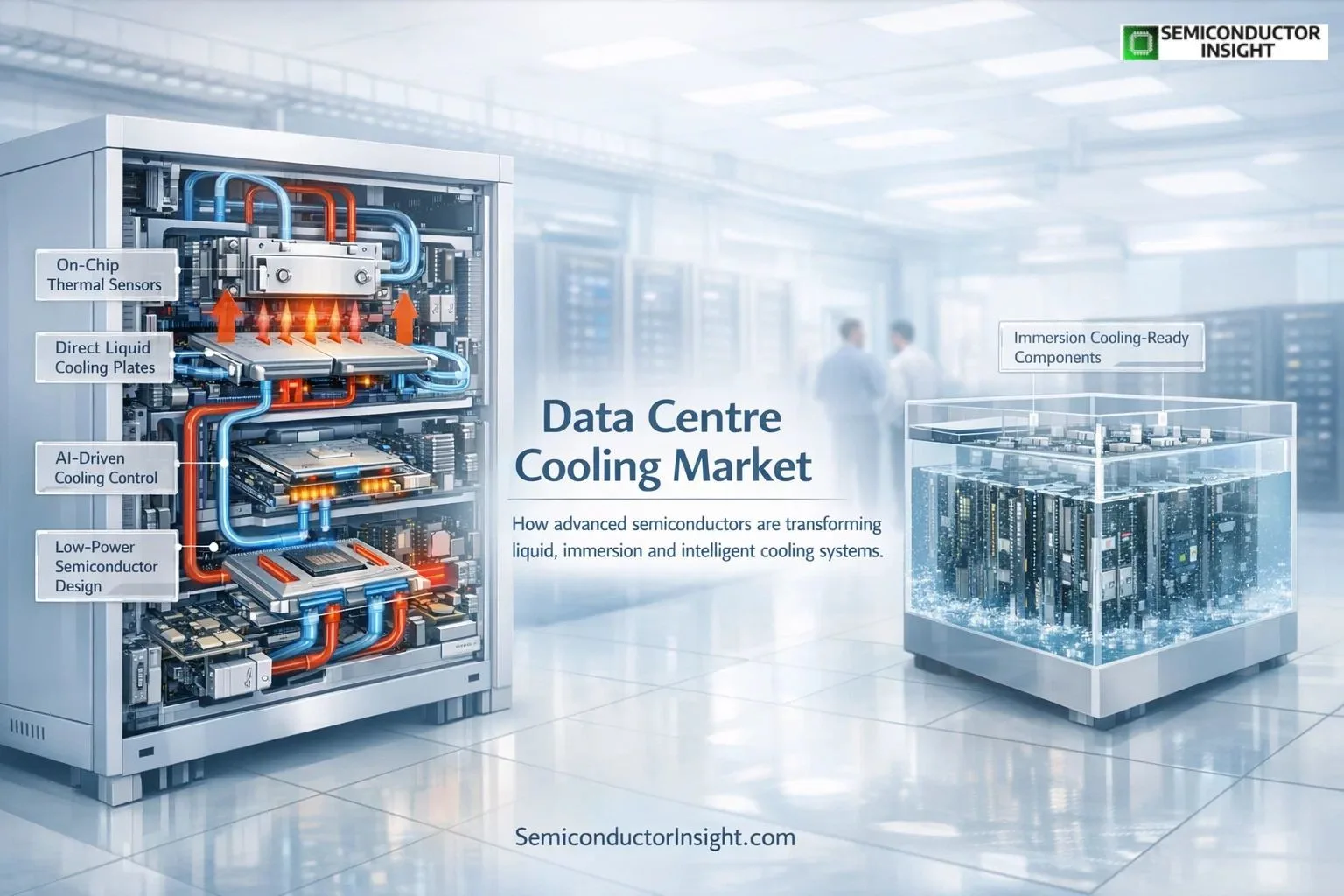
Leading semiconductor companies are now building thermal awareness into chip architecture itself. Instead of treating cooling as an afterthought, next-generation CPUs and accelerators feature thermal sensors, dynamic voltage adjustments, and on-chip communication with external cooling subsystems.
Such designs allow chips to negotiate cooling needs dynamically. When workloads spike, chips can request more cooling in localized zones rather than triggering cooling for an entire room. This level of granularity boosts performance, reduces wasted energy, and extends hardware lifetime.
Latest Developments:
For instance, in October 2025:
- GS Caltex declared the release of Kixx DLC Fluid PG25, a direct liquid cooling (DLC) system designed to increase data centre energy efficiency.
- With its most recent release, GS Caltex has made two market debuts: DLC and immersion cooling.
- By moving DLC fluid through cooling plates, DLC controls the thermal output of high-heat electrical parts like CPUs and GPUs in servers.
- These two techniques have lately become important technologies in the data centre sector, together with immersion cooling, which immerses electronic equipment in fluid.
For instance, in September 2025:
- Flex, a global manufacturing leader and innovator in data centre infrastructure solutions, declared the release of its newest cooling product, the Modular Rack-Level Cooling Distribution Unit (CDU), which would be available right away.
- This launch is the first phase of Flex’s larger market coverage strategy for cooling distribution units, which was created by JetCool, a Flex firm that specializes in cutting-edge liquid cooling technology.
Immersion Cooling and the Role of Advanced Materials
Immersion cooling where servers are submerged in non-conductive fluids is emerging as a powerful option for high density facilities. Semiconductor manufacturers have supported this transition by designing components that withstand liquid exposure and deliver stable performance in submersion environments.
Recent deployments in AI data Centres demonstrate how immersion can reduce cooling costs by 50 percent or more while enabling mega-watt level compute clusters to run at peak efficiency. Advances in dielectric fluids and chip packaging now allow complete immersion without risk of corrosion or short circuits.
Don’t Forget to Surf Our Updated Report for More Detailed Analysis: https://semiconductorinsight.com/report/data-center-cooling-market/
Smarter Buildings with Semiconductor Sensors
Cooling efficiency is no longer determined by air handlers and chillers alone. Highly granular sensor networks based on semiconductor technologies are turning data Centres into smart buildings. Thousands of temperature, humidity, and airflow sensors feed real-time insights to AI-driven cooling orchestration platforms.
This means hotspots are detected and mitigated within seconds, not hours. Instead of running all cooling units at full blast, cooling systems adjust in real time based on workloads and thermal predictions generated by machine learning models. This level of intelligence was nearly impossible without tiny, low-power semiconductor sensors.
Edge Data Centres and Decentralized Cooling
- The move toward edge computing brings new cooling challenges. In contrast to centralized mega-data centers, edge facilities frequently function in small areas with little access to conventional HVAC systems. This change is being driven by advances in semiconductors for compact heat management.
- Edge servers now use micro liquid loops, phase-change materials, and AI-optimized fans that adapt to environmental conditions.
- For example, a recent rollout of edge nodes in urban micro-Centres used semiconductor-driven cooling modules that adjusted airflow based on local weather and workload data, ensuring consistent performance irrespective of external conditions.
Energy Efficiency Meets Sustainability
The data Centre cooling market is now defined by sustainability goals. Operators are under pressure to reduce carbon emissions while expanding capacity. Energy-efficient semiconductors play a central role in this transformation.
By lowering chip power consumption and integrating thermal feedback mechanisms, companies are cutting cooling energy usage dramatically. In colder climates, advanced systems now reuse waste heat from semiconductors to warm office spaces or supply district heating, closing the loop on energy usage.
One notable example is a Nordic data park that reroutes heat from high-density compute clusters to residential heating grids during winter, effectively turning cooling waste into community benefit. This reflects a broader industry trend where cooling isn’t just about heat removal but about heat utilization.
Real Time Analytics and Predictive Cooling
Data Centre cooling no longer operates on fixed schedules or static settings. Predictive analytics, powered by semiconductor-enabled telemetry, anticipates thermal events before they occur. These systems analyze workload patterns, incoming weather forecasts, and even maintenance schedules to proactively adjust cooling infrastructure.
In practice, this means data Centres can pre-cool certain zones ahead of a scheduled high-intensity workload or throttle cooling where predictive models indicate a lull in demand. This level of foresight can yield double-digit savings in energy costs and prevent thermal throttling that impacts performance.
What Industry Leaders Are Doing Today?
Industry leaders like Hyperscaler and cloud providers are publicly committing to cooling innovation. They are retrofitting legacy centres with liquid loops, deploying new sensor arrays, and building custom silicon with integrated thermal intelligence. Even chip start-ups now market designs optimized for efficient heat dissipation, making thermal performance a selling point rather than a challenge.
As workloads continue to evolve, so will cooling strategies. The interplay between semiconductor design and thermal management will define the next frontier of data centre efficiency, sustainability, and scalability.
Cooling is no longer an auxiliary function of data centre operations it is a strategic capability powered by semiconductor advances. By integrating chip-level thermal awareness, embracing liquid and immersion techniques, and harnessing real-time analytics, data centres are becoming smarter, greener, and far more resilient.
The semiconductor revolution in cooling has just begun, and its impact will reverberate across cloud ecosystems, edge deployments, and every compute environment that demands both performance and efficiency.

Comments (0)