
How Advanced Display Coatings Are Transforming Glossy Monitor Performance
Computer monitors once relied on cathode ray tubes whose curved glass surfaces already carried a natural sheen. When liquid crystal displays overtook CRT units for the first time in 2003, the industry faced a new choice of outer finish.
Matte anti-glare layers scattered ambient light and reduced reflections, yet they also softened perceived contrast and color intensity. Glossy surfaces restored saturation and edge sharpness by allowing more of the panel light to reach the viewer without diffusion.
Coating Science and Reflection Management Paragraph on modern coatings
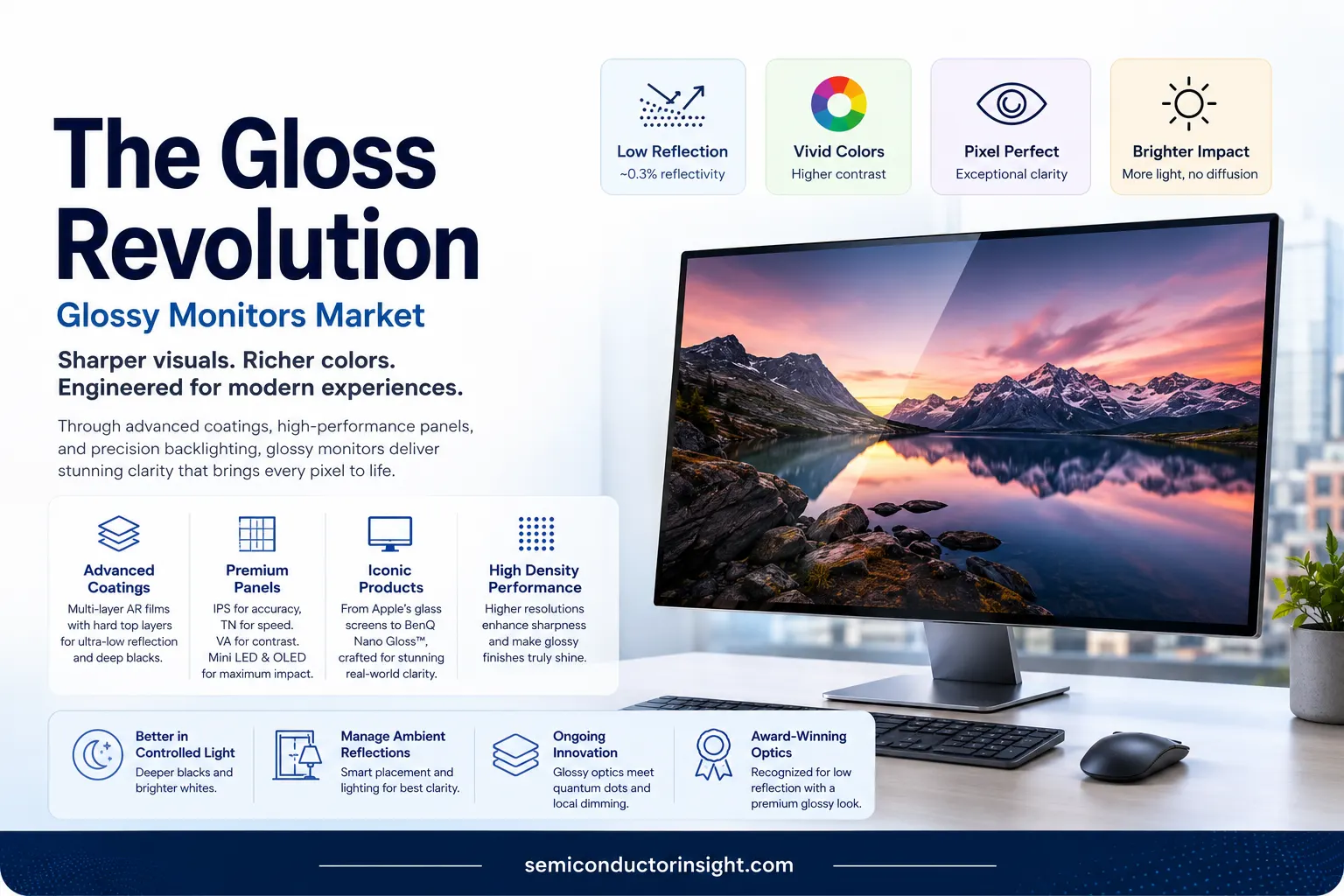
Recent studies notes that glossy displays improve color intensity and contrast ratios in controlled lighting while introducing visible reflections from windows or lamps. Manufacturers responded with multi-layer anti-reflective stacks.
Dexerials developed roll to roll films that keep reflectivity near 0.3% while preserving a piano black dead front look when the screen is off. These films combine high and low refractive index coatings with hard top layers on triacetylcellulose substrates.
- Semiconductor Panel Integration with Glossy Layers Paragraph on panel types
- The semiconductor structure beneath the finish determines how well a glossy surface performs.
- IPS panels deliver wide viewing angles and stable color, making them frequent partners for glossy treatments in professional and creative work.
- TN panels prioritize rapid response times measured in fractions of a millisecond, while VA panels emphasize deeper native contrast.
- Mini LED backlight arrays and OLED self-emissive pixels further raise the light output that a glossy cover can transmit without diffusion loss.
- Specific Product Instances from Recent Lines Paragraph on brand examples
- Apple’s Cinema Display and later Thunderbolt Display models popularized glass covered glossy screens with resolutions reaching 2560 by 1440 on 27 inch panels.
- BenQ later introduced Nano Gloss coatings that aim to retain Mac like clarity while cutting reflections more effectively than earlier clear plastic layers.
- These coatings appear on models such as the MA270S and MA320UP series, demonstrating incremental engineering rather than wholesale reinvention.
Resolution Density and Perceived Sharpness Paragraph on pixel progress
Monitor resolutions climbed from early 280 by 192 patterns in the late 1970s to 1024 by 768 in the late 1990s and far beyond. Higher pixel densities make the advantage of a glossy finish more noticeable because individual pixels become less visible and color transitions appear cleaner.
Retina class displays from Apple pushed this density principle across both laptop and external monitor lines, reinforcing the preference for finishes that preserve every detail.
For additional report info, feel free to view our most recent edition: https://semiconductorinsight.com/report/glossy-monitors-market-2/
Ambient Interaction and Practical Viewing Paragraph on light conditions
In a darkened room or one lit only by diffused sources, glossy panels produce deeper blacks and brighter whites than matte alternatives. The same surface under strong overhead lighting or near windows can mirror those sources and reduce readability. Users therefore adjust placement, blinds, or task lighting to keep the reflection advantage of the finish without sacrificing usability.
Ongoing Coating and Backlight Pairing Paragraph on current development
- Current work pairs glossy outer layers with quantum dot enhancement films and local dimming mini LED
- These combinations raise peak brightness while the outer coating maintains the visual pop that first drew attention to glossy screens.
- Society for Information Display awards have recognized related optical films that achieve low reflectivity without sacrificing the glossy aesthetic required for seamless interior styling.
The result is a continuous refinement of semiconductor driven light management meeting carefully engineered surface optics.

Comments (0)