

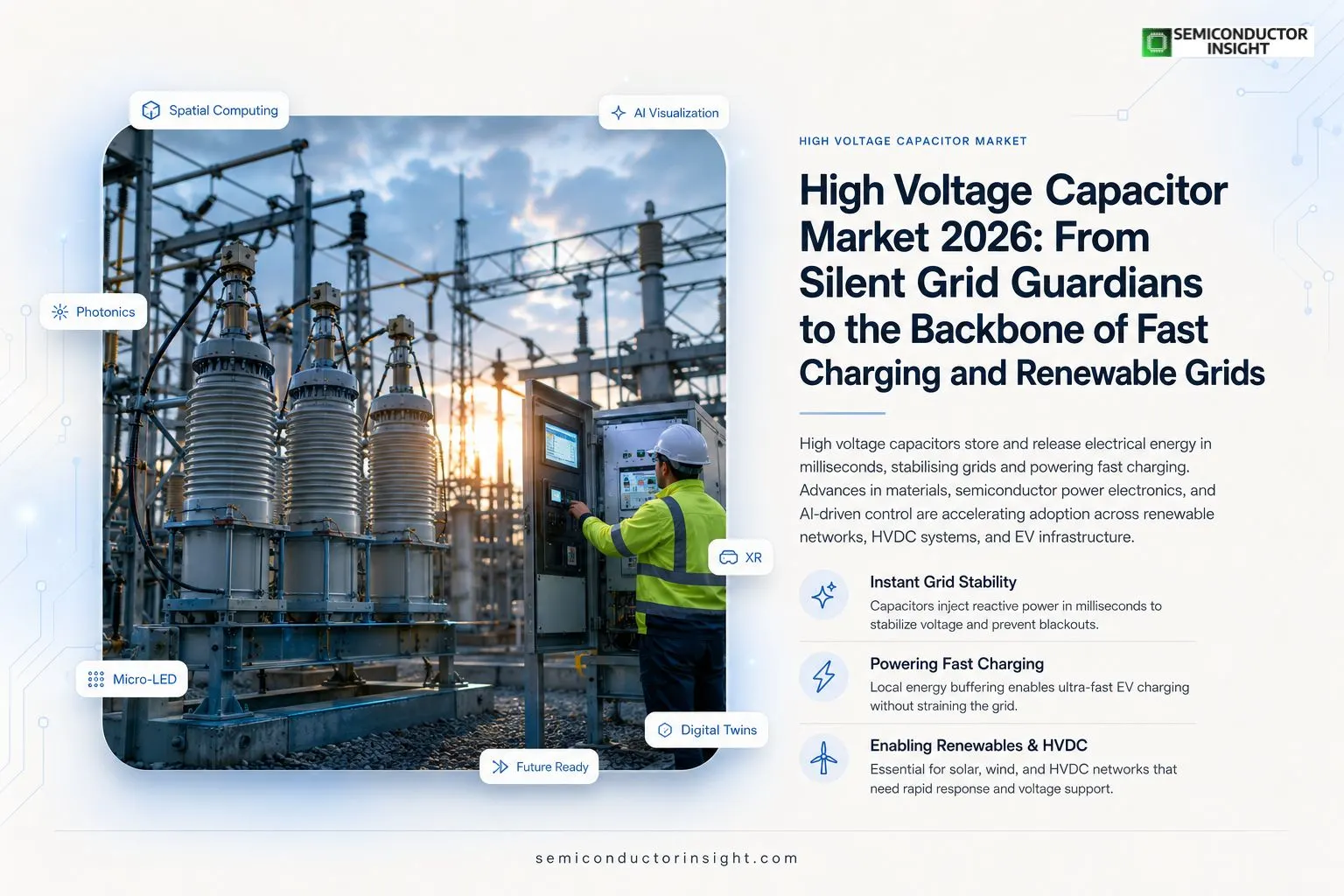
High Voltage Capacitor Market 2026: From Silent Grid Guardians to the Backbone of Fast‑Charging and Renewable Grids
High voltage capacitors are not the kind of component anyone writes home about. They sit inside substations, hang from utility poles, and hum inside industrial power supplies without ever drawing a curious glance. Yet in 2026, a quiet confluence of grid modernisation, renewable energy buildout, and electric vehicle charging infrastructure is pushing these unglamorous devices into a position of unexpected strategic importance. When a transmission line needs reactive power compensation in milliseconds, or a fast‑charger needs to buffer a sudden 350‑kilowatt load without crashing the local grid, it is high voltage capacitors – not batteries, not flywheels – that do the job. And that job is getting bigger.
A high voltage capacitor is essentially a device that can store and release electrical energy extremely quickly, usually in the range of microseconds to a few seconds. Unlike batteries, which are built for energy density, capacitors are built for power density and cycle life. They can charge and discharge millions of times without meaningful degradation, and they respond to voltage changes in a fraction of a single AC cycle. This makes them indispensable for everything from power factor correction in factories to voltage stabilisation in railway traction systems. What has changed over the past few years is the sheer number of places that now need that kind of instantaneous electrical muscle.
The grid is getting twitchier, and capacitors are the tranquilliser
For most of the twentieth century, grid stability came from enormous spinning turbines – coal, gas, nuclear – that provided what engineers call inertia. Those heavy rotating masses smoothed out small disturbances simply by being hard to slow down. But a grid increasingly powered by solar inverters and wind turbines, which connect electronically rather than electromechanically, has far less natural inertia. The result is a power system that flickers more often, with frequency deviations that can trip protective relays and cause blackouts if not corrected within milliseconds.
This is the problem that high voltage capacitor banks were built to solve. Static volt‑ampere reactive compensators (SVCs) and synchronous condensers paired with capacitor banks can inject reactive power into the grid almost instantaneously to prop up voltage during a disturbance. In January 2026, the Australian Energy Market Operator published an incident report on a frequency dip caused by the sudden loss of a coal unit during a South Australian heatwave. The report noted that capacitor banks, working in tandem with battery storage, provided the initial reactive power injection within three AC cycles – preventing what could have been a cascading outage across the state. This was not a laboratory demonstration; it was a real grid event in a region that now generates over 70 percent of its electricity from renewables. Stories like this circulate quietly through utility engineering circles and turn into purchase orders.
On the investment side, governments have started to put serious money behind grid‑scale capacitor deployment. In March 2026, the Indian Ministry of Power announced a plan to install thousands of megavolt‑ampere reactive (MVAr) of capacitor banks across the country’s interstate transmission network as part of a broader grid strengthening initiative. The plan specifically targets regions with high solar penetration, where midday voltage spikes are becoming a recurring headache. Similarly, the European Network of Transmission System Operators for Electricity, in its 2026 ten‑year network development plan, flagged a need for a 40 percent increase in reactive power compensation capacity across the continent by 2030, with capacitor banks identified as the primary technology for the bulk of that expansion.
Electric vehicle fast‑charging is creating a parallel demand surge
High voltage capacitors are not only found in remote substations. They are increasingly packed into the power electronics of ultra‑fast electric vehicle chargers. A 350‑kilowatt charger that can add 200 miles of range in fifteen minutes draws an enormous amount of current in a very short time. If multiple chargers at a depot all fire up simultaneously, the local distribution grid can buckle. Capacitors act as a local buffer, storing energy at a steady rate from the grid and then releasing it in a sudden burst when a vehicle connects.
HVDC and the interconnector boom
Another driver that rarely makes consumer headlines is the accelerating buildout of high‑voltage direct current (HVDC) transmission lines. These are the long‑distance, low‑loss arteries that move power from offshore wind farms in the North Sea to industrial centres in Germany, or from hydro‑rich regions in Canada to load centres in the United States. HVDC converter stations, where AC is turned into DC and back again, are filled with large capacitor banks that filter harmonics, stabilise voltage, and provide reactive power.
Global investments in HVDC are surging as countries try to connect remote renewable resources to their grids. The United Kingdom and the Netherlands are progressing with the LionLink interconnector, a multi‑gigawatt HVDC link scheduled for completion later this decade. In May 2026, the project’s developers confirmed that the capacitor banks for the converter stations would be among the largest ever deployed in a submarine interconnector, with individual units rated at several hundred kilovolts. Contracts like these are not won in public view, but they fill order books for years and create a steady demand floor underneath the high voltage capacitor market.
The manufacturing base is shifting, slowly
For decades, high voltage capacitor production was concentrated in a handful of specialised firms in Europe, Japan, and the United States. The technology is mature, but the manufacturing is not trivial – winding thin films of polypropylene, impregnating them with insulating fluids, and enclosing them in bushings that can withstand lightning strikes requires precision and hard‑won experience. Today, Chinese manufacturers have entered the market aggressively, especially for capacitors used in power factor correction and lower‑voltage transmission applications. Their scale has pushed down prices on commodity units, which has squeezed margins for traditional suppliers while also expanding the total addressable market.
The response from legacy manufacturers has been to shift toward higher‑value, application‑specific products. In April 2026, a long‑established German capacitor manufacturer announced a new line of hermetically sealed, gas‑insulated high voltage capacitors designed specifically for offshore wind converter platforms, where salt spray, humidity, and extreme temperature swings destroy ordinary equipment. The company cited direct demand from wind farm developers who were tired of replacing capacitors prematurely in harsh marine environments. This move up the value chain – toward reliability, customisation, and extreme‑environment performance – is becoming the playbook for Western capacitor firms as the commodity market gets tougher.
Why this market will not make headlines but will keep growing
The high voltage capacitor market does not double overnight. It grows steadily, in the mid‑single digits annually, because the installed base is already enormous and the replacement cycle is slow. A capacitor bank in a substation can sit there for twenty or thirty years before it needs replacement. But the growth that is happening is structural. Every new solar farm needs reactive power compensation. Every new HVDC link needs filter banks. Every new fast‑charging depot needs a buffer that batteries alone cannot economically provide. These are all incremental demands that add up year after year.
In 2026, the most telling sign of the market’s direction is not a single big number but the pattern of the announcements: grid operators quietly ordering more capacitor banks, fleet operators discovering that capacitors solve their charging power problem, offshore wind developers specifying capacitors that can handle salt and storms. Capacitors are becoming more essential to the energy transition while remaining almost entirely invisible to the public. That is precisely the kind of steady, unexciting growth that builds a durable market. The high voltage capacitor may never get its moment on the cover of a magazine, but inside substations, charging hubs, and converter halls around the world, it is quietly doing work that nothing else can do – and the world is asking for more of it.
Learn More in the Full Market Report: https://semiconductorinsight.com/report/high-voltage-capacitor-market-2/

Comments (0)