
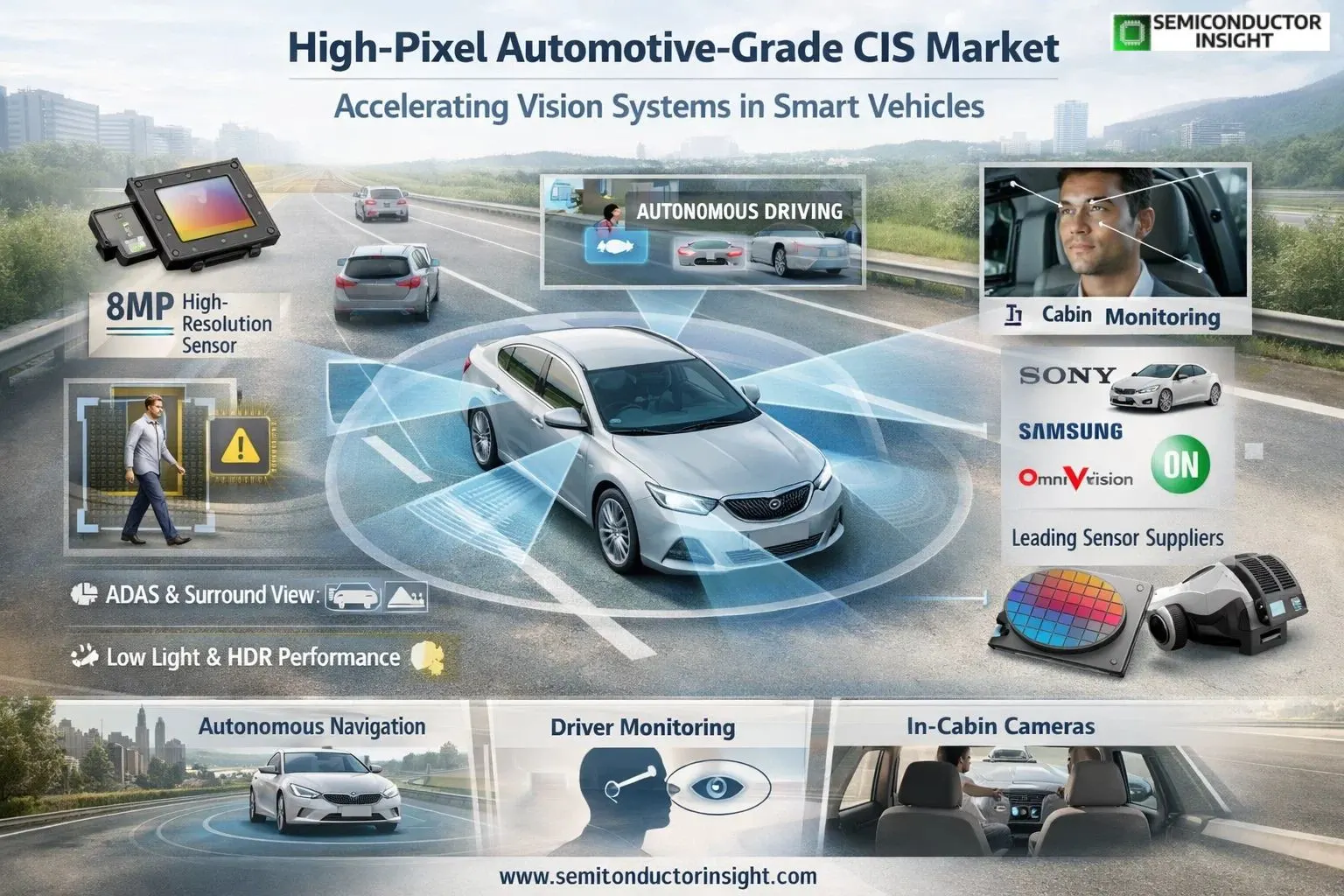
High-Pixel Automotive-grade CIS Market Accelerating Vision Systems in Smart Vehicles
The automotive industry is entering a new era where vehicles rely heavily on vision-based sensing systems. Cameras have become a critical component in advanced safety technologies, enabling cars to observe road conditions, detect obstacles, and assist drivers in real time. This technological transformation has significantly accelerated the growth of High-Pixel Automotive-grade CIS Market, a segment focused on high-resolution image sensors designed specifically for automotive environments.
Complementary metal-oxide-semiconductor (CMOS) image sensors used in vehicles are engineered to capture highly detailed images while operating under challenging lighting conditions such as low light, glare, fog, or high dynamic range environments. As vehicles incorporate more camera modules for monitoring surroundings, demand for higher pixel density sensors continues to rise across global semiconductor supply chains.
The Expanding Role of Vehicle Camera Architectures
Modern vehicles increasingly rely on multi-camera systems to support driver assistance features. Many advanced cars today integrate 6 to 12 camera modules across different positions including front view, rear view, surround view, and interior monitoring.
High-pixel CIS sensors allow these systems to capture more detailed visual data, enabling accurate detection of lane markings, pedestrians, road signs, and surrounding vehicles. High-resolution sensors are particularly important for advanced perception algorithms used in ADAS systems, where even small visual details can influence safety decisions.
In recent vehicle platforms, camera resolutions have expanded from traditional 1-2 megapixel sensors to advanced 8-megapixel and above sensors, supporting higher detection accuracy and wider field-of-view capabilities.
Semiconductor Engineering behind Automotive-grade Sensors
Unlike consumer smartphone cameras, automotive sensors must meet strict durability and reliability requirements. These sensors are designed to function across extreme temperature ranges, constant vibrations, and long operational lifecycles that can exceed 10 to 15 years of vehicle usage.
Automotive semiconductor engineers focus on improving pixel architecture, signal-to-noise ratio, and dynamic range. These improvements allow sensors to capture clear images in bright sunlight as well as in poorly lit road conditions such as tunnels or night time highways.
Advanced semiconductor fabrication processes are also enabling the integration of larger pixel arrays, improved photodiode structures, and faster data processing pipelines. These developments significantly enhance the performance of CMOS image sensors, particularly in real-time automotive vision applications.
High-Resolution Imaging for Autonomous Navigation
Autonomous and semi-autonomous driving systems require precise environmental perception. High-pixel image sensors support this requirement by delivering detailed visual information that helps artificial intelligence algorithms interpret complex road scenarios.
High-resolution sensors improve object classification accuracy, allowing vehicles to differentiate between pedestrians, cyclists, animals, and static obstacles. In urban driving environments where road conditions change rapidly, this level of image clarity becomes essential.
Some autonomous vehicle prototypes now incorporate multiple high-pixel camera arrays capable of generating 360-degree visual coverage around the vehicle. These systems work alongside radar and lidar sensors to provide layered environmental perception for navigation and safety.
Automotive Manufacturers Expanding Camera-Based Safety
- Several leading automotive and semiconductor companies are actively developing advanced imaging platforms for vehicles.
- Sony Semiconductor Solutions has introduced high-resolution automotive image sensors capable of supporting enhanced object recognition and high dynamic range imaging for next-generation vehicles.
- Samsung Electronics has also expanded its automotive sensor portfolio with high-pixel CIS solutions designed to support intelligent driver assistance features and digital mirror systems.
- Another notable contributor is ON Semiconductor, which focuses on automotive-grade imaging sensors optimized for safety-critical vision systems including collision avoidance and lane monitoring technologies.
- Meanwhile, OmniVision Technologies continues to develop compact, high-resolution sensors widely used in surround-view and in-cabin monitoring cameras.
In-Cabin Monitoring Creating New Sensor Demand
Beyond external perception, automotive imaging systems are now expanding into the vehicle interior. Driver monitoring systems use cameras to track head movement, eye direction, and driver alertness levels.
High-pixel sensors provide the accuracy required for facial recognition and gaze tracking, allowing safety systems to detect signs of driver fatigue or distraction. These features are becoming increasingly important as regulators push for stronger vehicle safety standards.
New vehicle safety frameworks in several regions encourage the integration of driver monitoring systems, which has increased adoption of interior cameras across premium and mid-range vehicle segments.
Sensor Miniaturization and Power Efficiency
Another important development within the semiconductor ecosystem is the miniaturization of imaging components. Automotive manufacturers prefer compact sensor modules that can be integrated into mirrors, bumpers, or roof structures without affecting vehicle design.
Semiconductor engineers are therefore focusing on reducing power consumption while increasing pixel density and image processing capabilities. This allows sensors to operate efficiently within vehicle electronic architectures that already support multiple radar, lidar, and infotainment systems.
Improved sensor packaging technologies and stacked chip designs are also enabling faster data transfer and improved thermal management, both of which are essential for long-term automotive reliability.
Take a Quick Glance at Our In-Depth Analysis Report: https://semiconductorinsight.com/report/high-pixel-automotive-grade-cis-market/
Mobility Innovation and the Road Ahead
The transformation of vehicles into intelligent machines is reshaping the semiconductor industry. High-resolution imaging sensors are becoming one of the most important components in modern vehicle electronics, enabling safety systems, automated driving functions, and real-time environmental awareness.
As automotive manufacturers continue to invest in automotive-grade sensors, advanced semiconductor fabrication, and improved vehicle perception systems, the High-Pixel Automotive-grade CIS Market is emerging as a vital segment within the broader mobility technology landscape.
With continued innovation in CMOS image sensors and the rapid evolution of intelligent transportation systems, high-pixel automotive imaging technologies will remain central to the development of safer and smarter vehicles worldwide.

Comments (0)