
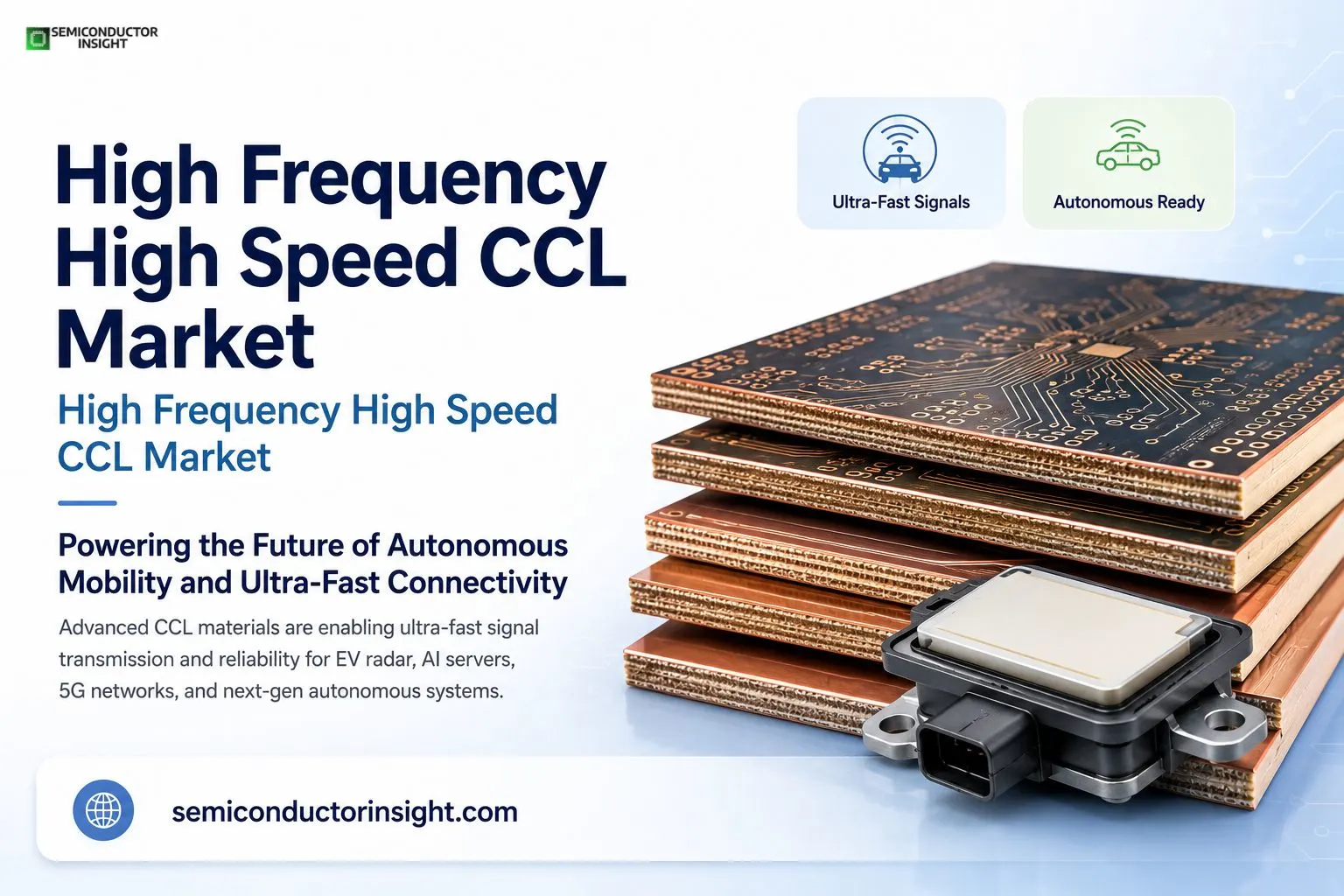
High Frequency High Speed CCL Market Expansion across EV Radar and Autonomous Systems
The semiconductor industry is entering a phase where material science is becoming just as important as chip architecture. At the centre of this shift stands High Frequency High Speed CCL market, a critical segment supporting the performance demands of AI servers, 5G infrastructure, autonomous vehicles, aerospace electronics, and hyperscale data centers.
Copper Clad Laminates, commonly called CCLs, form the foundation of printed circuit boards. However, traditional laminates are no longer sufficient for systems handling ultra-fast data transmission and low latency computing. High frequency high speed variants are now engineered with low dielectric loss, enhanced thermal stability, and signal integrity capabilities that align with the requirements of advanced semiconductor ecosystems.
The transition is happening rapidly as industries race toward faster connectivity and denser computing environments.
Silicon Alone No Longer Defines Performance
- For years, semiconductor progress focused mainly on transistor scaling. That narrative is changing. Modern electronics increasingly depend on how efficiently signals travel between chips, substrates, antennas, and processing modules.
- AI accelerators and high-performance GPUs now operate with data transfer speeds exceeding 224 Gbps per lane in advanced networking environments. Such bandwidth places enormous pressure on PCB materials. High speed CCL materials are therefore becoming indispensable for minimizing transmission loss and maintaining electrical stability.
- Large AI server deployments illustrate this shift clearly. In 2025, several hyperscale cloud operators expanded liquid-cooled AI clusters containing tens of thousands of GPUs connected through ultra-low latency networking systems. The reliability of those systems depends heavily on advanced PCB laminates capable of supporting continuous high-frequency signal transmission.
Explore the full report details in our recently refreshed edition anytime: https://semiconductorinsight.com/report/high-frequency-high-speed-ccl-market/
The Quiet Material Revolution inside Data Centres
Data centres are no longer just storage facilities. They have evolved into massive computational ecosystems supporting generative AI, cloud gaming, financial modelling, and industrial automation.
According to publicly available infrastructure updates from major cloud providers and semiconductor conferences, modern AI training clusters can consume over 100 megawatts of electricity in a single facility. Alongside processors and memory modules, PCB material quality has become a hidden determinant of operational efficiency.
High frequency high speed CCL materials are now widely used in:
- 800G Ethernet switches
- AI accelerator boards
- Optical networking modules
- High bandwidth memory interconnect systems
- Advanced telecom routers
These laminates help maintain lower insertion loss while supporting multi-layer board complexity exceeding 40 layers in certain high-end computing platforms.
Automotive Radar Is Expanding the Market beyond Consumer Electronics
The automotive sector is becoming one of the strongest growth engines for advanced CCL adoption. Modern vehicles increasingly rely on radar systems operating in the 77 GHz frequency band for adaptive cruise control, lane detection, and collision avoidance.
- Electric vehicles now integrate dozens of semiconductor-driven sensing modules. Some premium autonomous platforms contain more than 3,000 semiconductor chips distributed across infotainment, battery management, power electronics, and ADAS systems.
- High frequency CCL materials are critical because radar performance depends on precise signal transmission with minimal distortion.
As global EV manufacturing continues to rise, PCB material suppliers capable of delivering ultra-low dielectric constant laminates are securing stronger positions within automotive supply chains.
Space Technology and Defence Electronics Creating New Demand Patterns
Another emerging influence comes from aerospace and defence applications. Satellite communication systems, phased-array radar platforms, and electronic warfare equipment require PCB materials that can withstand extreme temperatures while maintaining stable electrical properties.
Low Earth Orbit satellite deployments are increasing rapidly. Publicly accessible launch records indicate that thousands of communication satellites have been deployed over the last five years to support broadband connectivity and earth observation programs.
These systems rely on high frequency electronics operating in Ka-band and Ku-band spectrums, where signal degradation can directly impact communication quality. High speed CCL materials therefore play a significant role in maintaining transmission reliability under harsh operational conditions.
Material Innovation Is Becoming a Strategic Advantage
Manufacturers are investing heavily in resin chemistry, glass fiber technology, and thermal management capabilities. Instead of competing only on production scale, companies are now differentiating themselves through material engineering.
Several advanced laminates entering the market feature:
- Extremely low dissipation factors for faster signal propagation
- Enhanced thermal conductivity for AI hardware cooling
- Reduced moisture absorption for aerospace stability
- Hybrid dielectric structures for multi-function PCB designs
This trend reflects a broader semiconductor industry movement where packaging, substrates, and materials increasingly determine final device performance.
Asia Continues to Shape the Manufacturing Landscape
East Asia remains the global center for advanced PCB and laminate manufacturing. Countries including Japan, South Korea, Taiwan, and China continue expanding substrate and material production linked to semiconductor supply chain localization efforts.
Taiwan alone hosts some of the world’s most advanced semiconductor fabrication and packaging ecosystems. Meanwhile, Japan maintains strong influence in specialty material innovation, especially in high-reliability laminates used for automotive and industrial electronics.
Government-backed semiconductor investment programs across Asia are also indirectly accelerating demand for high frequency PCB materials as nations strengthen domestic electronics manufacturing capacity.
The Next Chapter Belongs to Intelligent Connectivity
High Frequency High Speed CCL market is no longer operating quietly behind semiconductor manufacturing. It is becoming one of the most strategically important material segments enabling the future of intelligent connectivity.
From AI supercomputers and autonomous mobility to satellite broadband and advanced telecom networks, next-generation electronics depend on signal precision at unprecedented speeds. As devices become faster and systems more interconnected, the role of advanced laminate materials will continue expanding far beyond traditional PCB manufacturing.
The next semiconductor breakthrough may not come only from smaller transistors. It may come from the invisible material layers carrying signals between them at extraordinary speed.

Comments (0)