
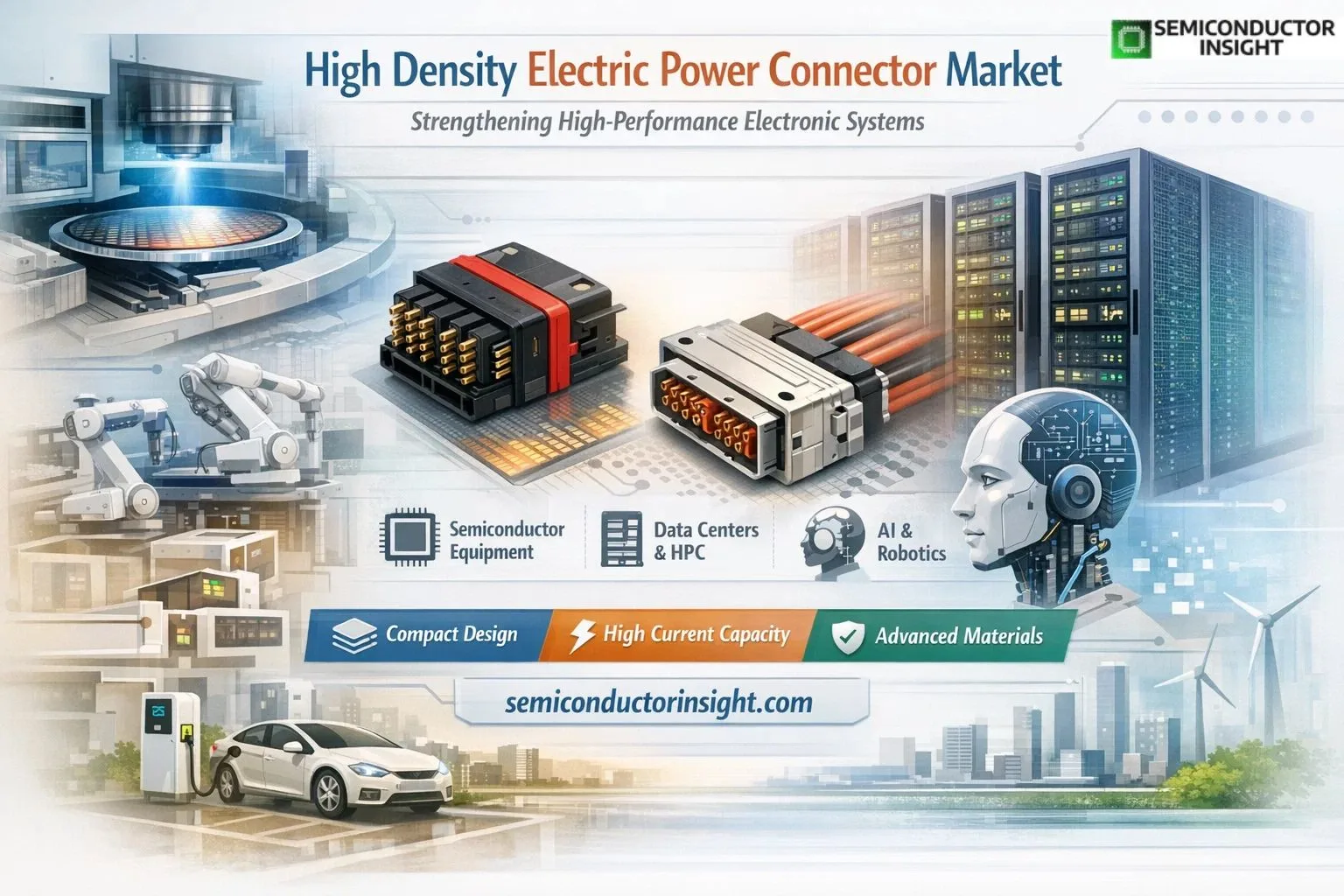
High Density Electric Power Connector Market Strengthening High-Performance Electronic Systems
As electronic devices become smaller, faster, and significantly more powerful, the demand for compact yet reliable power connectivity has grown sharply. This shift has positioned the High Density Electric Power Connector Market as a crucial component within modern electronics and semiconductor ecosystems.
High-density power connectors are engineered to deliver high electrical currents within compact footprints, allowing manufacturers to optimize board space while maintaining reliable power transfer. These connectors are widely used in semiconductor equipment, data center infrastructure, advanced computing hardware, and industrial automation systems where efficient power distribution is essential.
Across global electronics manufacturing, nearly 65% of modern electronic assemblies now incorporate compact high-density connectors to accommodate miniaturized circuit architectures and multi-layered circuit boards.
Miniaturization Trends Reshaping Connector Engineering
Semiconductor devices have become significantly smaller over the past decade while their computational capabilities continue to grow. This shift toward compact integrated circuits and multi-chip modules has created new design challenges for electrical connectivity.
Traditional connectors designed for larger systems cannot meet the spatial constraints of modern electronics. High-density connectors address this issue by incorporating multiple electrical contacts within a reduced physical area while maintaining electrical stability and thermal efficiency.
Advanced connector systems now support current densities that are 30% higher than conventional connector designs, allowing manufacturers to deliver greater power capacity without expanding system size. These characteristics make them essential for semiconductor equipment used in wafer processing, lithography systems, and chip packaging tools.
Power Architecture in Semiconductor Manufacturing Equipment
Semiconductor fabrication facilities rely on extremely complex machines such as lithography tools, plasma etchers, deposition systems, and wafer inspection equipment. Each of these systems contains hundreds of electronic modules that require stable power delivery.
High-density electric power connectors are integrated into these systems to ensure uninterrupted energy flow between circuit boards, control units, and power modules. Even minor connectivity failures can disrupt semiconductor production cycles that operate continuously for 24 hours a day across multiple fabrication stages.
As semiconductor fabs expand production capacity to support AI processors and advanced logic chips, the reliability of power connectors becomes increasingly important. Robust connector designs reduce maintenance requirements while ensuring consistent machine performance in highly controlled fabrication environments.
Data Centres and High-Performance Computing Infrastructure
- Beyond semiconductor manufacturing, high-density connectors play a critical role in modern data center architecture.
- High-performance computing servers, GPU clusters, and AI processing units require stable power distribution across densely packed circuit boards.
- Modern AI servers can consume 40% more electrical power compared with traditional enterprise servers, making efficient connector systems essential for managing electrical loads.
- High-density connectors enable server manufacturers to integrate multiple power rails while maintaining compact system layouts.
- These connectors are commonly used in blade servers, rack power distribution units, and high-speed networking equipment. Their ability to handle high current loads while maintaining thermal stability supports the growing demand for data processing capacity across cloud computing platforms.
Materials and Design Innovations in Connector Technology
Connector manufacturers are investing heavily in advanced materials and structural engineering to improve electrical conductivity and durability. High-performance copper alloys, gold-plated contacts, and reinforced polymer housings are now widely used to ensure long-term reliability.
Thermal management has also become a central design priority. Modern connector systems incorporate heat-resistant materials that allow them to operate safely in environments where electronic components generate significant heat.
Recent engineering improvements have increased connector lifespan by nearly 35% compared with earlier industrial connector models, making them suitable for high-duty applications such as semiconductor processing equipment and telecommunications infrastructure.
Industry Leaders Advancing Connector Technology
- Several major electronics component manufacturers are actively shaping innovation within the high-density connector ecosystem.
- TE Connectivity has introduced compact connector platforms designed for high-current data center applications, allowing equipment manufacturers to integrate dense power architectures into next-generation computing hardware.
- Amphenol Corporation continues expanding its portfolio of high-power connectors used in telecommunications infrastructure, semiconductor tools, and aerospace electronics.
- Another influential player, Molex, has developed advanced board-to-board connector systems that support high current loads while maintaining strong mechanical stability in compact electronic devices.
- Meanwhile, Samtec focuses heavily on high-speed and high-density interconnect technologies used in FPGA development platforms, semiconductor testing systems, and advanced computing hardware.
- These companies invest heavily in electrical simulation, reliability testing, and thermal analysis to ensure connectors meet the demanding requirements of modern semiconductor and electronics manufacturing environments.
For More Detailed Insights You Can Surf Our Latest Report Here: https://semiconductorinsight.com/report/high-density-electric-power-connector-market/
Expanding Role in Emerging Technologies
The evolution of next-generation technologies is creating new opportunities for high-density power connector systems. Artificial intelligence hardware, advanced robotics, electric mobility infrastructure, and industrial automation platforms all require compact yet high-capacity electrical connectivity.
For instance, advanced robotics platforms often integrate multiple power distribution modules within limited mechanical space. High-density connectors allow engineers to design smaller robotic control units without compromising power delivery performance.
Similarly, semiconductor test equipment used in chip validation processes relies on stable power connections to ensure accurate electrical measurements. Even minor fluctuations in electrical supply can affect test results, making reliable connectors an essential component in semiconductor quality control.
As electronic systems continue to grow more powerful and compact, the importance of High Density Electric Power Connector Market solutions becomes increasingly evident. Innovations in semiconductor equipment, advanced power connectors, and high-performance data center infrastructure will continue shaping the next generation of electronics manufacturing and computing technology.

Comments (0)