
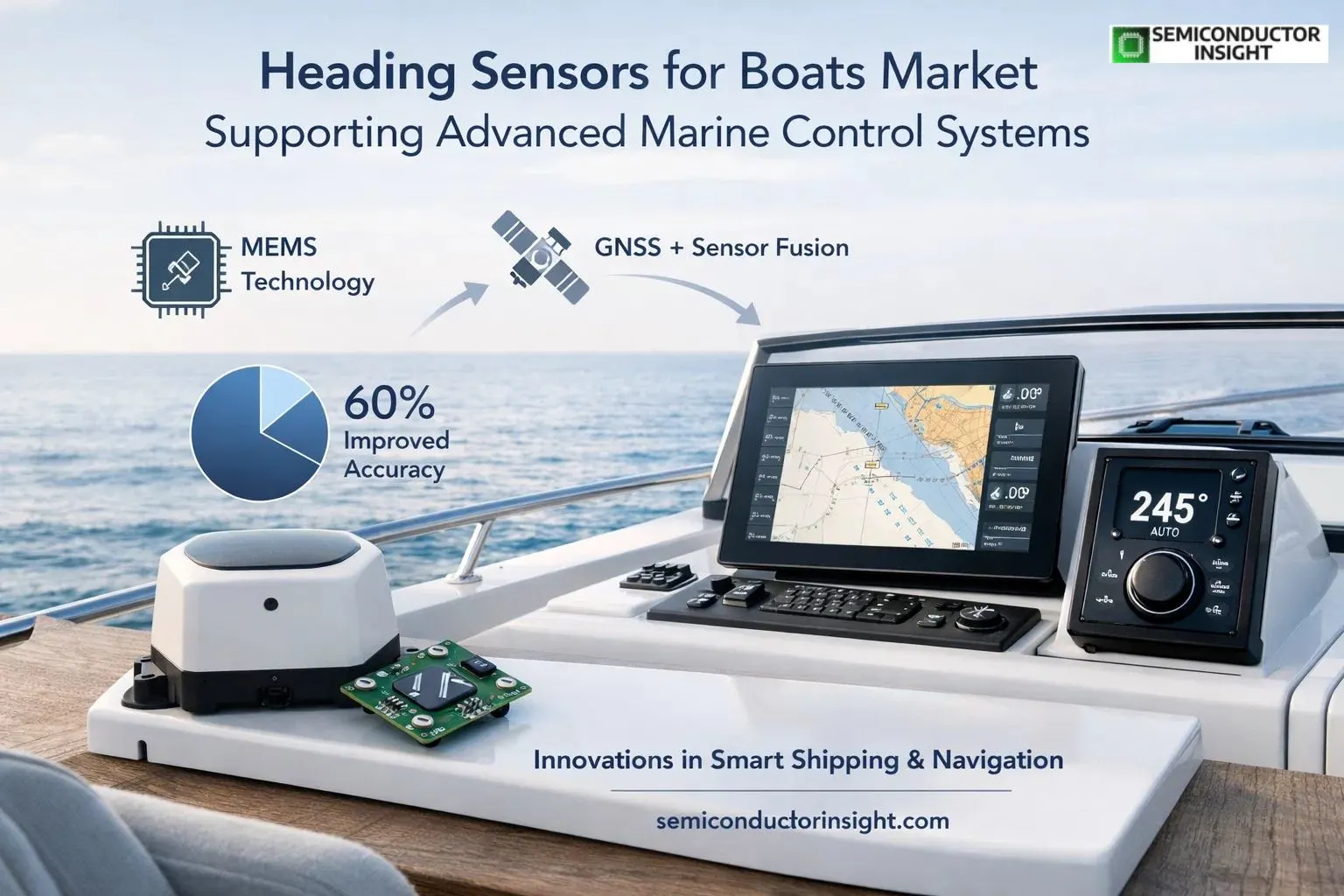
Heading Sensors for Boats Market Supporting Advanced Marine Control Systems
Heading Sensors for Boats market is becoming a critical part of modern marine electronics, where precision, reliability, and real-time responsiveness define operational success.
Today’s heading sensors, in contrast to conventional compass systems, mostly rely on semiconductor-based technology to provide precise directional data even under difficult maritime situations. These sensors are essential in both commercial and recreational maritime contexts because they are integrated into navigation systems, autopilot modules, and advanced vessel control units.
Semiconductor Foundations behind Modern Heading Sensors
- At the core of heading sensors lies semiconductor-driven sensing technology. MEMS gyroscopes and accelerometers, fabricated using silicon-based processes, form the backbone of most modern heading systems. These components measure angular velocity and orientation, allowing vessels to maintain accurate heading information even when GPS signals fluctuate.
- Companies involved in semiconductor manufacturing have significantly improved MEMS sensor performance over the past decade. For example, advancements in fabrication techniques have reduced sensor drift and improved stability, enabling more reliable readings over long durations. According to technical publications from IEEE, MEMS gyroscopes have achieved drift reductions of over 40% in the last decade, enhancing their suitability for marine navigation.
- This progress highlights the importance of precision silicon engineering, where even minor improvements in chip design translate into significant gains in real-world performance.
Integration with GNSS and Multi Sensor Fusion Systems
Heading sensors are no longer standalone devices. They are increasingly integrated with Global Navigation Satellite Systems (GNSS) and other on-board sensors to create multi-layered navigation solutions.
Sensor fusion technology combines data from gyroscopes, accelerometers, and satellite signals to deliver highly accurate and stable heading information. This is particularly important in marine environments where signal interference, wave motion, and magnetic disturbances can impact performance.
Marine electronics manufacturers report that integrated GNSS-heading systems can improve directional accuracy by up to 60% compared to standalone magnetic compasses, especially in dynamic conditions. This integration reflects a growing shift toward intelligent navigation architectures, where multiple data sources work together to ensure reliability.
Advancing Next Generation Smart Shipping Solutions
- The rise of autonomous and semi-autonomous vessels is reshaping demand for heading sensors. These vessels rely heavily on real-time data to make navigation decisions, and heading sensors play a central role in maintaining course stability.
- In pilot projects involving autonomous ships, heading sensors are used alongside radar, LiDAR, and AI-based control systems to enable precise maneuvering. Without accurate heading data, autonomous navigation systems cannot function effectively.
- Maritime technology initiatives in regions like Northern Europe and Japan have demonstrated that advanced sensor systems can reduce human intervention in navigation by over 30% in controlled environments, signaling strong potential for future adoption.
- This shift is pushing manufacturers to develop sensors that support low latency processing and continuous data output, essential for automated decision-making.
Demand from Recreational Boating and Compact Electronics
While commercial shipping drives high-end demand, the recreational boating segment is emerging as a strong growth area. Smaller vessels are increasingly equipped with compact navigation systems that include heading sensors.
This trend is closely tied to the miniaturization of semiconductor components. Modern MEMS sensors are not only smaller but also more energy-efficient, making them suitable for battery-powered systems in leisure boats and yachts.
Marine equipment suppliers have observed that compact navigation units with integrated heading sensors have seen double-digit adoption growth in recent years, particularly among mid-range recreational vessels.
The shift toward compact sensor modules is making advanced navigation accessible to a wider user base.
Reliability Standards and Marine Grade Semiconductor Design
Marine environments are among the harshest operating conditions for electronic components. Saltwater exposure, temperature fluctuations, and constant vibration demand robust and durable sensor designs.
Semiconductor-based heading sensors must meet strict marine-grade standards, including resistance to corrosion and long-term operational stability. Manufacturers are investing in advanced packaging techniques and protective coatings to ensure reliability.
In technical case studies from marine electronics companies, failure rates of properly sealed MEMS sensors have been reduced to below 1% over extended deployment periods, underscoring the importance of ruggedized chip design.
This focus on durability is not optional it is a fundamental requirement for gaining trust in maritime applications.
Before continuing, you can freely peruse our most recent updated report to find out more: https://semiconductorinsight.com/report/heading-sensors-for-boats-market/
Innovation in Low Power and Edge Processing Capabilities
As vessels become more digitally connected, there is a growing need for sensors that can process data efficiently without consuming excessive power. Semiconductor advancements are enabling heading sensors to incorporate edge processing capabilities, reducing the need for constant data transmission.
Low-power chip architectures allow sensors to operate continuously while minimizing energy usage, which is especially important for smaller vessels and autonomous systems.
Recent developments in embedded processing have enabled heading sensors to perform on-device calibration and error correction, improving accuracy without relying heavily on external systems. This evolution reflects a broader move toward smart sensor ecosystems, where intelligence is built directly into the hardware.

Comments (0)