

Handheld Portable Projectors Market Technology Shaping Digital Viewing Experience
Featuring small, light, and powerful projection systems, handheld portable projectors are revolutionizing visual communication and changing how people and organizations consume digital content. Wireless connectivity, semiconductor imaging chips, and sophisticated optical engineering are all combined in handheld devices, which are smaller than traditional projection systems. Their growing adoption reflects the shift toward mobility driven digital lifestyles, where entertainment, business presentations, and educational content require flexible display solutions.
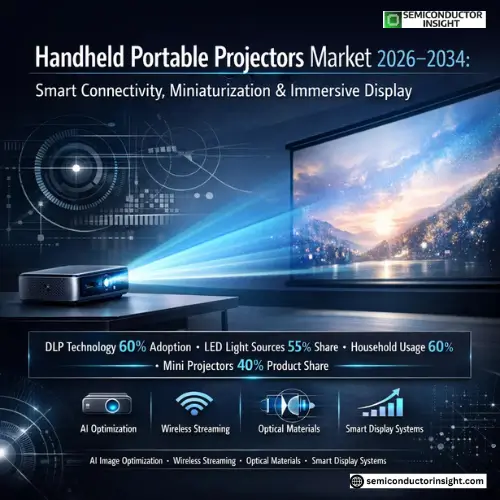
Portable projectors are designed using miniaturized imaging technologies such as Digital Light Processing (DLP) and Liquid Crystal on Silicon (LCOS), enabling high contrast and improved image clarity in compact designs. DLP technology alone accounts for more than 60% of portable projector adoption, highlighting its strong preference due to reliability and image quality improvements. These systems use microscopic mirrors to reflect light and create images, delivering enhanced brightness and color accuracy while maintaining low maintenance requirements.
The transition from traditional lamp-based projectors to LED and laser light sources has significantly improved device lifespan and energy efficiency. LED projectors represent nearly 55% of global portable projector technology adoption, reflecting demand for sustainable and durable solutions. This technological evolution has accelerated adoption across residential and commercial environments.
Core Technology Architecture and Chemical Components
The performance of handheld projectors depends heavily on their optical and photonic material composition. Projection systems rely on semiconductor chips, optical lenses, phosphor coatings, and light-emitting materials that enable image formation and brightness control. Modern devices use gallium nitride based LEDs, liquid crystal panels, and micromirror arrays to achieve efficient light modulation.
Laser projection technology further enhances brightness through advanced photonic components and phosphor materials that convert blue laser light into multi-color output. Emerging research in photonic integrated circuits demonstrates improvements in color gamut exceeding 200% enhancement compared to traditional displays, highlighting the growing role of advanced materials in projection technology.
Additionally, manufacturers are increasingly focusing on energy efficient materials, low heat generation components, and sustainable optical systems. These developments support long operational life cycles and reduce power consumption, making handheld projectors more suitable for mobile environments.
Rising Consumer Adoption and Usage Expansion
The widespread adoption of handheld projectors is driven by changing consumer behavior toward immersive visual experiences. The household segment accounts for approximately 60% of device usage, reflecting the rapid expansion of home entertainment systems and personal viewing environments. Users increasingly prefer large screen experiences without permanent installation, especially in small living spaces and shared environments.
In the education sector, portable projectors support digital classrooms and interactive learning environments. The education segment contributes around 22% of overall demand, demonstrating strong institutional adoption. Similarly, business presentations account for nearly 35% of device utilization, highlighting their importance in corporate communication and remote collaboration.
The growing popularity of streaming services, gaming, and outdoor entertainment has further accelerated demand. Portable projectors can display screens up to 300 inches, offering immersive viewing experiences comparable to traditional large displays.
Smart Connectivity and AI Driven Display Systems
The integration of smart features and wireless connectivity represents a major transformation in handheld projection devices. More than 50% of new portable projectors include Wi Fi and Bluetooth connectivity, enabling seamless streaming and device integration. Advanced models now incorporate voice control, app ecosystems, and real time image optimization technologies.
Recent product innovations demonstrate the industry’s technological progress. In 2026, Samsung introduced a compact projector featuring AI based image optimization and automatic focus adjustment, improving projection quality based on environmental conditions. Similarly, manufacturers are integrating built-in operating systems, immersive audio technologies, and automated setup features, enhancing user experience and reducing technical complexity.
These developments reflect the convergence of consumer electronics, artificial intelligence, and optical engineering, positioning handheld projectors as multifunctional smart devices.
Don’t Forget to Surf Our Updated Report for More Detailed Analysis:
https://semiconductorinsight.com/report/global-handheld-portable-projectors-market/
Design Innovation and Portability Engineering
Engineering advancements in thermal management, battery technology, and miniaturization have enabled the creation of ultra-portable projection devices. Mini and handheld projectors represent approximately 40% of portable projector product share, demonstrating strong demand for lightweight solutions.
Manufacturers focus on compact housing, efficient heat dissipation materials, and high lumen brightness within small form factors. High definition and 4K resolution capabilities are increasingly integrated into portable devices, enhancing visual clarity while maintaining device mobility. More than 50% of new projector models now feature high definition imaging capabilities, indicating rapid technological advancement.
This balance between performance and portability continues to drive innovation across consumer electronics and professional visualization applications.
Regional Innovation and Industry Expansion
Geographically, North America accounts for nearly 35% of market adoption, while Asia Pacific demonstrates rapid growth due to rising digital infrastructure and consumer demand for smart electronics. Increasing digital literacy, expanding entertainment industries, and technological investments support market expansion across emerging economies.
Educational institutions, corporate environments, and digital entertainment sectors remain key contributors to industry growth. The adoption of portable display technologies in hybrid work environments and remote education continues to strengthen global demand.
The future of the handheld portable projectors market lies in AI integration, advanced photonics, and smart ecosystem connectivity. Industry trends indicate growing demand for holographic projection, laser based imaging, and energy efficient display technologies. Improvements in optical materials and semiconductor components will further enhance brightness, resolution, and device longevity.
As digital lifestyles evolve, handheld projectors are expected to become essential tools for communication, entertainment, and professional visualization. Their ability to combine portability, performance, and intelligent functionality positions them as a transformative technology within the global consumer electronics landscape.

Comments (0)