
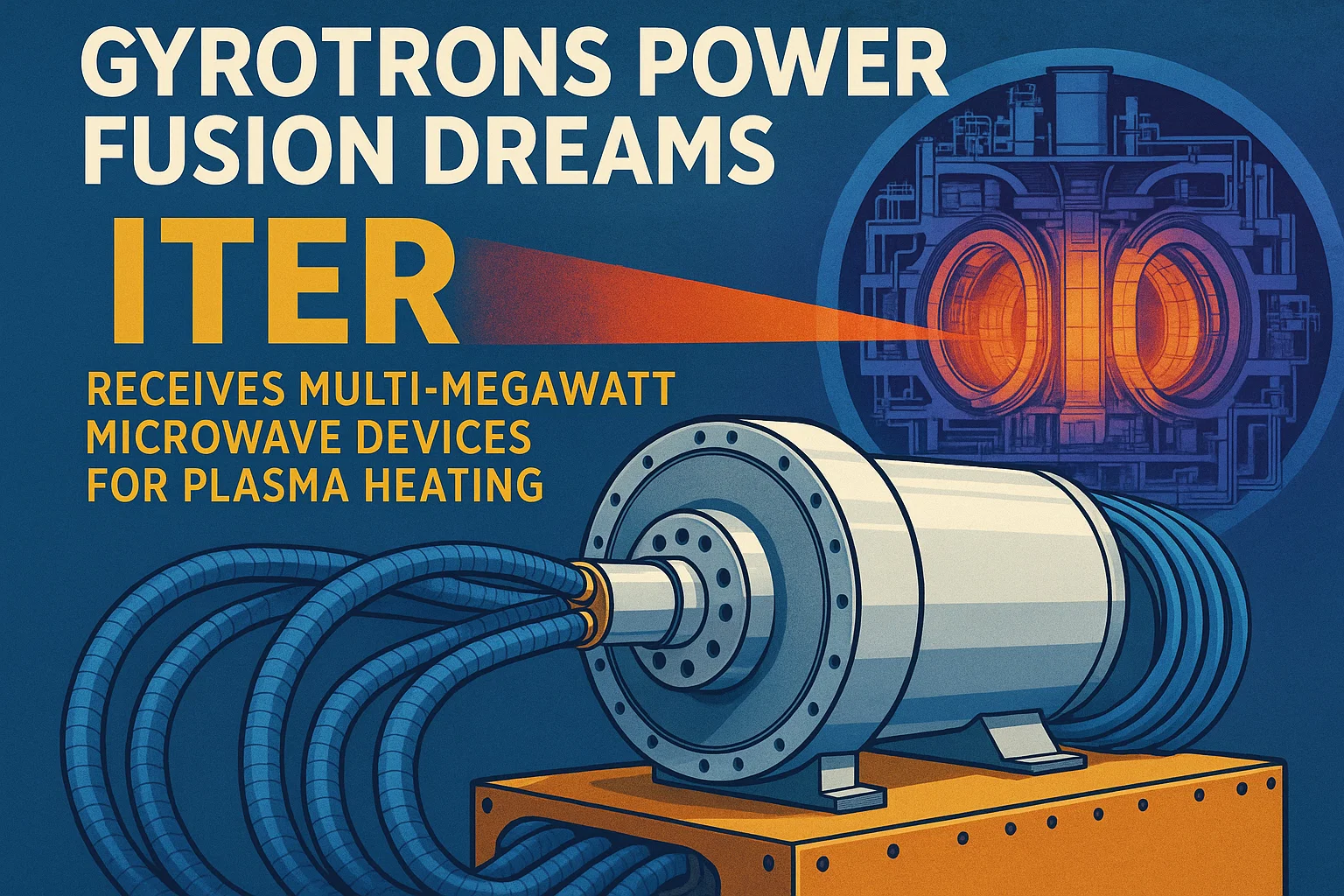
Gyrotrons Power Fusion Dreams: ITER Receives Multi-Megawatt Microwave Devices for Plasma Heating
Microwave Electric Vacuum Devices (VEDs) may sound like remnants from the early days of radar and broadcast engineering, but in 2024 they remain at the heart of some of the most advanced technologies in defense, space exploration, medical imaging, and scientific research. Despite competition from solid-state devices, klystrons, traveling-wave tubes (TWTs), magnetrons, and gyrotrons continue to be indispensable in high-power, high-frequency applications where efficiency, reliability, and sheer performance matter most.
Recent developments across defense, aerospace, energy, and industrial applications have underscored the enduring importance of these devices. The global market reflects this resilience: valued at US$ 1.83 million in 2024, it is projected to grow steadily to US$ 2.95 million by 2032, at a healthy CAGR of 6.1% from 2025 to 2032.
Access Your Free Sample Report- Microwave Electric Vacuum Devices Market
Defense and Aerospace: Reinventing Electronic Warfare
The Strategic Role of VEDs in Modern Warfare
In the defense sector, vacuum electronic devices remain vital to radar systems, satellite communications, and directed-energy weapons. Reports from Defense News highlight that the U.S. Navy and Air Force continue to invest in high-power microwave (HPM) systems, particularly for electronic warfare and counter-drone technologies.
Traveling-wave tubes (TWTs) and klystrons stand out as core components in advanced radar systems. These tubes offer high gain, wide bandwidth, and resilience in extreme conditions, making them superior to many solid-state alternatives in demanding military scenarios.
Industry Leaders: Northrop Grumman and L3Harris
Northrop Grumman and L3Harris are among the top defense contractors spearheading next-generation microwave electronic warfare solutions. Their systems integrate advanced TWTs to ensure superior jamming, detection, and countermeasure capabilities. With rising geopolitical tensions, particularly in Eastern Europe and the Indo-Pacific, demand for robust, long-range microwave solutions is only expected to increase.
Directed Energy Weapons (DEWs)
Microwave-based directed-energy weapons are no longer science fiction. By focusing high-power microwave beams, DEWs can disable enemy drones, missiles, and electronic systems without kinetic impact. Defense News has reported significant progress in this field, noting that high-power VEDs particularly klystrons and TWTs remain central to DEW systems due to their efficiency and ability to generate extremely high output power.
Scientific Research and Fusion Energy: Powering Tomorrow’s Breakthroughs
ITER’s Multi-Megawatt Gyrotrons
The ITER Project in France is among the most ambitious scientific experiments in human history, aiming to demonstrate the feasibility of nuclear fusion as a large-scale and carbon-free energy source. A cornerstone of ITER’s plasma heating system is the gyrotron a high-power vacuum electronic device capable of generating continuous wave power at frequencies above 100 GHz.
According to ITER Newsline (2024), European and Japanese suppliers have successfully delivered multi-megawatt gyrotrons to ITER. These devices are crucial for electron cyclotron resonance heating (ECRH), which sustains the plasma necessary for fusion reactions. Their success represents a milestone in the field of VEDs and underscores their role in enabling the energy systems of the future.
CERN’s Particle Accelerators
In Switzerland, CERN relies on klystrons to power the radio-frequency (RF) cavities in its particle accelerators, including the Large Hadron Collider (LHC). CERN Courier (2023–2024) reported ongoing upgrades to these systems, with newer generations of klystrons delivering improved efficiency and stability.
This continued reliance on VEDs at the forefront of physics research highlights their unmatched ability to deliver stable, high-power RF energy over extended periods, something that solid-state technologies still struggle to replicate at such scales.
Download Sample Report PDF- Microwave Electric Vacuum Devices Market
Satellite and Space Communications: TWTs Beyond the Atmosphere
ESA’s Contracts for Space-Qualified TWTs
In 2024, the European Space Agency (ESA) awarded new contracts to leading manufacturers of traveling-wave tube amplifiers (TWTAs) for satellite payloads. These devices are prized for their ability to deliver high-efficiency amplification at high frequencies, particularly in Ku-band and Ka-band communications. Despite advances in solid-state power amplifiers (SSPAs), TWTs remain the gold standard for high-power satellite communication links.
ESA’s investment reflects the growing need for reliable, high-capacity communication infrastructure to support Earth observation, navigation, and space exploration missions.
NASA’s Deep Space Network
The NASA Deep Space Network (DSN) continues to rely heavily on VEDs. TWTs and klystrons provide the immense RF power required to maintain communication with spacecraft exploring the far reaches of our solar system. According to NASA Tech Reports (2023–2024), ongoing upgrades to the DSN include the integration of more efficient VEDs to reduce power consumption while maintaining performance.
This is a strong reminder that when it comes to transmitting signals across billions of kilometers, the reliability of VEDs is unmatched.
Industrial and Medical Applications: Beyond Defense and Space
Industrial Heating and Plasma Processing
VEDs are also making waves in industrial settings. Magnetrons and gyrotrons are increasingly used in advanced material processing, including plasma-enhanced semiconductor fabrication, ceramics, and metallurgy. IEEE Spectrum (2023–2024) reported on the rise of gyrotron-based plasma systems in semiconductor etching, enabling greater precision in chip manufacturing a key driver in the age of artificial intelligence and quantum computing.
Medical Imaging and Therapy
In healthcare, klystrons and magnetrons are indispensable to medical linear accelerators (linacs), which generate the X-rays used in cancer radiotherapy. Recent reports in Nature Photonics and Medical Physics News highlight ongoing innovations in medical accelerators, with VEDs providing the reliable high-frequency power needed for accurate tumor targeting. As cancer incidence continues to rise globally, demand for linac-based therapies is expected to grow, ensuring a stable market for medical-grade VEDs.
Market Outlook: Growth, Drivers, and Challenges
Market Growth Projections
The global Microwave Electric Vacuum Devices market, valued at US$ 1.83 million in 2024, is projected to reach US$ 2.95 million by 2032, expanding at a CAGR of 6.1% (2025–2032). This growth reflects rising demand across defense, aerospace, energy, healthcare, and industrial applications.
Key Market Drivers
- Rising defense budgets and emphasis on electronic warfare capabilities.
- Fusion energy initiatives (ITER, DEMO, and other projects) requiring high-power gyrotrons.
- Satellite and deep-space missions, which continue to depend on TWTAs.
- Healthcare demand for advanced radiotherapy solutions.
- Semiconductor industry growth, spurred by AI and next-gen computing, driving need for high-precision plasma processes.
Market Challenges
While the outlook is positive, the industry faces challenges:
- Competition from solid-state technologies, particularly SSPAs, which are gaining ground in some applications.
- High manufacturing costs and complexity of VEDs.
- Specialized expertise requirements, which limit the number of suppliers and manufacturers worldwide.
Despite these hurdles, the unique advantages of VEDs especially at very high power levels ensure their continued relevance.
Click Here To Download Full Sample Report- Microwave Electric Vacuum Devices Market
Future Outlook and Technological Trends
Looking ahead, several key trends are likely to shape the industry:
- Hybrid Solutions – Combining solid-state and vacuum technologies to balance efficiency and performance.
- Miniaturization – Research is underway to develop smaller, lighter VEDs suitable for compact defense and satellite systems.
- Sustainability – With growing emphasis on energy efficiency, next-generation VEDs are expected to deliver higher output with lower energy consumption.
- Fusion Breakthroughs – If ITER or similar projects succeed, demand for gyrotrons could skyrocket.
With the global market projected to grow from US$ 1.83 million in 2024 to US$ 2.95 million by 2032, the industry stands at the intersection of tradition and innovation. Defense, space, energy, healthcare, and industrial sectors will all continue to rely on the proven reliability and performance of VEDs. The coming decade promises to be a transformative period where these devices will not only maintain their legacy but also redefine their future relevance in an increasingly high-tech world.

Comments (0)