
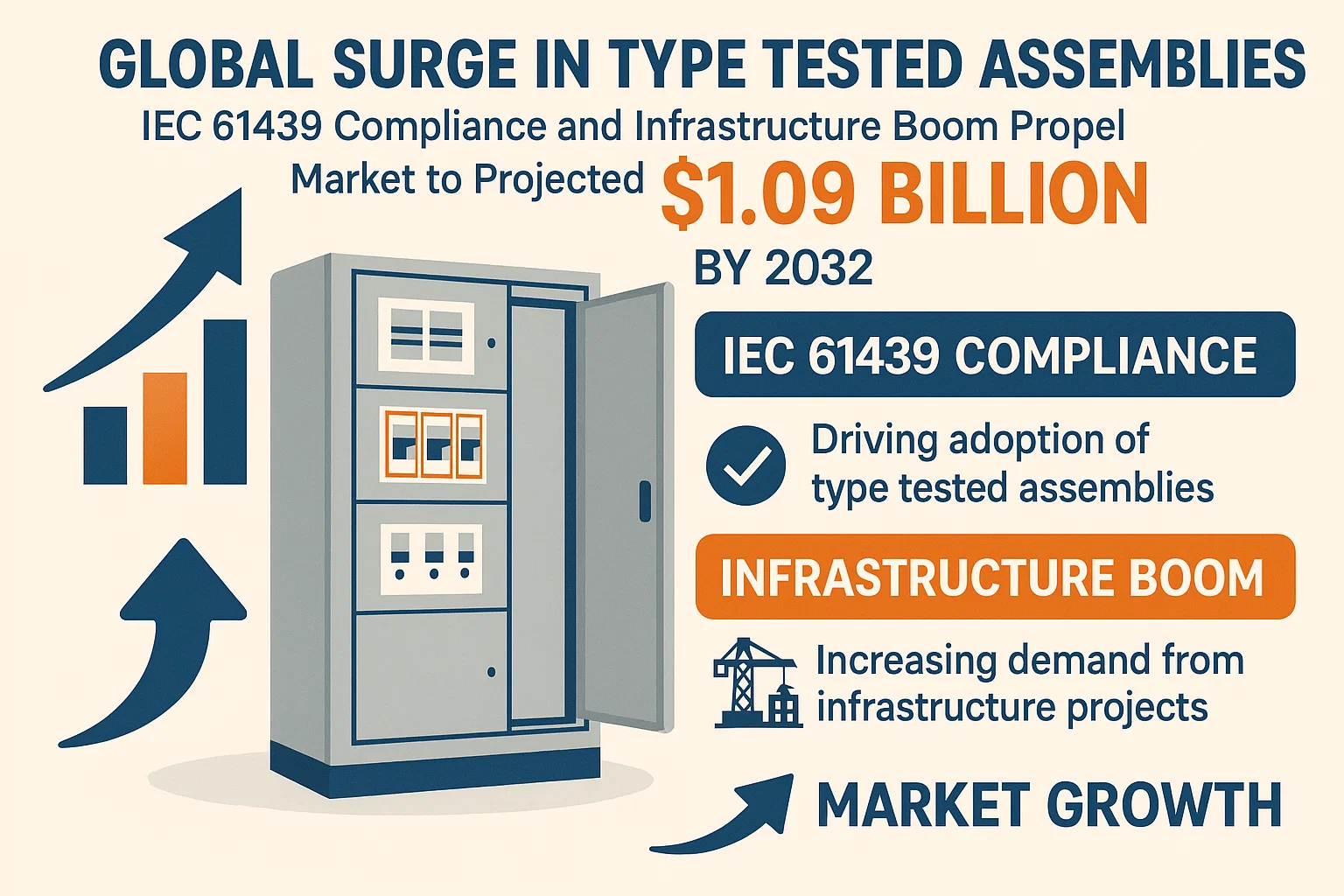
Global Surge in Type Tested Assemblies: IEC 61439 Compliance and Infrastructure Boom Propel Market to Projected $1.09 Billion by 2032
As the world marches toward electrification and digital transformation, the electrical infrastructure underpinning this progress must be safe, standardized, and scalable. A cornerstone of this infrastructure is low-voltage switchgear, and more specifically, Type Tested Assemblies (TTAs)—an engineering innovation that has quietly become a global benchmark for performance and safety.
The global Type Tested Assembly (TTA) market was valued at US$ 678 million in 2024 and is forecasted to reach US$ 1.09 billion by 2032, growing at a Compound Annual Growth Rate (CAGR) of 7.1% between 2025 and 2032. This impressive trajectory reflects a rising global awareness of electrical safety, design verification, and the need for compliant, reliable low-voltage distribution systems across commercial, industrial, and infrastructure projects.
Access Your Free Sample Report- Type Tested Assembly(TTA) Market
What is a Type Tested Assembly (TTA)?
At its core, a Type Tested Assembly (TTA) is a factory-built low-voltage switchgear or controlgear assembly that has been fully tested and certified under standard conditions, ensuring it can reliably operate under specified electrical and mechanical parameters. TTAs are vital in sectors like:
- Industrial automation
- Data centers
- Healthcare facilities
- Transport infrastructure
- Smart buildings
By guaranteeing safety, interoperability, and performance through standardized type testing, TTAs reduce risks of failure, downtime, and non-compliance.
Recent Industry Developments in the TTA Market
1. IEC 61439: Shifting the Global Compliance Landscape
One of the most influential changes in the TTA sector has been the implementation and widespread adoption of IEC 61439, the international standard for low-voltage switchgear assemblies. This standard replaces IEC 60439 and brings with it:
- A clear distinction between “Type-Tested Assemblies (TTA)” and “Partially Type-Tested Assemblies (PTTA)” is now replaced with the concept of “Design Verification”.
- Manufacturers are now legally obligated to verify that their products conform to documented performance specifications.
- A focus on temperature rise limits, dielectric properties, short-circuit withstand strength, and clearance/creepage distances.
These changes have made design verification a legal necessity, rather than a value-add, thus raising the quality threshold across the industry.
2. Modern Modular Assemblies: More than Just Metal Boxes
Manufacturers are developing next-gen modular TTAs that are:
- Compact yet powerful, supporting up to 1600 A or more in certain configurations.
- Highly customizable, with removable compartments, busbar options, and intelligent metering interfaces.
- Equipped for remote monitoring, predictive maintenance, and IoT connectivity.
For example, modular solutions like Weg’s TTW01, a TTA-compliant low-voltage switchgear, are becoming standard in smart building installations, where scalability and compliance must go hand-in-hand.
3. Growing Adoption in Infrastructure Projects
TTA assemblies are now mandated in many public and commercial infrastructure tenders across Asia, the Middle East, and Europe. This includes applications in:
- Urban metro and railway substations
- Water treatment plants
- Airports and seaports
- Government buildings
In particular, India’s Smart Cities Mission and large-scale electrical grid modernization programs in Gulf countries are prioritizing TTA-compliant systems for higher safety margins and operational efficiency.
Why is TTA Compliance Important?
TTAs are about much more than passing a factory test. Here’s why they matter in practice:
1. Safety First
Type-tested switchboards undergo short-circuit, dielectric, and temperature-rise tests, reducing fire risks, shock hazards, and internal arc faults. In critical environments like hospitals or data centers, this is non-negotiable.
2. Interchangeability and Compatibility
TTA systems guarantee component compatibility. This minimizes the likelihood of failure due to mismatched ratings, poor cabling, or inferior connections.
3. Reduced Liability for OEMs and EPCs
With increasing enforcement of IEC 61439 standards, OEMs and EPC contractors can face legal consequences for failures caused by non-compliant assemblies. TTAs offer documentation trails that protect vendors, integrators, and project owners alike.
4. Ease of Maintenance
Modern TTAs are designed for easy compartmentalization and replacement, meaning maintenance teams can isolate and service specific units without shutting down the entire assembly.
Download Sample Report PDF- Type Tested Assembly(TTA) Market
TTA vs PTTA vs Design Verified Assemblies
| Feature | TTA (Legacy) | PTTA (Legacy) | IEC 61439 Design Verified |
| Standard | IEC 60439 | IEC 60439 | IEC 61439 |
| Verification Method | Full-type test | Partially tested + assumptions | Test + calculation + design review |
| Manufacturer Responsibility | Medium | Medium | High (Legally Enforced) |
| Flexibility for Modularity | Low | Medium | High |
With IEC 61439, manufacturers now need to demonstrate equivalence through rigorous design validation, not just pass test cases.
Emerging Technology Trends in TTA Systems
1. Integration of Digital Monitoring Systems
Modern TTAs include features such as:
- Smart MCCBs and ACBs
- Temperature sensors and humidity controls
- Remote diagnostics and SCADA compatibility
Digital monitoring ensures predictive maintenance and energy efficiency tracking, allowing for lower OPEX and improved grid resilience.
2. Enhanced Arc Flash Protection
TTAs are being redesigned with advanced internal arc fault containment, including:
- Pressure relief flaps
- Arc barriers
- Fast tripping mechanisms
These help protect personnel and equipment in case of high-energy faults.
3. Sustainability & Material Innovation
There’s a shift toward low-impact, fire-retardant composite enclosures and halogen-free insulating materials, making TTAs more eco-conscious and compliant with green building codes.
Regional Market Insights
Asia-Pacific (Fastest Growing Market)
- India, China, and Southeast Asia are investing heavily in smart grids and industrial automation.
- National policies are mandating TTA-compliant boards in public sector electrification.
- CAGR in Asia-Pacific projected to exceed 2% during 2025–2032.
Europe (Mature but Regulated)
- Europe has long adopted IEC 61439 standards.
- Energy transition goals are driving retrofits of legacy switchboards with TTA-certified ones.
- Emphasis on electrical safety in aging infrastructure is boosting the retrofit market.
North America (Gradual Adoption)
- While UL 891 remains the dominant standard, cross-border trade and global OEM partnerships are influencing hybrid designs that support IEC TTA specifications.
- Adoption is slower but picking up pace in large industrial and tech campuses.
Key Manufacturers & Technology Providers
Several companies are innovating in the TTA space, including:
- ABB
- Siemens
- Schneider Electric
- Legrand
- WEG
- Eaton
- L&T Electrical & Automation
- Hager Group
These OEMs are investing in modular architectures, cloud-connected MCCBs, and factory-integrated design verification protocols for full lifecycle support.
Challenges and Roadblocks
Despite impressive growth and standardization, several obstacles remain:
High Initial Cost
TTAs are costlier upfront than PTTA or non-compliant boards. Many developers in developing nations opt for cheaper alternatives despite long-term safety risks.
Inadequate Enforcement
Even in countries adopting IEC 61439, enforcement is inconsistent. Site modifications post-installation sometimes invalidate initial certifications.
Training Gaps
Electricians and project engineers often lack hands-on familiarity with TTA systems, risking misapplication or poor maintenance practices.
Click Here To Download Full Sample Report- Type Tested Assembly(TTA) Market
Future Outlook (2025–2032)
As electrical infrastructure modernizes globally, TTAs are positioned for exponential growth. Key trends that will shape the next decade:
- Integration with AI-driven Building Management Systems (BMS)
- Widespread use of digital twins for virtual commissioning
- Standardized plug-and-play switchgear architectures
- Net-zero and circular economy mandates encouraging sustainable assembly design
The transition from simple “switchboards” to intelligent, tested, and verified power distribution systems will redefine the landscape for OEMs, contractors, utilities, and end-users.
The Type Tested Assembly (TTA) market is no longer a niche within electrical engineering—it is becoming a standard of excellence in a safety- and compliance-driven world. With a projected market size of US$ 1.09 billion by 2032, driven by an impressive 7.1% CAGR, TTAs will play a central role in electrification projects, smart city deployments, and future-proof industrial networks.
From evolving global standards to digitized diagnostics and sustainable materials, TTAs are poised to be the backbone of reliable, resilient, and regulation-ready electrical infrastructure.

Comments (0)