

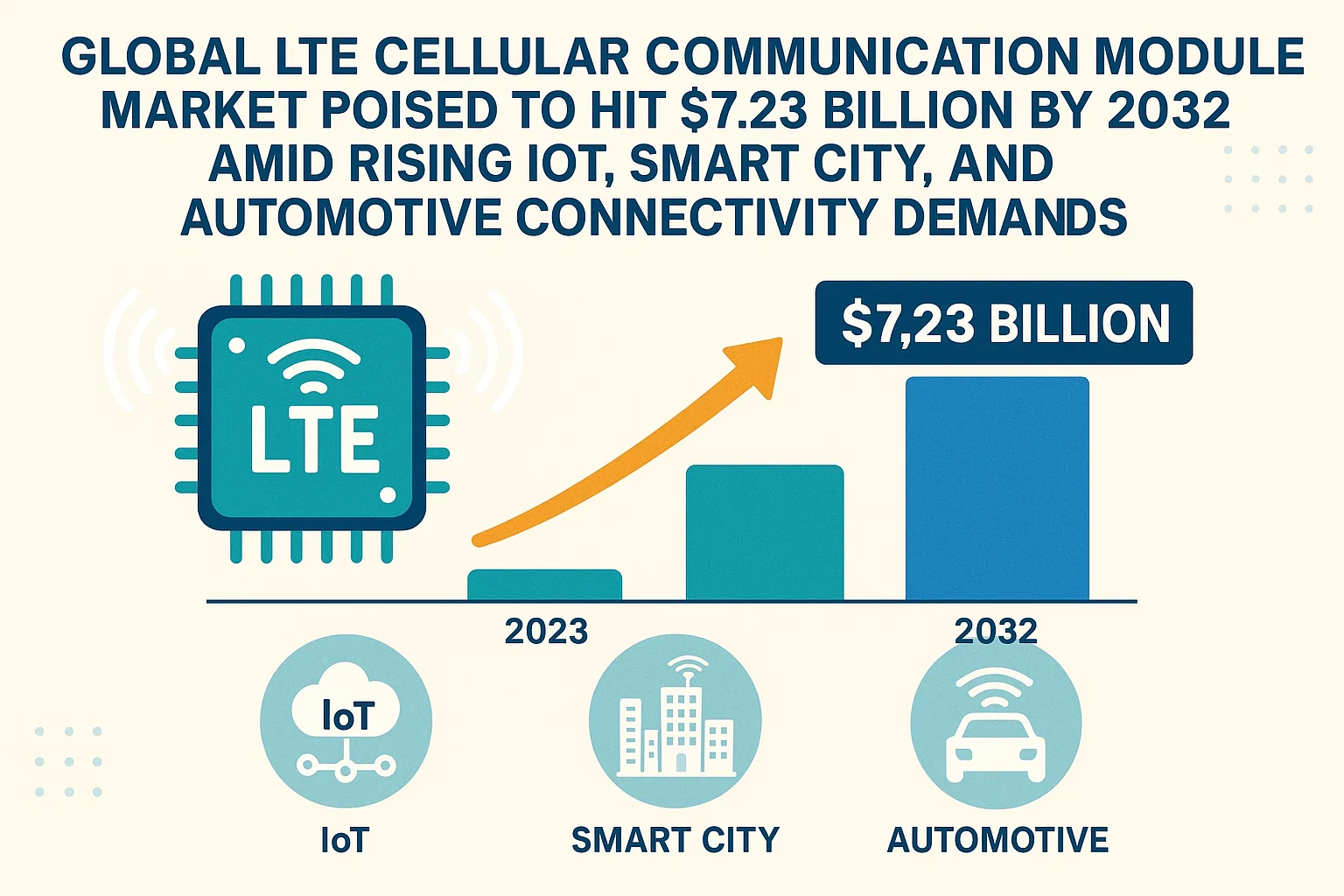
Global LTE Cellular Communication Module Market Poised to Hit $7.23 Billion by 2032 Amid Rising IoT, Smart City, and Automotive Connectivity Demands
In a hyper-connected world, LTE cellular communication modules have emerged as the backbone of modern connectivity, enabling seamless communication in IoT devices, smart infrastructure, industrial automation, and telematics. As the world transitions from legacy networks toward advanced 5G connectivity, LTE modules continue to serve as the pivotal bridge, ensuring global compatibility, affordability, and reliable performance. According to recent data, the global LTE Cellular Communication Module Market size was valued at US$ 4.67 billion in 2024 and is projected to reach US$ 7.23 billion by 2032, growing at a CAGR of 6.4% during 2025 to 2032.
Access Your Free Sample Report- LTE Cellular Communication Module Market
The Role of LTE Modules in the Connectivity Ecosystem
LTE (Long-Term Evolution) communication modules act as the critical link between devices and cellular networks, enabling Machine-to-Machine (M2M) and IoT applications across industrial, automotive, healthcare, agriculture, and consumer electronics sectors. Their significance has grown as enterprises seek to deploy scalable, secure, and cost-effective solutions amid digital transformation.
Key Applications:
- Smart meters and utilities
- Asset tracking and fleet management
- Connected cars and telematics
- Smart home and security systems
- Industrial IoT and automation
Market Snapshot: 2024 to 2032
The LTE module market is witnessing a dynamic transformation. With a valuation of US$ 4.67 billion in 2024, the sector is forecasted to expand to US$ 7.23 billion by 2032. This growth is driven by:
- Surging demand for Cat-1 bis modules
- Gradual shift to 5G RedCap (NR-Light) modules
- Regulatory shifts favoring secure and efficient communication
- OEM investments in low-power, compact LTE solutions
Recent Developments Shaping the Market
1. Quectel’s Leadership and Regulatory Headwinds
Quectel has maintained a dominant position in the global cellular IoT module market with a ~40% share, recording a 31% YoY shipment increase in Q1 2025. However, inclusion in the U.S. Department of Defense’s 1260H List has sparked concerns over national security, pushing Western manufacturers to reconsider supply dependencies.
2. u-blox Exits LTE Module Market
In a surprise strategic shift, u-blox exited the LTE cellular IoT module market in early 2025, divesting technology and staff to focus on positioning within satellite and short-range connectivity. Though accounting for only ~1.1% of global revenue, u-blox’s exit opens market space for emerging players.
3. Rise of Western Alternatives
Eagle Electronics, a U.S. startup using licensed Quectel designs, launched its own LTE module facility in Ohio. It aims to reduce reliance on China-based suppliers while fulfilling local compliance requirements. This move is emblematic of a broader localization trend.
4. Surge in LTE Cat-1 bis Adoption
2024 marked a tipping point for Cat-1 bis modules, which saw 100% YoY growth, especially in asset tracking, smart metering, and smart city deployments. These modules offer optimal balance between speed, cost, and power consumption, outperforming legacy LTE Cat-1 and NB-IoT in many use cases.
5. Decline of NB-IoT and Cat-M
By contrast, NB-IoT and Cat-M modules faced steep declines—34% and 51% YoY, respectively—due to performance limitations and lack of global interoperability.
The Emergence of 5G RedCap: LTE’s Successor?
5G RedCap (Reduced Capability), also known as NR-Light, represents the next leap in cellular module technology. It is tailored for wearables, smart cameras, and IoT applications requiring lower bandwidth, latency, and power than traditional 5G.
- T-Mobile and AT&T have announced RedCap module rollouts for 2025.
- Cavli Wireless launched its first RedCap module (CQM220) in Q2 2025.
RedCap is expected to complement, not immediately replace LTE, and become mainstream post-2027.
Regulatory Trends: EU Cybersecurity Directive (RED 2025)
The European Union’s Radio Equipment Directive (RED), effective August 1, 2025, mandates:
- Secure boot processes
- Encrypted firmware updates
- Hardware-level access control
These rules favor module vendors who maintain transparent, secure, and documented software stacks, presenting challenges to opaque platforms, particularly from certain Chinese vendors.
Download Sample Report PDF- LTE Cellular Communication Module Market
Shipment and Revenue Trends
Shipment Recovery in 2024:
After a 9% revenue decline in 2023, global LTE module shipments rebounded 10% in 2024, driven by:
- 21% growth in China
- 31% growth in India
- Recovery in automotive and smart grid sectors
Price Pressure and Consolidation:
Module ASPs (average selling prices) continue to fall 12–15% annually, intensifying pressure on smaller suppliers. Larger OEMs are investing in vertical integration and embedded SIM/SoC solutions to maintain profitability.
Regional Insights
United States
- Market driven by telematics, defense electronics, and industrial IoT.
- Demand for domestic sourcing and RedCap compliance is high.
China
- Largest LTE module manufacturing hub.
- Focused on Cat-1 bis, smart energy, and surveillance.
Europe
- Stringent security regulations promote transparent vendors.
- Automotive and smart grid applications are key.
India
- Emerging as a high-growth region for LTE modules, supported by “Make in India” and telecom digitization.
Technology Innovations and Industry Shifts
Integration and Miniaturization
New LTE modules integrate:
- GNSS (Global Navigation Satellite Systems)
- Low-power microcontrollers
- AI-capable chipsets
These are ideal for smartwatches, portable health monitors, and intelligent sensors.
Hybrid LPWAN-LTE Modules
Manufacturers are launching dual-mode modules combining LTE-M and NB-IoT, supporting seamless handoffs between low and mid-speed networks. Forecasted market size for hybrid modules: $2.5 billion by 2027.
Automotive Sector
- LTE modules embedded in 90% of new cars by 2028.
- Applications: eCall, predictive maintenance, infotainment, V2X communication.
Competitive Landscape
Key Players:
- Quectel
- Fibocom
- Cavli Wireless
- Thales
- Sierra Wireless
- Eagle Electronics
Emerging Players to Watch:
- Sunsea AIoT
- Neoway
- u-blox (in satellite and non-cellular segments)
Future Outlook: Where Is the Market Headed?
LTE Will Remain Relevant:
Despite the 5G surge, LTE will maintain relevance due to:
- Lower cost
- Mature ecosystem
- Global coverage
RedCap and Beyond:
By 2028, LTE shipments may plateau as RedCap matures. Hybrid LTE-5G modules will dominate.
Click Here To Download Full Sample Report- LTE Cellular Communication Module Market
Focus on Security and Localization:
OEMs will emphasize:
- Open SDKs
- Compliance with RED and FCC guidelines
- Localized supply chains
As the LTE Cellular Communication Module market moves toward a $7.23 billion valuation by 2032, the next decade promises both growth and upheaval. LTE technology remains vital—bridging today’s IoT demands with tomorrow’s 5G possibilities. Vendors that can balance performance, compliance, affordability, and innovation will shape the future of connectivity. Amid the shift to RedCap, cybersecurity regulation, and regional supply chain realignments, the LTE module industry stands at a crucial inflection point.
Stakeholders must stay agile, invest in secure design practices, explore emerging technologies, and align with global regulatory frameworks to succeed in this evolving digital landscape.

Comments (0)