
From SIM Trays to Silicon Layers: ESIM market Revolution in Devices
The evolution from physical SIM cards to embedded SIM (eSIM) technology marks a fundamental shift not just in telecom, but in semiconductor engineering. Unlike traditional SIM cards, eSIMs are directly soldered onto device motherboards, integrating secure elements within chipsets. This transformation aligns closely with the semiconductor industry’s long-standing trajectory toward miniaturization and system-on-chip (SoC) integration.
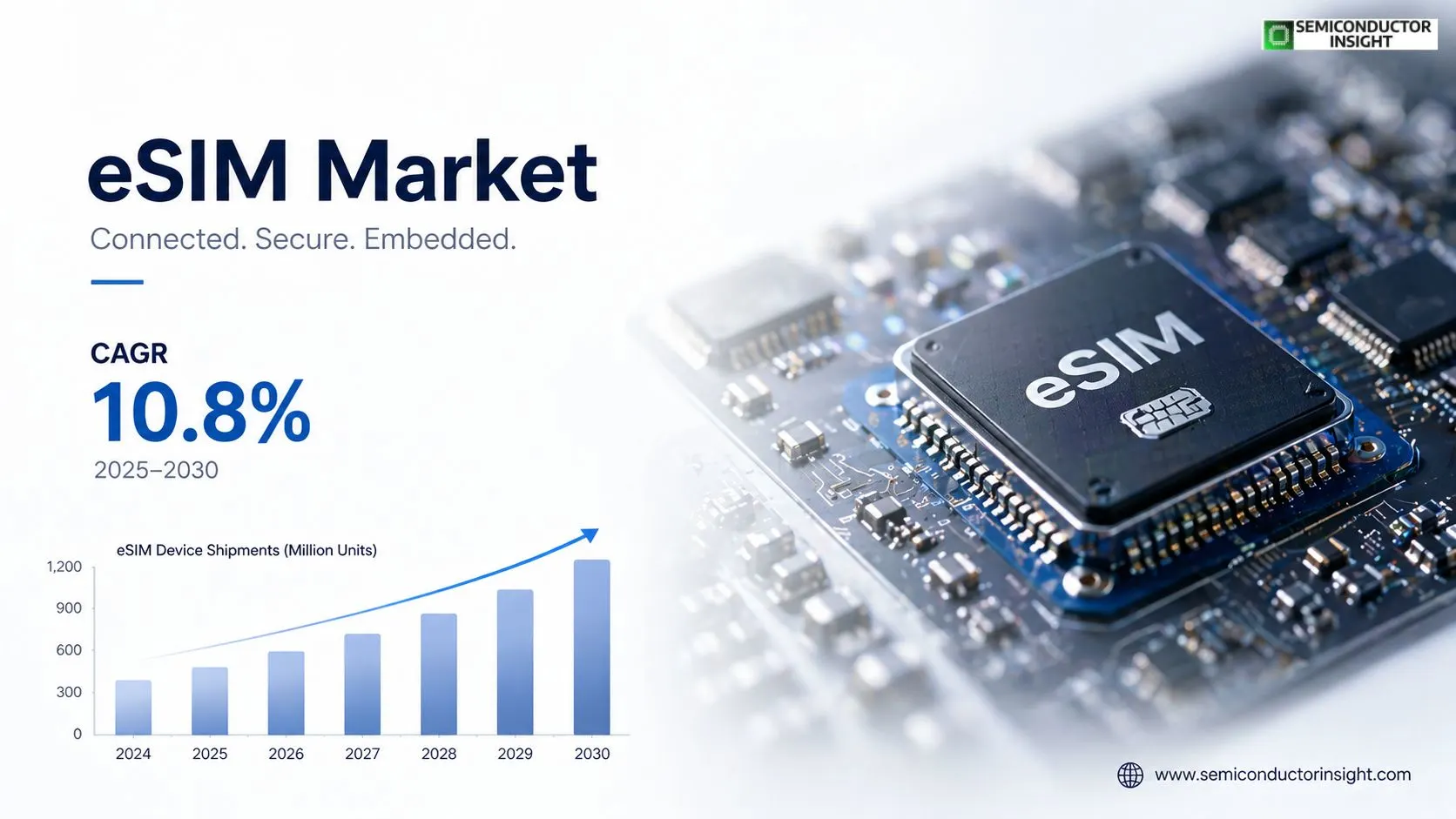
As of 2025, global eSIM-enabled device shipments have crossed 600 million units annually, spanning smartphones, wearable, connected vehicles, and IoT modules. Smartphones alone account for over 350 million of these shipments, with flagship devices from major OEMs eliminating physical SIM trays entirely. This shift is not merely aesthetic it reduces component count, saves board space by up to 30-40 mm² per device, and enhances durability.
Secure Elements: The Core of eSIM Architecture
At the heart of the eSIM lies a secure element (SE), a tamper-resistant chip designed to store credentials and execute cryptographic operations. Semiconductor companies are increasingly embedding these secure elements within application processors or dedicated connectivity chips.
Key technical characteristics shaping this segment include:
- Memory capacities ranging from 512 KB to 2 MB for profile storage
- Hardware-based encryption engines supporting AES, RSA, and ECC standards
- Power consumption levels below 10 µA in standby modes for IoT deployments
- Compliance with GSMA Remote SIM Provisioning (RSP) standards
The integration of secure elements into multi-function chips has reduced the need for discrete components, improving manufacturing efficiency and lowering bill-of-material (BOM) costs by approximately $0.50-$1.20 per device at scale.
Stay updated with the newest findings from the report: https://semiconductorinsight.com/report/esim-market/
Manufacturing Convergence: Foundries and Connectivity
ESIM market is deeply tied to semiconductor fabrication trends. Most eSIM chips are manufactured using mature process nodes such as 28 nm and 40 nm, balancing cost efficiency with reliability. Unlike high-performance processors, eSIM chips prioritize security, longevity, and low power over computational density.
In automotive applications, for instance, eSIM chips must withstand temperature ranges from -40°C to 105°C and maintain functionality over 10-15 years. This has led to increased demand for automotive-grade semiconductor certifications such as AEC-Q100.
A notable recent development is the integration of eSIM functionality into connectivity modules for 5G. In 2024, over 180 million 5G modules shipped globally included eSIM capabilities, particularly in industrial IoT and smart city infrastructure.
Device Ecosystem Expansion: Beyond Smartphones
While smartphones dominate the eSIM landscape, the real expansion is happening in adjacent device categories. Connected vehicles now represent one of the fastest-growing segments, with over 120 million vehicles globally equipped with eSIM-based telematics systems. These systems enable real-time navigation updates, remote diagnostics, and over-the-air (OTA) software upgrades.
Wearable and consumer IoT devices are also contributing significantly:
- Smart watches account for over 80 million eSIM-enabled units annually
- Laptops and tablets contribute around 40 million units
- Industrial IoT devices exceed 100 million deployments with eSIM integration
This diversification is pushing semiconductor firms to design chips that support multi-network profiles and dynamic switching, enabling seamless global connectivity without physical intervention.
Remote Provisioning: A Software-Silicon Synergy
A core driver of the eSIM market is remote SIM provisioning (RSP), a feature that empowers users to download and manage multiple carrier profiles digitally. This functionality relies heavily on the integration of secure firmware and sophisticated software within the semiconductor stack.
From a hardware standpoint, this necessitates non-volatile memory capable of hosting five to ten operator profiles per chip, along with robust secure boot mechanisms to guard against unauthorized firmware access and low-latency communication interfaces between the modem and the secure element. As of 2025, over 70% of new eSIM-enabled devices facilitate this multi-profile management, highlighting an increasing demand for connectivity flexibility among global consumers and enterprises alike.
Supply Chain Realignment and Component Economics
The shift to eSIM is subtly reshaping semiconductor supply chains. Traditional SIM card manufacturers are transitioning toward chip-level solutions, while semiconductor firms are capturing more value within the device ecosystem.
Key economic shifts include:
- Reduction of physical SIM production, which previously exceeded 4 billion units annually
- Increased demand for secure microcontrollers and embedded connectivity chips
- Consolidation of suppliers specializing in secure element IP and firmware
This transition is also reducing logistical overhead for telecom operators, eliminating the need for physical distribution of SIM cards across markets.
Engineering the Invisible Infrastructure
ESIM market represents more than a connectivity upgrade it is a redefinition of how identity, security, and communication are embedded at the silicon level. By eliminating physical constraints and enabling programmable connectivity, eSIM technology is aligning perfectly with the semiconductor industry’s vision of compact, efficient, and intelligent systems.
As devices continue to shrink and networks expand, the role of semiconductors in enabling seamless, secure, and scalable connectivity will only grow stronger, making the eSIM not just a feature, but a foundational element of the digital ecosystem.

Comments (0)