
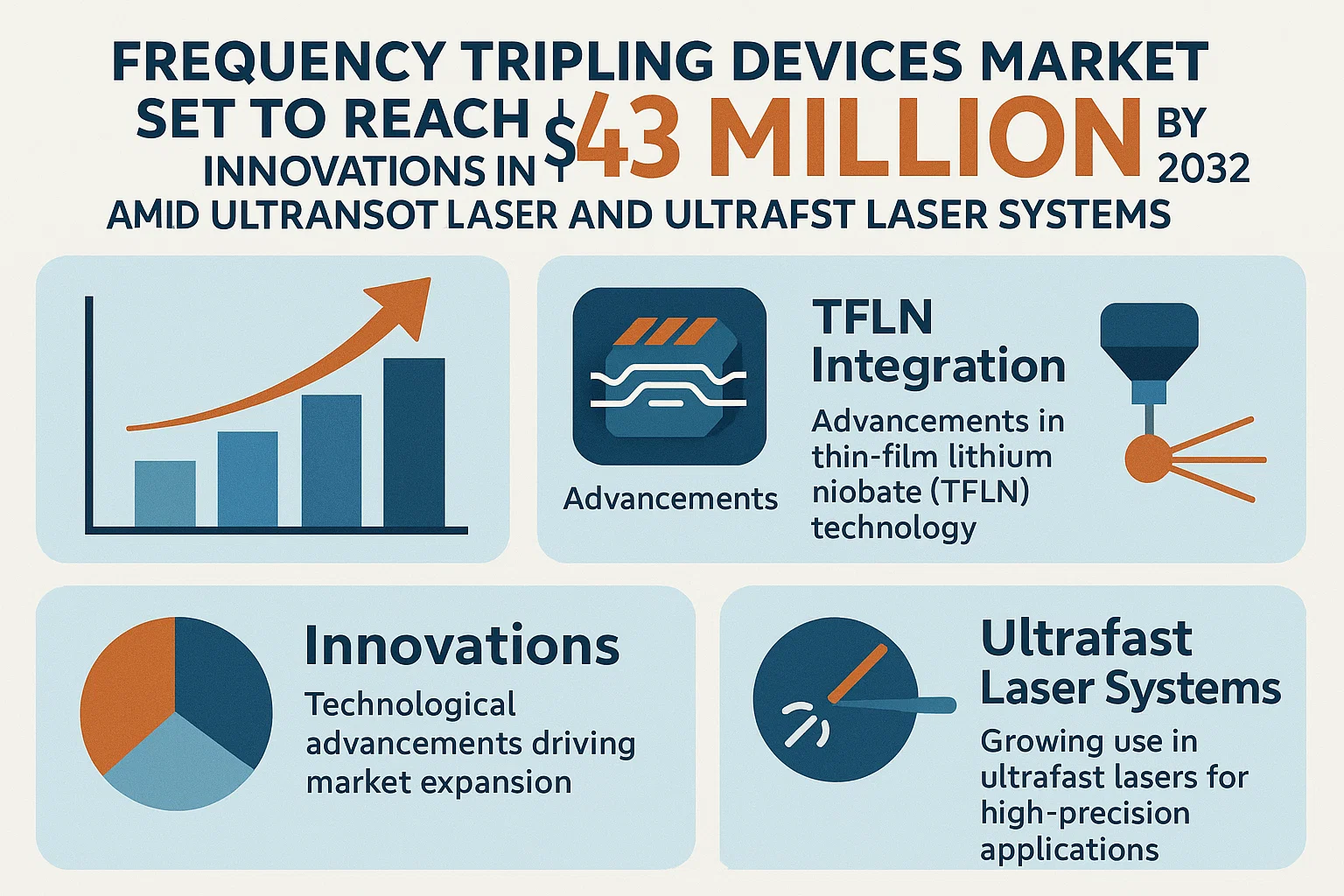
Frequency Tripling Devices Market Set to Reach $43 Million by 2032 Amid Innovations in TFLN Integration and Ultrafast Laser Systems
In the realm of advanced photonics and high-frequency signal processing, frequency tripling devices are carving a niche that’s rapidly expanding. These precision components, crucial for generating third-harmonic signals through nonlinear optical processes, are gaining renewed importance across sectors like aerospace, quantum sensing, medical diagnostics, and terahertz communications.
As of 2024, the global frequency tripling devices market was valued at USD 34 million. With consistent innovation and increasing demand for compact, high-performance frequency converters, the market is projected to grow to USD 43 million by 2032, reflecting a CAGR of 3.3% during the forecast period of 2025–2032.
Access Your Free Sample Report- Frequency Tripling Devices Market
What Are Frequency Tripling Devices?
Frequency tripling devices are nonlinear optical components used to generate light at triple the frequency (one-third the wavelength) of an incident laser source. This process, called third-harmonic generation (THG), typically involves the use of nonlinear crystals like LBO, BBO, or periodically poled materials such as PPLN (periodically poled lithium niobate).
They are essential in:
- Generating UV light for microscopy, lithography, and dermatological lasers
- Creating blue-green laser output from infrared sources
- Supporting terahertz and high-speed communications systems
- Enabling quantum optics and spectroscopy research
With the demand for miniaturization and photonic integration growing, frequency tripling devices are moving beyond lab benches into scalable commercial applications.
Market Overview and Forecast
- 2024 Valuation: USD 34 million
- Projected Valuation (2032): USD 43 million
- Forecasted CAGR (2025–2032): 3.3%
Regional Highlights:
- North America remains a technological leader in photonics and laser-based research, maintaining strong demand in defense and aerospace sectors.
- Asia-Pacific is emerging rapidly, with countries like China, Japan, and South Korea investing heavily in photonics manufacturing, telecom infrastructure, and medical lasers.
- Europe is driving innovation through strategic research initiatives (e.g., Move2THz consortium), enhancing component efficiency and integration.
Recent Developments and Breakthroughs
1. Frequency Electronics: Tapping into a $20M+ Opportunity by FY 2027
In a strategic move, Frequency Electronics Inc.—a key player in high-precision timing and frequency components—announced an anticipated market expansion exceeding $20 million in opportunities through FY 2027. This projection is based on rising demand from defense-grade radars, drone navigation systems, and quantum sensor platforms that rely heavily on frequency multiplication and stability.
By leveraging their expertise in timing modules, the company is expected to integrate tripling functionality into next-gen systems. The signal: growing commercial viability for niche high-frequency components.
2. Soitec-Led Move2THz Consortium Targets Photonic Integration
In a groundbreaking initiative, Soitec, in collaboration with European R&D organizations, launched the Move2THz project aimed at pushing the frontiers of THz-frequency semiconductor components. Though the project’s primary focus is on material and substrate engineering, its downstream applications include on-chip nonlinear devices, especially those enabling THG and higher-harmonic generation.
These developments underscore a trend toward wafer-level integration of frequency tripling capabilities—promising a future where these devices are part of standard photonic chips.
3. Menlo Systems Launches ELMO 780 XHP Ultrafast Laser
Menlo Systems, a global pioneer in precision laser systems, released its latest product: the ELMO 780 XHP, an ultrafast fiber laser capable of delivering over 1W of average power at 780 nm with ~100 fs pulse durations. While this laser does not include a tripling module per se, its compatibility with third-harmonic generation chains makes it an enabling platform for downstream UV applications.
The demand for such femtosecond lasers is fueling the growth of THG modules, particularly in applications such as biomedical imaging, materials processing, and precision spectroscopy.
4. Optica Reports Milestone in Semiconductor-Disk Laser Tripling
A recent study published by Optica details a semiconductor-disk laser system frequency-tripled to 327 nm, delivering over 0.5 W output in the ultraviolet spectrum. The innovation utilized Type-I phase-matching in nonlinear crystals, offering:
- Greater wavelength tuning
- Compact footprint for integration
- Potential for lithography and microfabrication applications
This highlights the evolution of UV tripling devices from bulky lab equipment to portable, efficient, and tunable systems suitable for industry-grade deployment.
5. Yb:YAG Laser Achieves Record Third-Harmonic Conversion
A team of researchers demonstrated third-harmonic generation from a Yb:YAG-based cryogenic laser system, reaching output of 50 J per pulse at 343 nm with 53% conversion efficiency. Such high-energy, high-repetition-rate systems have significant implications for industrial machining, defense, and materials analysis.
By utilizing large LBO crystals in sum-frequency mode, the system sets a benchmark for high-power UV laser generation through tripling—signaling new possibilities for production-scale deployment.
6. Advancements in Fiber-Based Tripling Using Tm-Doped Lasers
Tm-doped fiber lasers, traditionally operating at 1950 nm, were recently optimized to achieve frequency tripling outputs at 650 nm using PPLN crystals. The all-fiber nature of these setups offers key advantages:
- Compact, rugged designs
- Compatibility with medical instruments
- Higher thermal management efficiency
These innovations support expanding use of fiber-based THG modules in handheld dermatology and ophthalmology lasers.
7. Thin-Film Lithium Niobate (TFLN) Breakthrough for Nonlinear Devices
Another milestone was achieved with wafer-scale manufacturing of quasi-phase-matched frequency converters on thin-film lithium niobate (TFLN). These devices promise:
- Higher conversion efficiency
- Smaller device footprints
- Integration with photonic integrated circuits (PICs)
TFLN is rapidly becoming the material platform of choice for integrated nonlinear optics, and frequency tripling devices built on this substrate are poised to revolutionize sectors like telecom, AR/VR, and quantum computing.
Download Sample Report PDF- Frequency Tripling Devices Market
Key Application Areas Fueling Demand
1. Medical Technology
Ultraviolet (UV) light produced via frequency tripling is increasingly used in:
- Ophthalmic surgeries
- Dermatological laser treatments
- Cancer detection imaging
Compact, fiber-compatible THG modules are particularly suited for minimally invasive systems, aligning with the trend toward portable, in-clinic solutions.
2. Aerospace and Defense
The defense sector is turning to frequency tripling devices for:
- Short-wavelength radar systems
- LIDAR and night vision calibration
- Precision targeting and communications
The high-frequency and short-pulse characteristics of THG systems make them ideal for next-gen, spaceborne, or drone-mounted solutions.
3. Scientific Research and Metrology
Precision spectroscopy, quantum experiments, and atomic clocks often rely on frequency tripling to generate specific wavelengths not easily available through direct laser emission. Academic and national labs remain consistent buyers of these components.
4. Industrial Manufacturing
UV and deep-UV lasers derived via frequency tripling are crucial for:
- Semiconductor lithography
- Micromachining and engraving
- 3D microfabrication and printing
As manufacturing processes become more intricate, the need for high-stability, high-intensity UV sources will continue to grow.
Competitive Landscape and Innovations
Leading Players
- Frequency Electronics Inc.
- Menlo Systems GmbH
- Thorlabs Inc.
- Ekspla
- MKS Instruments (Spectra-Physics)
- Light Conversion
- Coherent Inc.
These companies are engaged in developing increasingly compact, integrated, and higher-efficiency THG modules, often pairing them with ultrafast laser systems for complete solutions.
Strategic Focus Areas
- Miniaturization and Photonic Integration
- Increased Wavelength Tunability
- Higher Output Efficiency (W/mJ per input)
- Thermal and Power Stability Enhancements
Challenges and Market Constraints
Despite steady growth, the frequency tripling devices market faces some obstacles:
- High manufacturing cost of nonlinear crystals and phase-matching components
- Thermal instability and alignment issues in compact systems
- Slow adoption outside research and niche applications
- Integration complexity in mass-scale photonic platforms
However, with investments in wafer-level manufacturing, chip-scale nonlinear devices, and multi-purpose modules, many of these issues are being actively addressed.
Click Here To Download Full Sample Report- Frequency Tripling Devices Market
Future Outlook: 2025–2032
The future of frequency tripling devices looks promising, bolstered by both technical progress and increasing application demands. Some key forecasts include:
- Tripling Devices as Chip Components: With breakthroughs in TFLN and photonic integration, expect THG modules embedded in standard photonic ICs.
- Growth in UV Biomedical Devices: Portable laser-based diagnostic and surgical tools will drive demand for miniature tripling modules.
- Expansion in Consumer AR/VR Applications: Compact UV and visible light sources (via tripling) could find a place in smart glasses and headsets.
The frequency tripling devices market, while niche, is becoming more relevant with each passing year. From powering the latest in biomedical imaging to enabling next-generation quantum sensors and defense systems, these devices offer a gateway to ultra-fast, ultra-precise photonics.
With a projected CAGR of 3.3% from 2025 to 2032, it’s clear that the industry is transitioning from experimental labs to real-world applications, thanks to continuous R&D, miniaturization efforts, and cross-sector innovation.
In a world that increasingly demands higher frequencies, smaller devices, and broader functionality, frequency tripling devices are no longer optional—they’re essential.

Comments (0)