
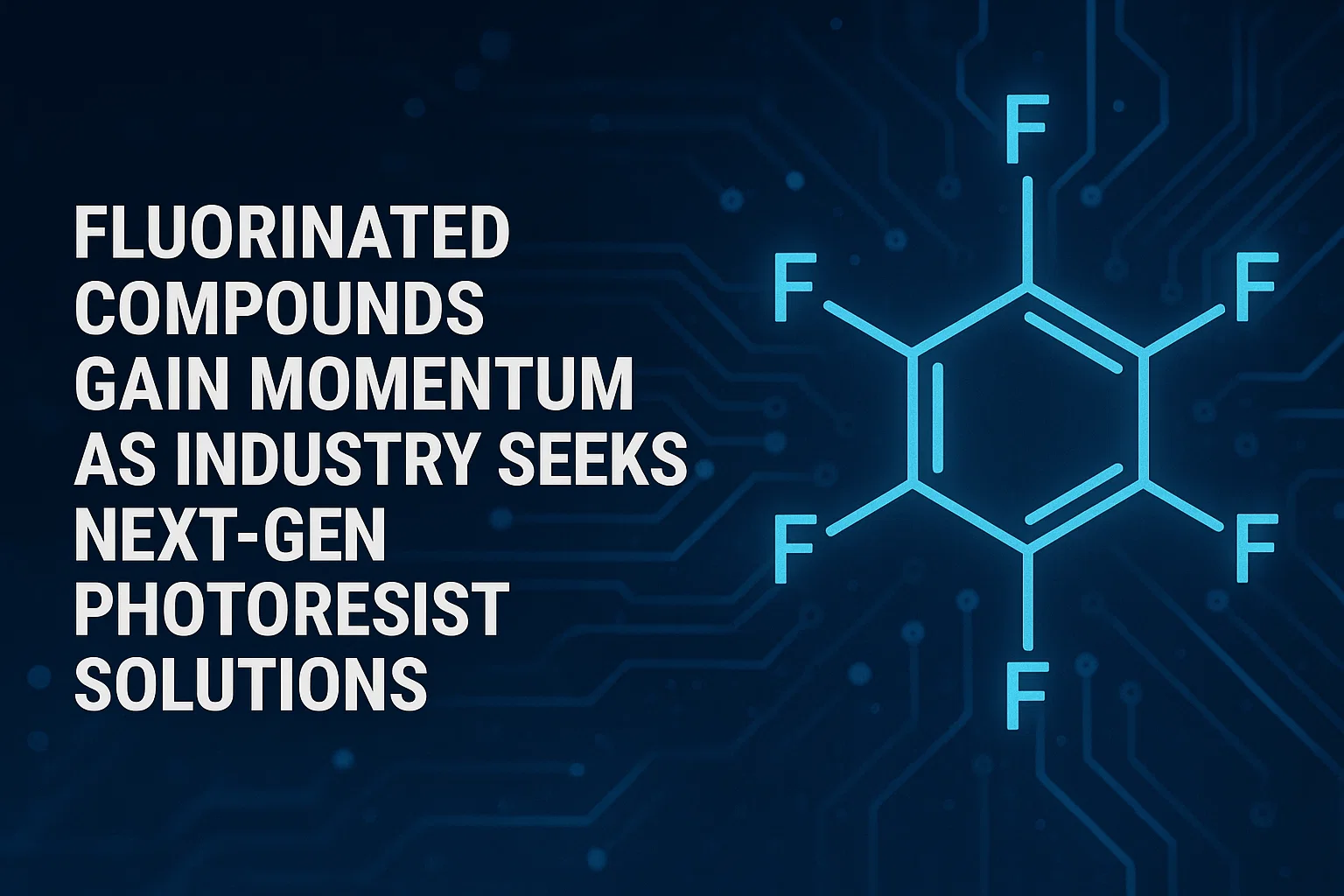
Fluorinated Compounds Gain Momentum as Industry Seeks Next-Gen Photoresist Solutions
In the world of semiconductor manufacturing, lithography materials are the quiet but essential enablers of technological progress. Among them, photoresists the light-sensitive polymers used to define patterns on silicon wafers remain a cornerstone of chip fabrication. While the global spotlight often shines on extreme ultraviolet (EUV) resists and advanced 193 nm immersion materials, the 248 nm (KrF) photoresist market continues to play an indispensable role.
As of 2024, the 248 nm photoresist market was valued at approximately US $456 million. Despite the dominance of more advanced lithography techniques for cutting-edge chips, this segment is projected to reach US $723 million by 2032, growing at a CAGR of 6.8% between 2025 and 2032. This growth is fueled by enduring demand in legacy semiconductor nodes, rising adoption in specific memory and logic applications, and the increasing push for domestic supply chains especially in Asia.
Access Your Free Sample Report- 248nm Photoresist Market
Why 248 nm Photoresist Still Matters
Despite the buzz around EUV and 193 nm immersion lithography, 248 nm KrF photoresist is far from obsolete. Its enduring role can be explained by three main factors:
- Legacy Node Dominance
- Many chips don’t require the cutting-edge 5 nm or 3 nm nodes. In fact, the majority of semiconductors manufactured globally are still produced on mature nodes (65 nm and above). KrF photoresists are particularly well-suited for these processes.
- Applications include power management ICs, analog devices, display drivers, and image sensors.
- Cost Efficiency
- KrF lithography remains significantly cheaper compared to 193 nm immersion or EUV. For manufacturers producing high volumes of chips with modest performance requirements, 248 nm photoresists strike the right balance of cost and performance.
- Process Compatibility
- Certain memory fabrication processes, such as flash storage, continue to rely on 248 nm photoresists due to compatibility and proven reliability.
In short, 248 nm resists are the workhorses of the semiconductor supply chain quietly powering industries like automotive electronics, IoT devices, and consumer appliances, even as the latest smartphones showcase EUV-based chips.
Market Outlook and Growth Potential
The market size of US $456 million in 2024 is not an accident; it reflects both steady demand and a resurgence of interest due to supply chain rebalancing. By 2032, with a projected US $723 million valuation, KrF resists will maintain a vital niche.
Key Growth Drivers:
- Automotive demand: As vehicles integrate more semiconductors for ADAS (advanced driver assistance systems), EV power electronics, and infotainment, demand for reliable, lower-cost chips continues to climb.
- Industrial and IoT growth: Billions of connected devices don’t need the smallest node sizes but do need efficient, cost-effective semiconductors.
- Regional diversification: Governments in the US, Europe, and China are pushing for onshore or nearshore chip production. This increases demand for all lithography materials including 248 nm resists for legacy fabs.
Growth Challenges:
- Competition from 193 nm resists: While KrF is well-established, more fabs are gradually transitioning to ArF (193 nm dry or immersion) for certain mid-node requirements.
- Environmental regulation: PFAS phase-out timelines may complicate material supply chains.
Recent Industry Developments
Legacy Node Demand Surges
According to Semiconductor Digest and TECHCET, KrF photoresists are witnessing a steady uptick in demand as legacy node production expands. Even though advanced nodes grab headlines, over 70% of semiconductors shipped worldwide come from mature technology nodes. This ensures a steady baseline for KrF materials.
China’s Domestic Progress
A landmark development in December 2024 was Hubei Dinglong’s successful client validation for both ArF and KrF resists. The company not only gained validation but also secured orders from two domestic wafer manufacturers, exceeding RMB 1 million.
- This is a strategic milestone: for years, China has relied heavily on Japanese and Korean suppliers (e.g., JSR, Tokyo Ohka Kogyo, and Shin-Etsu Chemical).
- With Dinglong entering validated supply chains, China is reducing reliance on imports, aligning with Beijing’s semiconductor self-sufficiency goals.
- This move could shift competitive dynamics, particularly in the Asia-Pacific region.
Download Sample Report PDF- 248nm Photoresist Market
Environmental and Chemical Challenges
PFAS-based photoacid generators are under increasing scrutiny. The US and EU regulators are calling for a phase-out of these persistent chemicals due to their environmental and health risks.
- Developing PFAS-free PAG alternatives is technically challenging because they must provide high acid strength, stability, and diffusion control.
- TechCET estimates it will take 5–10 years for viable replacements to enter production at scale.
Materials Transition: The Fluorine Factor
One reason 248 nm resists can’t transition seamlessly into advanced lithography is their lack of transparency at 193 nm and below. Fluorinated compounds, however, provide both transparency and high absorption control for shorter wavelengths like EUV (13.5 nm).
- Halocarbon recently highlighted that future generations of photoresists will lean heavily on fluorine chemistry to bridge performance gaps.
- For 248 nm, this signals a plateau in technology but one that is stable, reliable, and well-supported.
Polymer Chemistry Evolution
Traditional 248 nm resists use polyhydroxystyrene (PHS) as the polymer backbone. While effective for DUV, PHS absorbs strongly at 193 nm, making it unsuitable for ArF resists.
- Researchers and suppliers have experimented with alicyclic methacrylates and cyclic olefin maleic anhydride (COMA) polymers as alternatives.
- Although these innovations are more relevant for 193 nm and EUV, they highlight the chemistry bottleneck that limited 248 nm resists’ forward compatibility.
Regional Landscape
Japan and Korea: Technology Leaders
- JSR, Tokyo Ohka Kogyo (TOK), and Shin-Etsu Chemical continue to dominate global supply.
- Their advantage lies in deep R&D pipelines and decades of customer trust.
China: The Emerging Challenger
- Hubei Dinglong’s breakthrough is just the beginning. Several other domestic players are ramping up pilot production.
- If China can scale to meet internal demand, this could reshape global supply chains, potentially reducing Japanese and Korean dominance in legacy materials.
United States and Europe: Security and Sustainability
- US and EU initiatives to onshore semiconductor production are creating new opportunities for local suppliers.
- However, PFAS restrictions may limit production flexibility, forcing companies to accelerate non-PFAS alternatives.
Challenges Ahead
- Regulatory Pressure on PFAS
- The transition will be disruptive, as new chemistries must balance performance and compliance.
- Geopolitical Risks
- US-China tensions could restrict the flow of critical raw materials, potentially fragmenting the photoresist market.
- Innovation Gap
- While KrF resists remain useful, investment in R&D for this segment is dwarfed by EUV efforts. Suppliers must weigh the ROI of incremental KrF improvements.
Opportunities in the KrF Photoresist Market
- Automotive Chips
- EV adoption and autonomous driving systems will require billions of mature-node chips, directly boosting demand for KrF resists.
- IoT Devices
- With forecasts of over 25 billion IoT devices by 2030, demand for cost-efficient semiconductors is rising.
- Localized Supply Chains
- As regions invest in local fabs, demand for regional resist suppliers will increase. This presents opportunities for new entrants.
Click Here To Download Full Sample Report- 248nm Photoresist Market
Future Outlook
The 248 nm photoresist market is not shrinking it is stabilizing and diversifying. By 2032, its US $723 million valuation will represent a healthy balance between legacy demand, regional expansion, and new supply chain realities.
- Short-term (2025–2027): Growth driven by automotive and IoT demand.
- Medium-term (2027–2030): China emerges as a credible supplier; PFAS transition accelerates.
- Long-term (2030–2032): KrF remains vital for legacy nodes, but investment increasingly shifts to new chemistries for EUV and beyond.
The story of 248 nm photoresist is not one of decline but of resilience. In a semiconductor world obsessed with nanometer-scale breakthroughs, KrF resists quietly sustain the backbone of modern electronics. With market growth projected at a 6.8% CAGR through 2032, coupled with China’s rising domestic capabilities and the push for sustainable chemistries, the next decade will see 248 nm photoresists continue to play a crucial if underappreciated role.

Comments (0)