
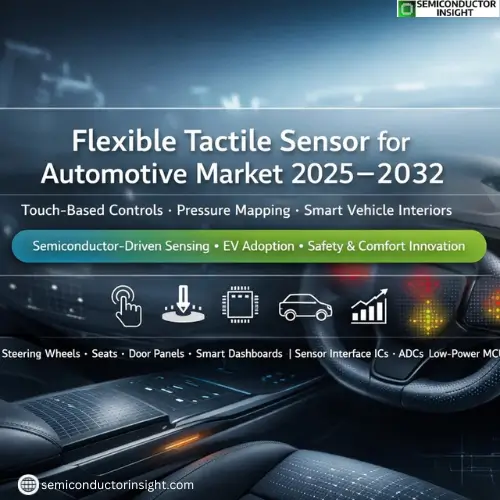
Flexible Tactile Sensors for Automotive Market Growth Fuels with Smart Mobility Electronics
Flexible Tactile Sensor for Automotive Market is gaining strong momentum because modern vehicles are rapidly evolving into intelligent electronic environments, where touch-based interaction and surface-level sensing are becoming essential.
Imagine closing a car door and the vehicle instantly understanding how much pressure was applied. Or a steering wheel that senses grip changes before driver fatigue becomes dangerous. The future of automotive technology is not only about seeing and computing it is about feeling.
This is where flexible tactile sensors are becoming one of the most exciting frontiers in the semiconductor-driven automotive transformation. These sensors, designed to detect touch, pressure, vibration, and force while remaining thin and bendable, are opening new possibilities across vehicle interiors, safety systems, and next-generation mobility platforms.
Understanding Flexible Touch Sensors in Automobiles
Flexible tactile sensors are pressure- or force-detection components built on bendable substrates such as polymers or thin-film materials. Unlike rigid sensors, they can conform to curved or moving surfaces, making them ideal for modern automotive designs.
In automotive applications, these sensors enable vehicles to respond to human contact and physical force in real time. They are increasingly being integrated into:
- Smart dashboards and interior panels
- Seats and occupant detection systems
- Steering wheels and control surfaces
- Door trims and armrests
- Robotic and automated manufacturing environments
From a semiconductor perspective, these sensors combine advanced materials with signal-processing electronics, forming a new category of automotive-grade sensing innovation.
Car Design Evolution Propels Demand for Responsive Surface Tech
Car interiors are undergoing a major shift. Automakers are replacing traditional buttons and mechanical switches with cleaner, touch-responsive surfaces. This design evolution is pushing demand for flexible tactile sensors that can be embedded invisibly while still delivering reliable feedback.
Consumers now expect vehicles to feel more like smart devices responsive, intuitive, and interactive. Flexible tactile sensors support this by enabling:
- Seamless touch control across curved surfaces
- Pressure-sensitive safety alerts
- Personalized comfort adjustments through contact detection
The vehicle cabin is becoming an intelligent sensing zone, and tactile technology is a key enabler of that transition.
Semiconductor Integration: Where Sensing Meets Signal Intelligence
Flexible tactile sensors are not standalone materials they depend heavily on semiconductor support systems. Each sensing layer requires electronics that convert physical pressure into usable digital signals.
Key semiconductor components involved include:
- Sensor interface ICs
- Analog-to-digital converters
- Low-power microcontrollers
- Embedded processing chips for real-time response
- Automotive-grade packaging for durability
This makes the market especially relevant for semiconductor suppliers looking to expand beyond conventional automotive chips into next-generation sensor platforms.
EV Growth and Smart Mobility Expanding Sensor Adoption
Electric vehicles are accelerating tactile sensor adoption for several reasons. EV platforms often feature redesigned interiors, minimalistic dashboards, and more digital interfaces, all of which create new space for touch-based control.
In addition, EV manufacturers focus heavily on comfort, personalization, and safety automation, areas where tactile sensing provides added value.
Flexible tactile sensors are being explored for:
- Battery enclosure pressure monitoring
- Advanced seat occupancy mapping
- Enhanced driver-assist interaction feedback
- Touch-enabled charging and access systems
As EV competition increases, sensor-rich interiors are becoming a differentiator.
Manufacturing and Robotics: A Secondary Growth Engine
Beyond vehicle integration, tactile sensors are increasingly used in automotive manufacturing itself. Modern vehicle production relies on robotics, automation, and precision assembly, where tactile feedback improves quality control.
Flexible tactile sensors help enable:
- Pressure-sensitive robotic gripping
- Automated defect detection in assembly
- Safer human-robot collaboration on factory floors
This dual demand from vehicles and from factories adds depth and resilience to the market outlook.
Feel Free to Reach Our Most Recent Updates of the Report:
https://semiconductorinsight.com/report/flexible-tactile-sensor-for-automotive-market/
Competitive Landscape and Key Industry Strategies
The competitive environment includes sensor innovators, semiconductor companies, and automotive electronics suppliers. Leading players are investing in scalable production and automotive qualification.
Key companies active in flexible tactile sensing development include:
- Infineon Technologies
- STMicroelectronics
- Texas Instruments
- TE Connectivity
- Analog Devices
- Panasonic Industry
- TDK Corporation
- Emerging flexible electronics startups across Asia and Europe
Common strategies shaping the market include:
- Partnerships with automotive OEMs for early integration
- R&D in durable flexible substrates
- Development of sensor arrays for high-resolution touch mapping
- Automotive-grade compliance for harsh operating environments
In this market, reliability and long-term supply capability are just as important as innovation.
Expanded sensor deployment throughout the vehicle body and intelligent surfaces will be the next stage of evolution.
High-potential future applications include:
- Touch-sensitive steering controls with safety feedback
- Full-seat pressure mapping for autonomous vehicle comfort
- Smart door panels with gesture-based tactile response
- Flexible sensor skins for exterior vehicle interaction
As cars evolve into sensory platforms, tactile sensing will become as important as vision-based sensors.
Rather than ending with a standard conclusion, here are a few forward-looking insights shaping this market:
Automotive interiors are becoming semiconductor-powered interactive environments.
Flexible tactile sensors will define the next generation of touch-first vehicle controls.
EV platforms are accelerating adoption through redesign and digital-first experiences.
Manufacturing automation is creating parallel demand beyond the vehicle itself.

Comments (0)