

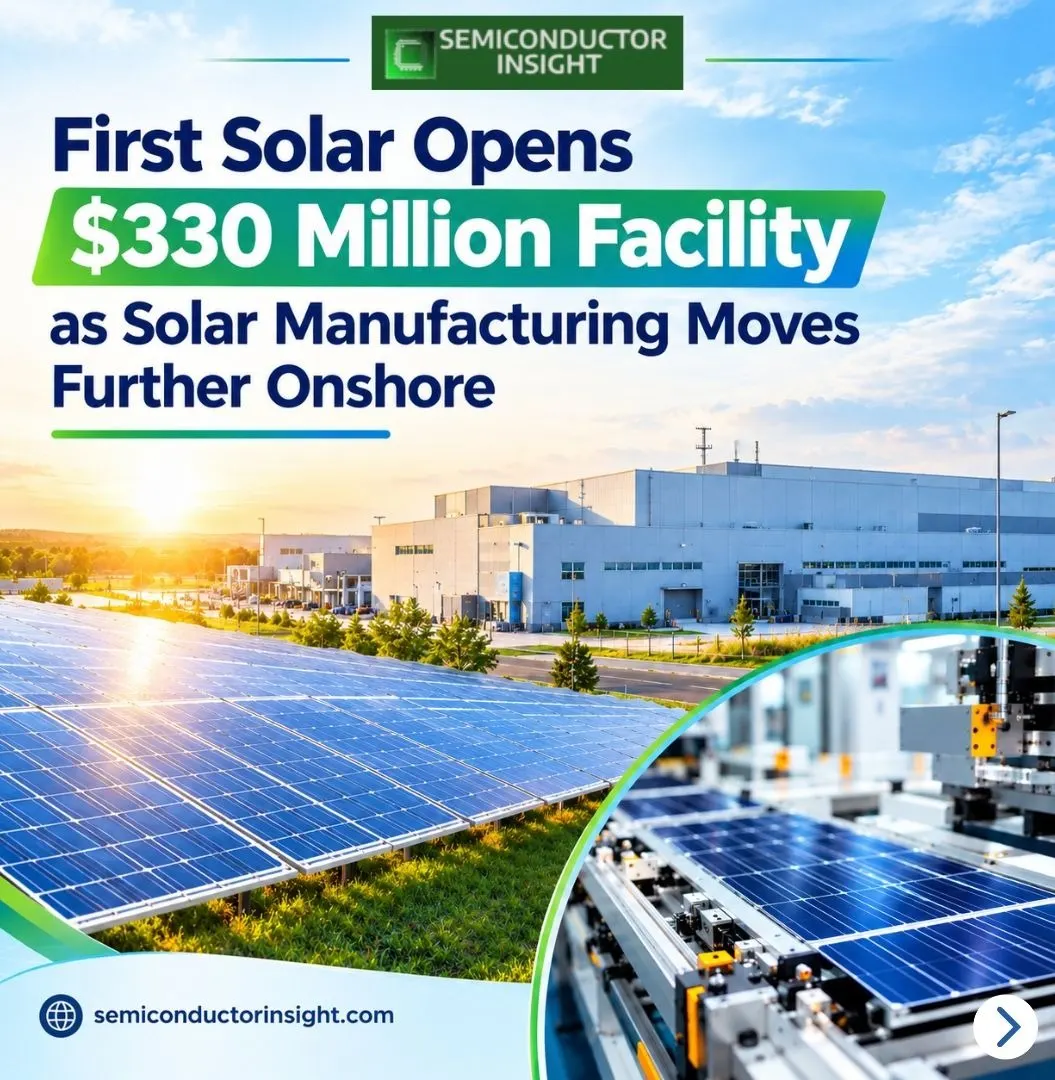
First Solar Opens $330 Million South Carolina Facility, Advancing US Thin-Film Semiconductor Manufacturing
The new facility strengthens domestic solar module production, with a second phase expected to double annual nameplate capacity to 3.4 GW by mid-2027 and introduce the company’s CuRe technology.
First Solar has inaugurated the first phase of its $330 million manufacturing facility in Gaffney, South Carolina, marking another step in the company’s expansion of US solar technology production.
The facility brings final production processes for Series 6 Plus photovoltaic modules to the United States. These processes were previously initiated within First Solar’s international manufacturing network, making the new site an important addition to the company’s vertically integrated production strategy.
The second phase is expected to be completed by mid-2027. Once completed, the facility is forecast to double its annual nameplate capacity to 3.4 GW, introduce First Solar’s CuRe technology, and increase its workforce from approximately 500 employees to nearly 700.
The development comes as governments, energy companies, and manufacturers continue to examine how domestic production capabilities can strengthen supply-chain resilience and support growing electricity requirements.
For the semiconductor sector, the announcement also highlights the importance of compound semiconductor materials in the renewable energy industry, particularly as manufacturers pursue alternatives to conventional crystalline-silicon photovoltaic technologies.
A New Manufacturing Milestone for the US Solar Industry
The Gaffney facility expands First Solar’s existing presence in South Carolina, which also includes a distribution center in Duncan and a longstanding logistics partnership involving Inland Port Greer.
The company operates manufacturing facilities in Alabama, Louisiana, and Ohio, alongside its South Carolina operations, and maintains research and development centers in Ohio and California.
According to Semiconductor Today, First Solar expects its cumulative investment in US manufacturing and R&D infrastructure to exceed $5 billion by the end of 2026. The company also forecasts approximately 17 GW of US module manufacturing capacity by 2027.
These figures illustrate the scale of the company’s domestic manufacturing strategy. However, nameplate capacity represents potential production capability rather than guaranteed output; actual production will depend on operational performance, market conditions, and the pace of facility ramp-up.
The Gaffney expansion is therefore significant not only because it adds manufacturing infrastructure, but also because it brings another stage of the module production process into the company’s US industrial network.
Why CdTe Technology Sets First Solar Apart
First Solar’s manufacturing strategy is built around cadmium telluride (CdTe), a compound semiconductor used in thin-film photovoltaic modules.
Conventional crystalline-silicon modules rely on silicon-based cells, whereas CdTe technology uses a different semiconductor material and manufacturing pathway. This distinction allows First Solar to pursue a differentiated production model rather than simply replicating the supply-chain structure used by conventional silicon-based manufacturers.
The difference matters because solar manufacturing competitiveness increasingly depends on more than module efficiency or factory scale. Material availability, manufacturing integration, process control, product performance, and supply-chain traceability can all influence a manufacturer’s strategic position.
First Solar has emphasized that its modules are manufactured without dependence on Chinese crystalline-silicon supply chains. This is particularly relevant in a global market where governments and companies are reassessing exposure to concentrated supply sources for strategic technologies.
Nevertheless, independence from a particular crystalline-silicon supply chain should not be interpreted as complete independence from international sourcing. Semiconductor materials, equipment, logistics, and other manufacturing inputs remain important considerations across the broader industrial ecosystem.
For the compound semiconductor industry, the development reinforces the commercial relevance of alternative materials in applications extending beyond traditional electronics and optoelectronics into large-scale energy generation.
CuRe Technology and the Next Phase of Capacity Expansion
The planned second phase of the Gaffney facility introduces another important milestone: the expected production of First Solar’s CuRe technology.
The expansion is forecast to bring the facility’s annual nameplate capacity to 3.4 GW by mid-2027, while increasing employment to nearly 700 people.
The successful execution of this phase will be an important indicator of how effectively First Solar can integrate additional technology and production capabilities into its domestic manufacturing network.
Several developments will be worth monitoring:
- Production ramp-up: Whether the facility achieves its planned capacity expansion within the projected timeline.
- Technology integration: How the introduction of CuRe technology progresses as the second phase comes online.
- Manufacturing efficiency: Whether additional production capability translates into consistent operational performance and competitive manufacturing economics.
- Workforce development: How staffing and technical capabilities expand as production requirements increase.
These factors will help determine the facility’s contribution to First Solar’s broader manufacturing objectives.
Supply-Chain Resilience Becomes a Semiconductor Industry Priority
The expansion reflects a wider industrial shift in which supply-chain security has become a strategic consideration alongside manufacturing costs and technological performance.
Solar modules are part of a complex value chain connecting semiconductor materials, specialized manufacturing equipment, glass, metals, electrical components, logistics, and energy project development.
Disruptions or constraints at any stage can affect manufacturing schedules, procurement decisions, and delivery commitments. As a result, manufacturers are increasingly evaluating how much control they have over critical production stages and how effectively they can manage exposure to external supply risks.
First Solar’s domestic expansion offers one example of how companies are responding: increasing local production while maintaining a differentiated technology platform.
However, reshoring manufacturing does not automatically eliminate supply-chain risks. Companies must still manage raw material availability, equipment sourcing, workforce requirements, production costs, and changing policy conditions.
The long-term competitiveness of domestic solar manufacturing will depend on how successfully these elements are managed together.
Economic Impact Extends Beyond the Factory
The Gaffney facility also represents an investment in regional manufacturing employment and industrial activity.
A study commissioned by First Solar and conducted by the University of Louisiana at Lafayette estimated that the company supported nearly 30,000 US jobs and $3 billion in labor income in 2025, while contributing approximately $5.8 billion to US gross domestic product.
The same analysis projects that by 2027, First Solar could support more than 39,000 jobs, generate $4 billion in labor income, and contribute approximately $7.8 billion to US GDP.
These are projections from a company-commissioned study, rather than independently established outcomes for the Gaffney facility alone.
Even with that distinction, the figures illustrate the potential economic reach of large-scale manufacturing investments across suppliers, logistics providers, local businesses, and associated industrial services.
For semiconductor and energy technology manufacturers, this broader economic footprint can be an important consideration when evaluating the strategic value of regional manufacturing networks.
What the Development Means for the Global Photovoltaic Market?
The Gaffney expansion highlights three developments relevant to the global photovoltaic industry.
- First, manufacturing location is becoming a more prominent part of industrial strategy. Production capacity is increasingly evaluated alongside supply-chain exposure, regional policy, customer requirements, and access to critical inputs.
- Second, semiconductor material diversity remains commercially important. CdTe thin-film technology demonstrates that the photovoltaic industry encompasses multiple technological pathways, each with its own manufacturing requirements and competitive considerations.
- Third, capacity expansion must be matched by execution. Announced manufacturing capacity creates potential, but its commercial impact depends on production ramp-up, quality, cost management, and the ability to deliver modules that meet customer requirements.
These considerations extend well beyond the United States. Solar manufacturers in Asia, Europe, and other markets face their own decisions concerning technology investment, supply-chain resilience, manufacturing economics, and access to end markets.
First Solar’s approach provides a useful example of how a differentiated semiconductor platform can shape those decisions.
The next major milestone for the Gaffney facility is the expected completion of its second phase by mid-2027.
The planned expansion will double annual nameplate capacity to 3.4 GW and introduce CuRe technology, while contributing to First Solar’s broader target of approximately 17 GW of US module manufacturing capacity by 2027.
The outcome will help demonstrate how effectively the company can translate capital investment into additional manufacturing capability and operational scale.
For the wider semiconductor industry, the announcement is a reminder that advanced materials are playing an increasingly important role in the transition to new energy infrastructure. Competitive positioning will depend not only on the semiconductor material itself, but also on the manufacturing processes, supply-chain relationships, and operational capabilities built around it.
The larger story is clear: the future of solar manufacturing will be shaped by the interaction of materials innovation, industrial scale, and supply-chain strategy. First Solar’s South Carolina expansion brings all three into focus, making its next production milestone one to watch as the global photovoltaic industry continues to evolve.
Dive into Our Most Recent Industry Analysis: https://semiconductorinsight.com/report/semiconductor-manufacturing-market/

Comments (0)