
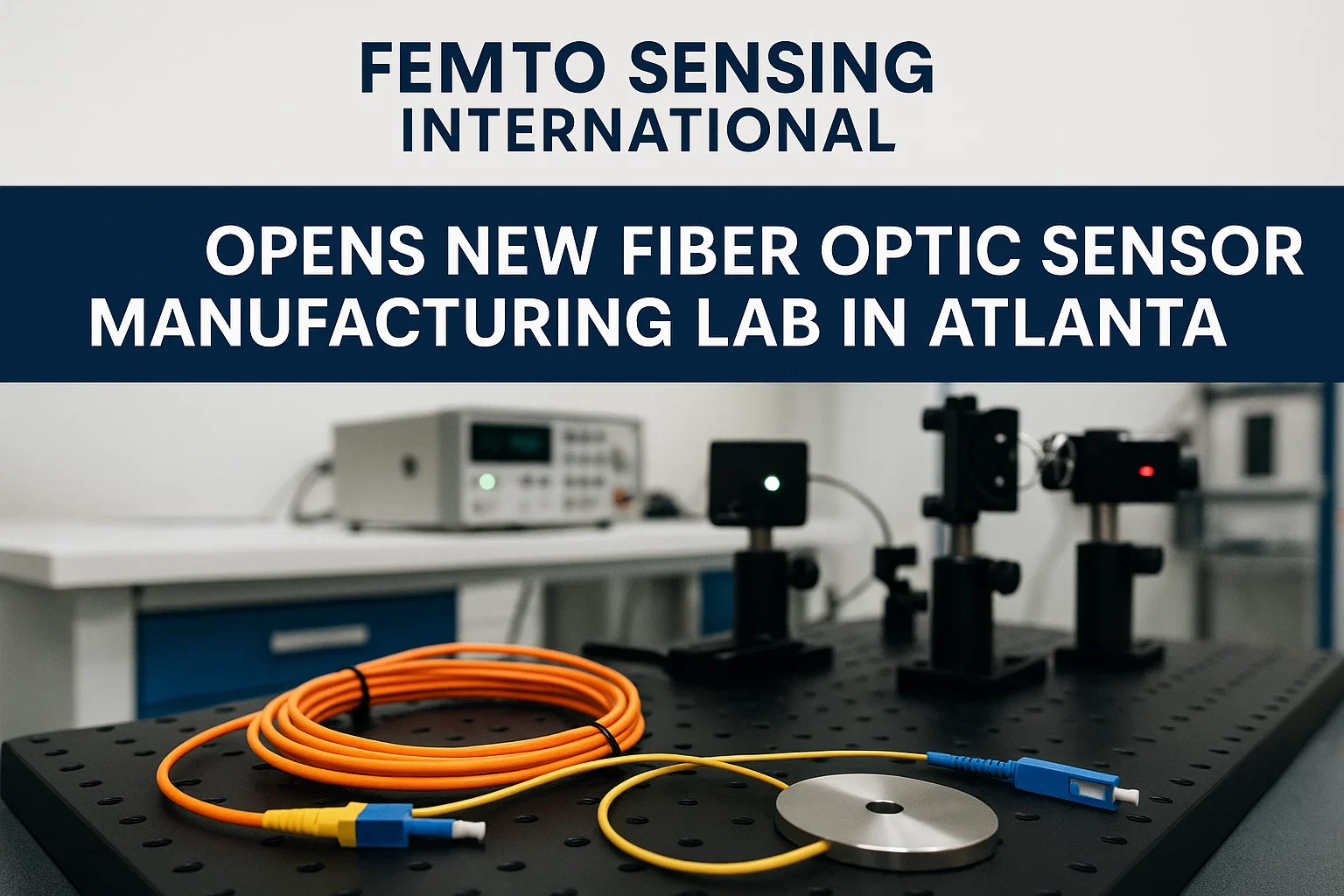
Femto Sensing International Opens New Fiber Optic Sensor Manufacturing Lab in Atlanta
Fiber optic technologies have reshaped the way we sense, communicate, and monitor physical environments. Among these, fiber grating sensors, particularly Fiber Bragg Grating (FBG) sensors, stand out for their exceptional ability to measure strain, temperature, vibration, and pressure with high sensitivity and immunity to electromagnetic interference. Over the past decade, these sensors have shifted from niche laboratory use to becoming critical tools in aerospace, civil engineering, energy, medical, and defense applications.
According to industry estimates, the global fiber grating sensor market was valued at US$ 837 million in 2024. Fueled by advances in manufacturing, new applications, and strong adoption in industrial monitoring, the market is expected to grow significantly, reaching US$ 1.47 billion by 2032, at a CAGR of 7.3% during 2025–2032.
Access Your Free Sample Report- Fiber Grating Sensor Market
Understanding Fiber Grating Sensors
What are Fiber Grating Sensors?
Fiber grating sensors operate on the principle of light reflection and wavelength shifts within optical fibers. A fiber Bragg grating (FBG) is created by inscribing a periodic variation of the refractive index in the fiber core. When light travels through the fiber, certain wavelengths are reflected depending on strain or temperature changes. This property enables precise sensing across distributed networks.
Key Advantages of FBG Sensors
- Immunity to electromagnetic interference (EMI) – ideal for power grids and defense applications.
- Miniaturization and flexibility – enabling embedding into composite materials, textiles, and microstructures.
- Multiplexing capability – multiple sensors along a single fiber allow distributed sensing.
- Durability in harsh environments – withstands high temperatures, radiation, and corrosive conditions.
Market Growth Drivers
The steady CAGR of 7.3% (2025–2032) is supported by several converging factors:
- Smart Infrastructure & Structural Health Monitoring (SHM): Governments and industries are investing heavily in real-time monitoring of bridges, tunnels, pipelines, and railways.
- Energy Sector Expansion: Wind turbines, power grids, and oil & gas rigs increasingly rely on FBG sensors for efficiency and safety.
- Aerospace & Defense Applications: Lightweight, EMI-resistant sensors are used for aircraft wing monitoring, submarine pressure sensing, and missile guidance systems.
- Medical Innovations: Fiber grating sensors are entering surgical instruments, biomedical implants, and wearable devices.
- Telecom & Data Centers: With demand for faster networks, FBG sensors are used in optical component monitoring.
Recent Developments in the Fiber Grating Sensor Industry
1. Femto Sensing International Expands Manufacturing in the U.S.
In a major step, Femto Sensing International opened a new manufacturing laboratory in Atlanta, enhancing its capacity to produce advanced fiber optic sensing instruments. This expansion signals growing commercial demand and a push toward localized manufacturing to ensure supply chain resilience.
Implication: Greater production capacity will reduce lead times for industrial users and allow large-scale deployment in energy and infrastructure sectors.
2. Luna Innovations Introduces New FBG Products
Luna Innovations recently launched os1100 and os1200 series pre-packaged FBG sensor arrays designed for scalable strain and temperature monitoring.
- os1100: Single FBG in a 2-meter fiber.
- os1200: Five FBGs spaced along a 6-meter fiber.
Why important? These customizable arrays enable multi-point sensing on a single line, drastically cutting costs for industries that need distributed monitoring like wind farms, aerospace, and rail.
3. PHOSFOS Project: Photonic Skins for Advanced Sensing
The EU’s PHOSFOS (Photonic Skins For Optical Sensing) project is pioneering flexible “skins” embedded with FBGs. These stretchable foils can be applied directly onto structures or even human skin to monitor deformation, pressure, or strain in real-time.
Potential Applications:
- Aircraft wing deformation monitoring.
- Civil engineering: dynamic load sensing on bridges.
- Wearables and robotics: next-gen smart prosthetics and exoskeletons.
4. Femtosecond Laser Inscription Technology
Recent advances in femtosecond laser inscription are transforming how FBGs are fabricated. This technique allows:
- Writing multiple gratings directly into the fiber core.
- Creating micro-slots and holes for enhanced environmental sensing.
Although not yet widely commercialized, this innovation promises multi-functional sensors with higher resolution and customizable spectral responses, potentially opening new doors in biomedical diagnostics and aerospace.
Download Sample Report PDF- Fiber Grating Sensor Market
5. Optomechanical FBG Sensor Network for Magnetic Fields
A breakthrough research paper introduced an optomechanical FBG-based sensor network capable of ultra-sensitive magnetic field detection. Results showed:
- DC field sensitivity: 8.73 pm/Gs.
- AC field detection: 537 fT/Hz¹ᐟ² in ambient environments.
This novel approach positions FBGs as candidates for magnetometry, with possible applications in geophysics, defense, and navigation systems.
Academic Review: Challenges and Future Directions
A 2025 scientific review emphasized both the strengths and challenges of FBG sensors:
Strengths: High sensitivity, immunity to EMI, multi-point sensing.
Challenges:
- Cross-sensitivity between temperature and strain.
- High cost of interrogation units.
- Need for robust packaging in harsh environments.
Emerging Directions:
- FBGs in biochemical sensing (pH, glucose).
- Integration in smart textiles for healthcare monitoring.
- Quantum sensing applications under exploration.
Emerging Applications of Fiber Grating Sensors
Smart Infrastructure and Urban Safety
FBG sensors are being embedded into bridges, dams, and skyscrapers for structural health monitoring (SHM). With increasing concerns about aging infrastructure worldwide, real-time monitoring prevents catastrophic failures.
Renewable Energy & Power Systems
In wind turbines, FBGs monitor blade strain, torque, and vibration, ensuring predictive maintenance. In the power grid, FBGs track line sag and conductor temperature, improving resilience and efficiency.
Aerospace & Defense
NASA and the U.S. Air Force have tested FBGs in spacecraft, jet engines, and UAVs. Lightweight and EMI-proof, they outperform conventional sensors in hostile aerospace environments.
Medical & Healthcare
Applications include:
- Smart surgical tools for force feedback.
- Respiratory monitoring in wearable patches.
- Implants that measure strain in bones and joints.
Oil & Gas Exploration
Downhole environments demand rugged sensors FBGs withstand extreme heat and pressure, monitoring drilling stress and pipeline integrity.
Smart Textiles & Robotics
Research into wearable textiles with integrated FBGs opens new frontiers in sports analytics, rehabilitation monitoring, and human–robot interaction.
Regional Insights
- North America: Leading in aerospace and defense adoption. Expansion by Femto Sensing and Luna Innovations strengthens domestic supply.
- Europe: Strong R&D focus through projects like PHOSFOS; emphasis on structural monitoring and renewable energy.
- Asia-Pacific: Fastest growth driven by China, Japan, and India investing in smart cities and energy projects.
- Middle East & Africa: Oil & gas exploration fueling demand for rugged FBG sensors.
Key Challenges Facing the Industry
Despite growth potential, the industry faces hurdles:
- High initial costs compared to traditional sensors.
- Complex installation and calibration
- Standardization gaps in global deployment.
- Competition from wireless MEMS sensors, which are cheaper but less robust.
Click Here To Download Full Sample Report- Fiber Grating Sensor Market
Future Outlook (2025–2032)
The fiber grating sensor industry is positioned for robust expansion. With a 7.3% CAGR, the market will approach US$ 1.47 billion by 2032. Key trends shaping the future:
- Miniaturization & Integration: Embedding FBGs into microchips, wearables, and even biomedical implants.
- Multiplexing Advancements: More sensors per fiber, enabling cost-effective distributed networks.
- AI & IoT Convergence: Data from FBGs will integrate into AI-driven predictive maintenance systems.
- Quantum & Smart Materials: Early-stage research on integrating FBGs with quantum sensing and photonic crystals.
- Sustainability: Eco-friendly monitoring of renewable energy systems and smart cities.
The fiber grating sensor industry is undergoing a period of exciting transformation. Recent developments from Femto Sensing’s new U.S. manufacturing facility and Luna Innovations’ sensor arrays, to the PHOSFOS project’s photonic skins and optomechanical breakthroughs in magnetic sensing are reshaping the technological landscape.
While challenges like high interrogation costs and packaging complexity persist, the industry’s trajectory remains strong, propelled by demand from infrastructure monitoring, aerospace, defense, energy, and healthcare.
With market size projected to climb from US$ 837 million in 2024 to US$ 1.47 billion by 2032, the coming decade will see fiber grating sensors cement their role as critical enablers of safe, sustainable, and intelligent systems worldwide.

Comments (0)