
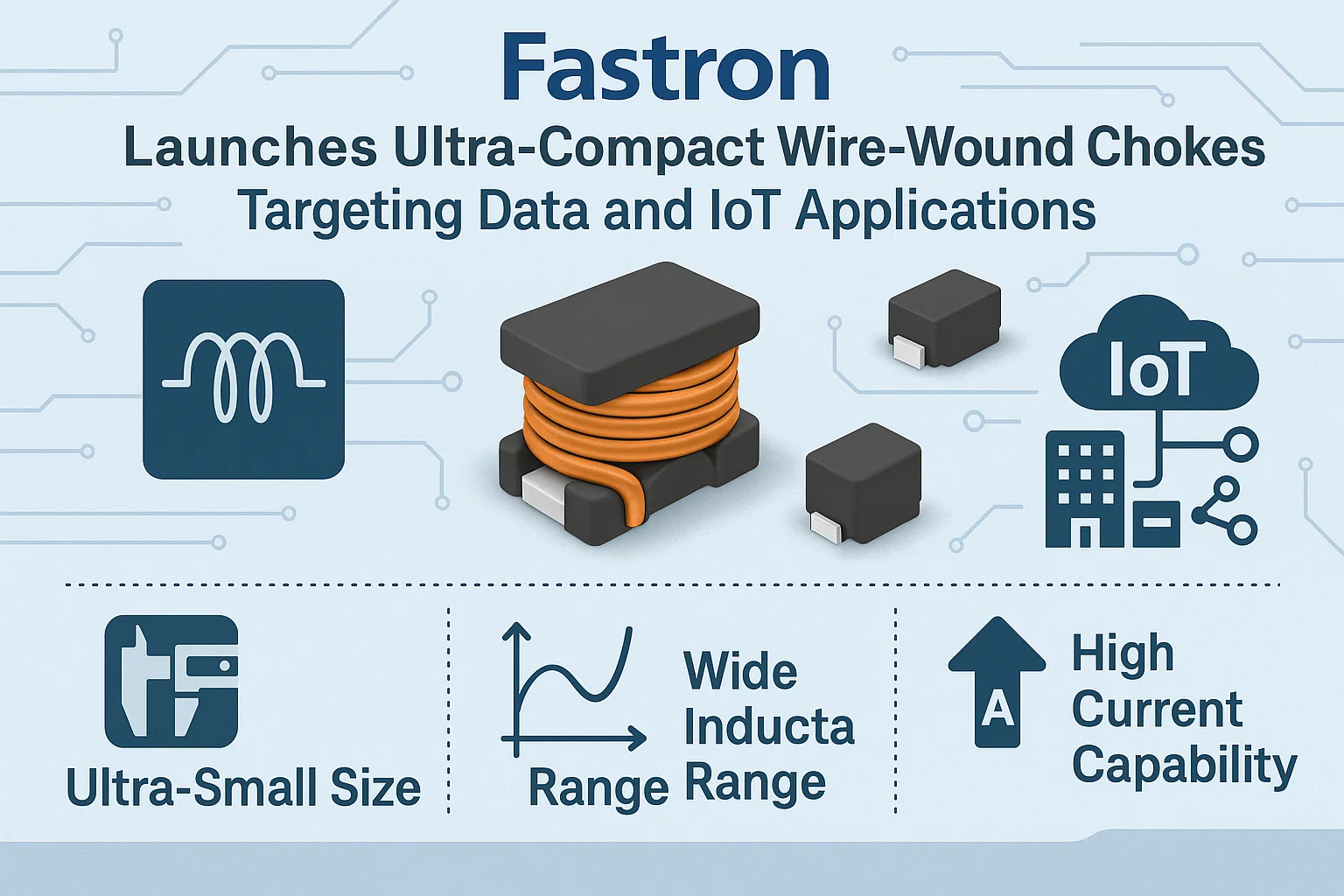
Fastron Launches Ultra-Compact Wire-Wound Chokes Targeting Data and IoT Applications
In the rapidly evolving world of electronics, RF (radio frequency) inductor chokes are emerging as one of the most critical components enabling signal clarity, noise reduction, and system stability across high-frequency domains. From smartphones to electric vehicles and next-gen communication infrastructure, RF chokes are no longer passive background players—they’re taking center stage in innovation.
In this in-depth analysis, we explore the recent developments within the RF Inductor Choke industry, drawing insights from top news sources, component manufacturers, and engineering publications. We’ll also examine the market’s trajectory, with the sector growing from a valuation of US$ 789 million in 2024 to a projected US$ 1.26 billion by 2032, at a compound annual growth rate (CAGR) of 6.9%.
Access Your Free Sample Report- RF Inductor Choke Market
Understanding RF Inductor Chokes: The Basics
Before diving into the industry updates, it’s essential to understand the role of RF inductor chokes. These components are designed to block high-frequency AC signals while allowing DC or low-frequency signals to pass. In RF circuits, they help reduce electromagnetic interference (EMI), improve signal integrity, and enhance the performance of power and communication lines.
RF chokes are widely used in:
- Wireless communication devices
- Automotive infotainment systems
- Base stations and routers
- Industrial sensors and control systems
- EV powertrains and converters
As the demand for faster data transmission and noise-free signals increases, so does the need for high-performance RF chokes with better thermal management, higher Q-factors, and miniaturized form factors.
RF Inductor Choke Market Overview: Strong Growth Ahead
The RF inductor choke market stood at US$ 789 million in 2024 and is projected to reach US$ 1.26 billion by 2032, with a 6.9% CAGR during the 2025–2032 forecast period.
Key Market Drivers:
- 5G rollout: High-frequency signal systems require precision RF filtering components to ensure smooth data communication.
- IoT and Edge Computing: More connected devices mean more EMI challenges, thus increasing demand for chokes.
- Electric Vehicles (EVs): Power converters in EVs heavily rely on chokes to minimize noise and ensure clean signals.
- Miniaturization trends: Space-constrained designs (wearables, smartphones) drive demand for compact yet powerful chokes.
Recent Developments: Technology and Product Innovations
- Fastron’s Compact Wire-Wound Chokes Set a New Benchmark
Fastron, a global leader in magnetic components, recently introduced the 1616FP wire-wound surface mount choke. Measuring just 4.2 x 4.2 x 1.88 mm, this ultra-compact inductor targets space-sensitive RF applications such as mobile devices and high-speed data links.
- Inductance range: 1 µH to 100 µH
- Saturation current: Up to 3.85 A
- Key Applications: Smart devices, routers, microcontrollers
In addition, Fastron’s 1812CMF/E series is aimed at Ethernet and automotive communications, offering excellent common-mode noise suppression in compact form. This series supports high-speed digital networks, ideal for autonomous driving technologies and ADAS systems.
Another standout from Fastron is the 1210CMF, designed for automated assembly lines, making it a favorite among high-volume OEMs focused on cost and speed.
- Murata’s Automotive-Grade High-Q RF Inductors
In early 2025, Murata Manufacturing Co., Ltd. announced its LQP02HQ_Z2 Series, a new family of high-Q RF inductors tailored for automotive communication systems.
Key Features:
- High Q-value: Enhances signal purity at GHz frequencies
- AEC-Q200 qualified: Ensures suitability for in-vehicle systems
- Compact size: 0402 (1.0mm × 0.5mm) package
These inductors offer precise performance in vehicle-to-everything (V2X) communication, infotainment modules, and radar systems, supporting the global movement toward connected mobility.
Emerging Trends Shaping the RF Choke Market
- Miniaturization Meets Performance
The push for smaller, thinner, lighter devices has led to a surge in demand for compact RF chokes. Modern devices need to balance size, inductance value, and thermal stability—a difficult trifecta that companies like Murata and Fastron are now addressing with innovation in ceramic cores, high-frequency windings, and automated packaging.
- Automotive-Grade Chokes on the Rise
As vehicles become more software-defined and interconnected, noise suppression and power integrity become critical. RF chokes help:
- Filter out switching noise in power converters
- Maintain signal quality in telematics and infotainment systems
- Enable radar and LiDAR systems to function without electromagnetic disturbances
The move toward electric drivetrains and autonomous driving is pushing suppliers to create high-Q, vibration-resistant, and temperature-tolerant inductors for automotive use.
- Material Advancements: Ferrite and Beyond
Ferrite cores remain popular, but newer materials are being introduced to improve frequency range and energy efficiency. Recent research indicates that nanocrystalline and amorphous alloys may outperform conventional ferrites in high-frequency applications. These materials enable better magnetic permeability, reduced core loss, and higher saturation limits—ideal for tomorrow’s power-hungry devices.
- RF Chokes in EV Converters
In-depth analysis from engineering publications like EVearly and TechTime shows that EMI suppression in DC-DC converters is a major application area for RF chokes. These components help meet increasingly strict EMC compliance requirements in electric cars and hybrid systems.
Download Sample Report PDF- RF Inductor Choke Market
Global Landscape and Competitive Analysis
Regional Insights:
- Asia-Pacific dominates the RF inductor choke market, led by manufacturing hubs in China, Japan, South Korea, and Taiwan. These countries house most of the world’s PCB assemblers and chipmakers.
- North America remains an innovation and R&D center, especially in the aerospace and automotive sectors.
- Europe shows steady growth, primarily from EV adoption, industrial automation, and green energy projects.
Major Players in the Industry:
| Company | Recent Highlights |
| Murata | Automotive-grade inductors with high-Q design |
| Fastron | Compact chokes for Ethernet and SMD lines |
| TDK | High-frequency multilayer inductors for telecom |
| Coilcraft | RF and power inductors for IoT and wearables |
| Bourns | EMC chokes and ruggedized designs for harsh environments |
| Vishay | High-current and temperature-stable chokes |
Smaller, regional manufacturers like Getwell, Zonkas, and Coilmaster are also gaining ground, particularly in customized or niche RF solutions.
Application Spotlight: Where RF Chokes are Powering Progress
- 5G Base Stations and Small Cells
5G infrastructure operates at much higher frequencies than LTE, making interference suppression critical. RF chokes help filter and manage these high-speed signals, enabling smoother communication in densely populated areas.
- Consumer Electronics and IoT
Smartphones, tablets, fitness trackers, and wearables rely on ultra-miniature inductors to manage power and signal integrity in tight layouts. High-frequency chokes help ensure reliable performance in multi-band RF transceivers and Wi-Fi/Bluetooth modules.
- Industrial Automation
With Industry 4.0 gaining steam, factories are adopting more wireless and sensor-driven systems. RF chokes are used in robot controllers, PLCs, and telemetry systems to maintain noise-free operations.
- Electric Vehicles (EVs)
From on-board chargers to battery management systems, EVs are dense with circuits needing precise filtering. RF chokes reduce harmonic distortion, smooth out switching operations, and help meet regulatory compliance.
Design Considerations and Buyer Trends
When selecting an RF inductor choke, engineers weigh factors like:
- Inductance value and tolerance
- Q-factor (quality factor)
- Self-resonant frequency (SRF)
- DC resistance (DCR)
- Saturation current and thermal stability
More recently, buyers are also looking for:
- AEC-Q200 certification
- RoHS/REACH compliance
- Tape-and-reel packaging for automation
- Support for pick-and-place systems
With design cycles getting shorter, manufacturers offering technical support, simulation models, and fast prototyping gain an edge.
Future Outlook: What’s Next for RF Chokes?
As digital systems grow more complex, the demand for precision signal control will rise exponentially. Here’s what lies ahead for RF choke manufacturers and users:
Short-Term Opportunities (2025–2027)
- Ramp-up in 5G and 6G development
- Expanded automotive-grade product lines
- Miniaturized inductors for AR/VR and next-gen smartphones
Mid-Term Opportunities (2028–2030)
- Adoption of nano-crystalline materials
- Full integration into EV propulsion and safety systems
- Growth in smart city infrastructure, increasing demand for EMI solutions
Long-Term Vision (2031–2032)
- RF chokes embedded in SoC and SiP modules
- Wider use in quantum computing circuits
- Eco-friendly, recyclable magnetic core designs
Click Here To Download Full Sample Report- RF Inductor Choke Market
The Silent Workhorse of Modern Electronics
The RF inductor choke may be a small, often invisible component, but its role in ensuring device performance and reliability is massive. As we transition into an era of ubiquitous connectivity, electric mobility, and high-speed communication, RF chokes will continue to evolve—growing smarter, smaller, and more powerful.
With innovations from companies like Murata and Fastron leading the charge, and the market on track to surpass US$ 1.26 billion by 2032, this humble component is stepping into the limelight. For engineers, OEMs, and investors, staying on top of developments in this space is not just smart—it’s essential.

Comments (0)