
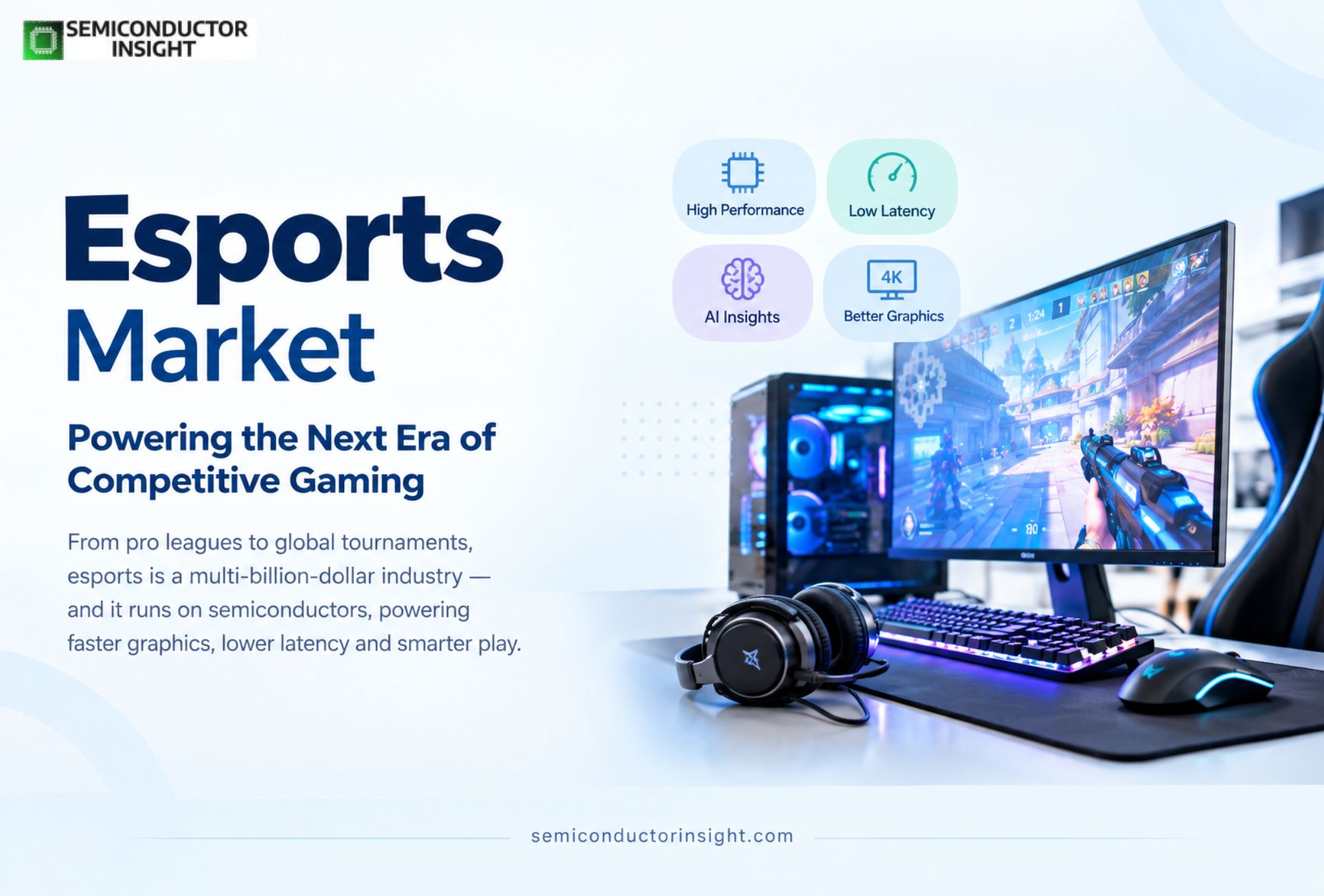
Esports Market in 2026: How Semiconductor Innovation Is Quietly Powering the Next Era of Competitive Gaming
The esports industry in 2026 is no longer a novelty. It is a multi-billion-dollar ecosystem with professional leagues, collegiate programs, global tournaments, and a hardware supply chain that rivals the consumer electronics industry in both scale and technical ambition. But behind the headline prize pools and franchise valuations sits something less visible and arguably more consequential: a semiconductor arms race. Every frame rendered, every input registered, every AI-driven coaching insight delivered to a player’s headset depends on silicon. And in 2026, that silicon is evolving faster than at any point in esports history.
The Hardware Reset: Native 1,000Hz and the Death of Refresh Rate Compromise
For years, monitor refresh rates were a game of diminishing returns. 144Hz gave way to 240Hz, then 360Hz, then 500Hz. Each step delivered a marginal improvement in motion clarity, but the jump from 500Hz to 1,000Hz was considered impractical. Panels could not sustain it natively without sacrificing resolution or color accuracy. In 2026, that barrier has fallen.
At ChinaJoy 2026 in Shanghai, TCL CSOT and LG Electronics unveiled the world’s first monitor with a native 1,000Hz refresh rate at full 1080p resolution. The LG UltraGear AI 24.5″ uses TCL CSOT’s custom ultra-fast liquid crystal materials and a proprietary black frame insertion algorithm to achieve the speed without the usual trade-offs in image quality. This is not a dual-mode monitor that drops to 720p to hit 1,000Hz. It delivers full-resolution frames at a rate that reduces the interval between display updates to roughly one millisecond.
The significance for competitive esports cannot be overstated. In first-person shooters, where reaction time is measured in milliseconds, a 1,000Hz native display gives players a measurable edge in tracking fast-moving targets. HKC has demonstrated a triple-mode monitor reaching up to 1,300Hz, and Acer’s Predator line has joined the 1,000Hz club with native FHD support. The industry is no longer debating whether extreme refresh rates matter. It is debating who can deliver them at scale and at what cost.
CPUs Built for the Frame-Rate Fight
The monitor is only as good as the frames it receives. In 2026, both Intel and AMD have released processors specifically tuned for esports workloads. Intel’s Core Ultra 200S Plus series, launched in March, brings up to 15% faster gaming performance compared to the previous generation, along with a new Binary Optimization Tool that improves native performance in games even when the workload was optimized for a different architecture. The flagship Core Ultra 7 270K Plus now carries 24 cores and supports DDR5 7200 MT/s memory, a specification that reduces system latency and improves frame consistency in CPU-bound esports titles.
AMD’s response arrived earlier in the year with the Ryzen 7 9850X3D, a gaming-focused CPU with a massive 104MB of L2 and L3 cache. Independent testing showed it delivering 27% faster 1080p gaming performance than Intel’s previous flagship, with a 120W TDP that keeps it viable for compact esports builds. The X3D architecture, which stacks cache vertically to reduce memory latency, has become the benchmark for competitive gaming performance. For esports players whose frame rates depend on how quickly the CPU can feed the GPU, cache size has become as important as clock speed.
NVIDIA’s RTX Spark: A Superchip for the Esports Generation
Perhaps the most strategically significant hardware announcement of 2026 came from NVIDIA. At Computex in May, the company introduced RTX Spark, an Arm-based superchip that integrates a Grace CPU with a Blackwell-based RTX GPU, delivering up to one petaflop of AI performance in a single system-on-chip. The chip is designed for slim laptops and compact desktops, and it supports the full RTX ecosystem, including DLSS 4.5 and ray tracing.
NVIDIA chose South Korea as the launch venue for a reason. The country’s esports dominance and thriving PC bang culture made it the ideal proving ground. CEO Jensen Huang visited T1’s base camp in Seoul, where the reigning League of Legends world champions demonstrated RTX Spark-powered gameplay in League of Legends and VALORANT. The event, held in collaboration with Riot Games, underscored NVIDIA’s intent to embed itself not just in the hardware layer but in the competitive esports ecosystem itself.
RTX Spark represents a strategic pivot. NVIDIA is no longer content to supply discrete GPUs. It is building the complete silicon platform for gaming and AI workloads, and it is doing so with a focus on Windows compatibility and esports performance. For esports players, the promise is high-end RTX features in portable, efficient machines. For the semiconductor industry, the message is that the boundaries between gaming, AI, and general-purpose computing are dissolving.
AI Is Rewiring Coaching and Performance Analysis
The most profound change in esports in 2026 is not happening on the screen. It is happening in the coaching room. AI-powered analytics platforms are now processing hundreds of thousands of matches to extract insights that human coaches cannot see. Omnic.AI, which became the official performance intelligence partner of the National Association of Collegiate Esports in 2026, has processed over 130,000 matches across Valorant, Rocket League, and League of Legends. Its platform develops a unique “fingerprint” for each player—a profile of playstyle, habits, and tendencies that becomes more accurate with every match.
SAP and Team Liquid took a different approach. In June 2026, they announced an AI-based voice intelligence application that analyzes raw voice chat data, converting unstructured communication into actionable insights for coaches. The system links in-game situations and outcomes to communication patterns, emotional states, and decision-making processes, giving coaches a window into team dynamics that was previously invisible.
This is not a niche experiment. Collegiate esports programs, which have historically struggled with coaching shortages, are adopting AI analytics as a force multiplier. The tools are becoming standard infrastructure, and the teams that master them are gaining a measurable competitive advantage.
Regional Growth: Asia Pacific Leads, Mobile Esports Expands
The esports market remains dominated by Asia Pacific, which accounted for over 43% of global market share in 2025 and is projected to grow at a compound annual rate of 21.9% through 2034. China alone has 350 million esports fans, and Shanghai hosts the largest concentration of esports clubs and offline events in the country. South Korea, with its PC bang culture and world-champion teams, remains the spiritual home of competitive gaming.
But the growth story of 2026 is mobile esports, and its expansion is global. Mobile Legends: Bang Bang (MLBB) transitioned to a five-region structure in 2026, covering Southeast Asia, Eastern Europe and Central Asia, Europe/Middle East/Africa, East Asia, and the Americas. This is a deliberate strategy to push mobile esports beyond its Southeast Asian stronghold into markets like Brazil, Türkiye, and Eastern Europe, where younger users have grown up gaming on phones rather than consoles or PCs. At the Esports World Cup 2026, MLBB drew 2.89 million peak viewers, the highest of any discipline, demonstrating that mobile esports can compete with PC-based titles for audience attention.
The Esports World Cup 2026: A Record-Breaking Proving Ground
The Esports World Cup, held in Paris for the first time outside Saudi Arabia, set new benchmarks for the industry. The tournament featured a record $75 million prize pool across 24 games, with the Club Championship alone accounting for $30 million and the winning club taking home $7 million. More than 2,000 players from 200 clubs across 100 countries competed over seven weeks.
The viewership numbers were equally striking. The event attracted 850 million viewers and 440 million hours of watch time, representing year-over-year growth of 13% and 26% respectively. In-person attendance reached 175,000 tickets sold, a 94% increase over 2025. Counter-Strike 2, in particular, saw a 93.7% increase in total watch hours compared to the previous year, with peak viewership exceeding one million.
These numbers matter for the semiconductor industry because they represent demand signals. Larger audiences, longer tournaments, and higher production values require more computing power for broadcast, more powerful hardware for players, and more sophisticated analytics for teams. The esports ecosystem’s growth is a direct driver of semiconductor demand.
Storage, Memory, and the Infrastructure of Competition
Kioxia’s partnership with Team Vitality, announced in July 2026, highlights a growing trend: storage and memory suppliers are becoming official partners of esports organizations. Kioxia supplies Team Vitality’s League of Legends and Rocket League teams with EXCERIA PRO G2 SSDs, ensuring fast load times and consistent performance during competition. The company also signed on as a Tier 4 Official Supplier for the 20th Asian Games and 5th Asian Para Games, where esports will be a medal event. Kioxia will supply its fastest personal SSD for the esports competition PCs.
This level of integration between semiconductor suppliers and esports teams is new. It reflects a recognition that esports is a demanding, high-visibility proving ground for storage performance, thermal management, and reliability under sustained load.
What Comes Next
The esports industry in 2026 is at an inflection point. The hardware is no longer the bottleneck. Native 1,000Hz displays, cache-heavy gaming CPUs, and AI-accelerated system-on-chips have removed the technical barriers to performance. The competition is shifting to software, analytics, and ecosystem integration. AI coaching tools are becoming standard. Mobile esports is globalizing. The semiconductor industry is embedding itself deeper into every layer of the competitive stack.
For the technology companies that serve this market, the opportunity is clear. Esports is not just a consumer of chips. It is a proving ground for the next generation of gaming and AI silicon. The players competing in Paris, Seoul, and Shanghai are not just athletes. They are the most demanding beta testers a semiconductor company could ask for. And in 2026, the industry is finally giving them the hardware they deserve.
Explore related report: https://semiconductorinsight.com/report/global-gaming-computers-and-peripherals-market/

Comments (0)