
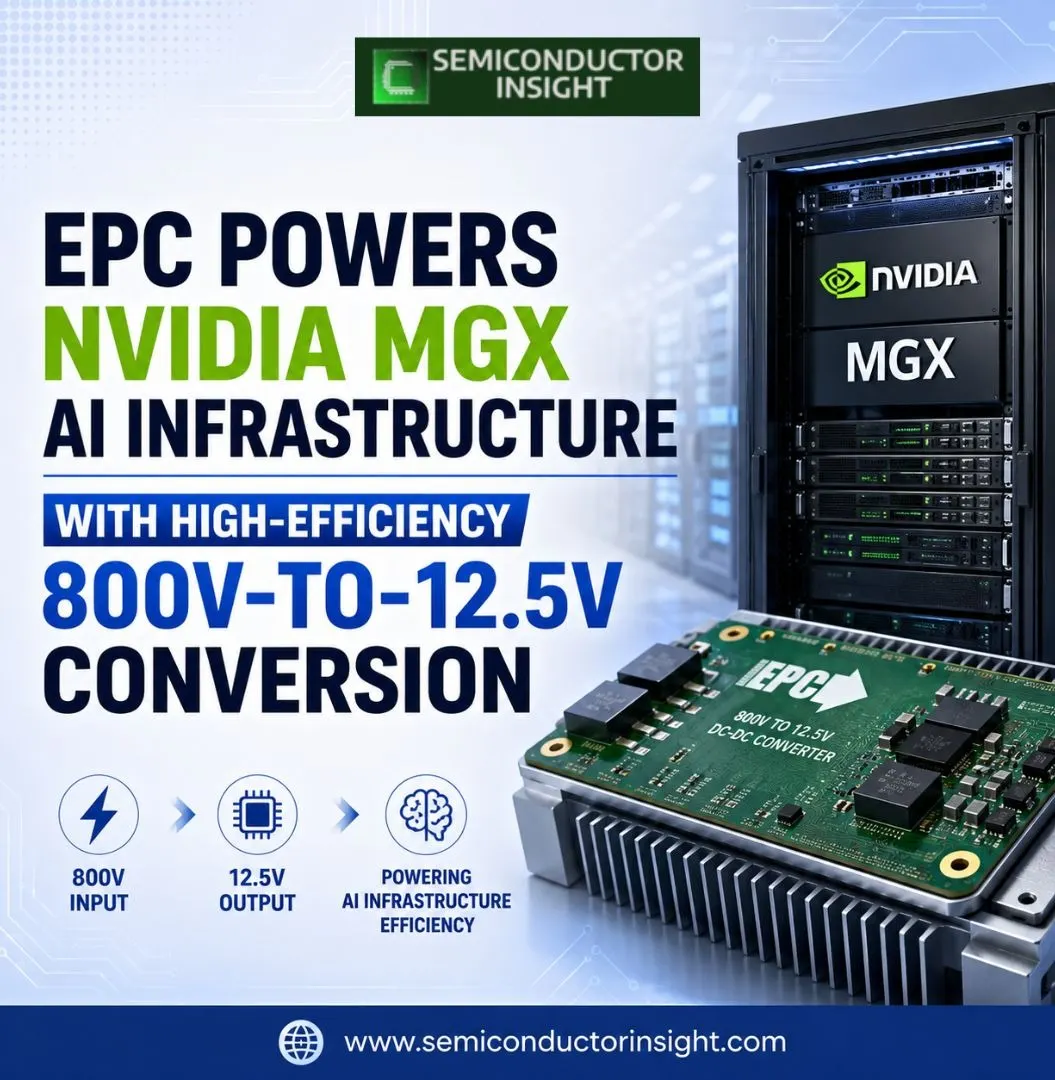
EPC Supports NVIDIA MGX AI Infrastructure with 800V-to-12.5V Power Conversion
Efficient Power Conversion Corp. (EPC), based in El Segundo, California, is advancing its role in the AI infrastructure ecosystem with new details on its EPC91123 evaluation board, an 800VDC-to-12.5VDC, 6kW isolated converter designed for next-generation data center power architectures. The solution is being positioned to support NVIDIA MGX-based AI infrastructure, where power density, efficiency, and scalability are becoming just as important as compute performance itself.
As AI workloads continue to grow in scale and complexity, the power requirements behind those systems are rising just as fast. That shift is pushing data center operators and hardware developers to rethink how electricity is distributed inside the rack. EPC’s latest solution is aimed at that challenge, offering a high-efficiency power conversion path that supports emerging 800VDC server architectures while reducing the need for multiple intermediate steps.
- One of the key features of the EPC91123 board is its ability to convert directly to 5VDC, eliminating the need for a 48V intermediate stage. According to EPC, this approach improves overall system efficiency by 1-2%, which may sound incremental but becomes highly significant at the scale of AI data centers consuming massive amounts of power. In infrastructure environments where every percentage point matters, even small gains can translate into meaningful operational and energy savings.
- The board is built on an input-series, output-parallel (ISOP) LLC topologyand uses EPC’s latest Gen7 eGaN power FETs. These include the EPC2366 and EPC2305 devices, both designed to support high-performance power conversion in compact designs. The result is a converter that achieves 2% peak efficiency and 97% full-load efficiency, while fitting into a highly compact 104 mm x 47 mm x 8 mm form factor.
- That compact design is particularly relevant for modern AI server environments, where space is limited and power density demands are high. As server racks become more crowded with accelerators, memory, networking hardware, and thermal management components, solutions that can deliver high performance in a smaller footprint are increasingly valuable. EPC’s approach is meant to help address that challenge without compromising efficiency or system flexibility.
The company’s strategy goes beyond a single evaluation board. EPC is building a broader portfolio of 800VDC AI power delivery solutions that span 800VDC to 48VDC, 12VDC, and 6VDC configurations. That layered approach reflects the reality that AI infrastructure requires different power architectures depending on the system level, and no single conversion stage will fit every use case. By developing a range of solutions, EPC is trying to position itself across multiple parts of the emerging AI power stack.
According to EPC’s DC-DC System Engineering leadership, the move toward 800V architectures is especially important because AI data centers consume enormous amounts of power and need to reduce conversion stages to improve efficiency and power density. The ISOP topology, in particular, is well suited for high step-down-ratio conversion, helping optimize transformer design and enabling interleaved operation. EPC says the same topology has also been selected for its next 800VDC-to-6VDC platform, indicating continued development across the low-voltage AI power chain.
EPC’s CEO and co-founder also emphasized the company’s alignment with NVIDIA MGX, describing the modular platform as an important foundation for scalable accelerated computing. NVIDIA’s broader strategy increasingly centers on 800VDC power architecture as a way to handle the growing demands of AI compute, and EPC’s contribution fits into that direction by providing advanced GaN-based conversion technology for emerging server designs.
The significance of this development lies in how it reflects a larger trend in the AI industry: innovation is no longer limited to processors and model performance. Power delivery has become a strategic layer of AI infrastructure, influencing efficiency, thermal design, rack density, and long-term scalability. As the industry pushes toward higher compute intensity, the supporting electrical architecture must evolve just as quickly.
EPC’s latest announcement therefore represents more than a product update. It is part of a broader shift toward smarter, denser, and more efficient power systems for AI factories and data centres. With its focus on high-efficiency conversion, compact form factor, and GaN-based architecture, EPC is helping build the electrical foundation that next-generation AI infrastructure will depend on.
You Can Go Through Our Latest Updated Insights Here: https://semiconductorinsight.com/report/isolated-dc-dc-converter-market/

Comments (0)