
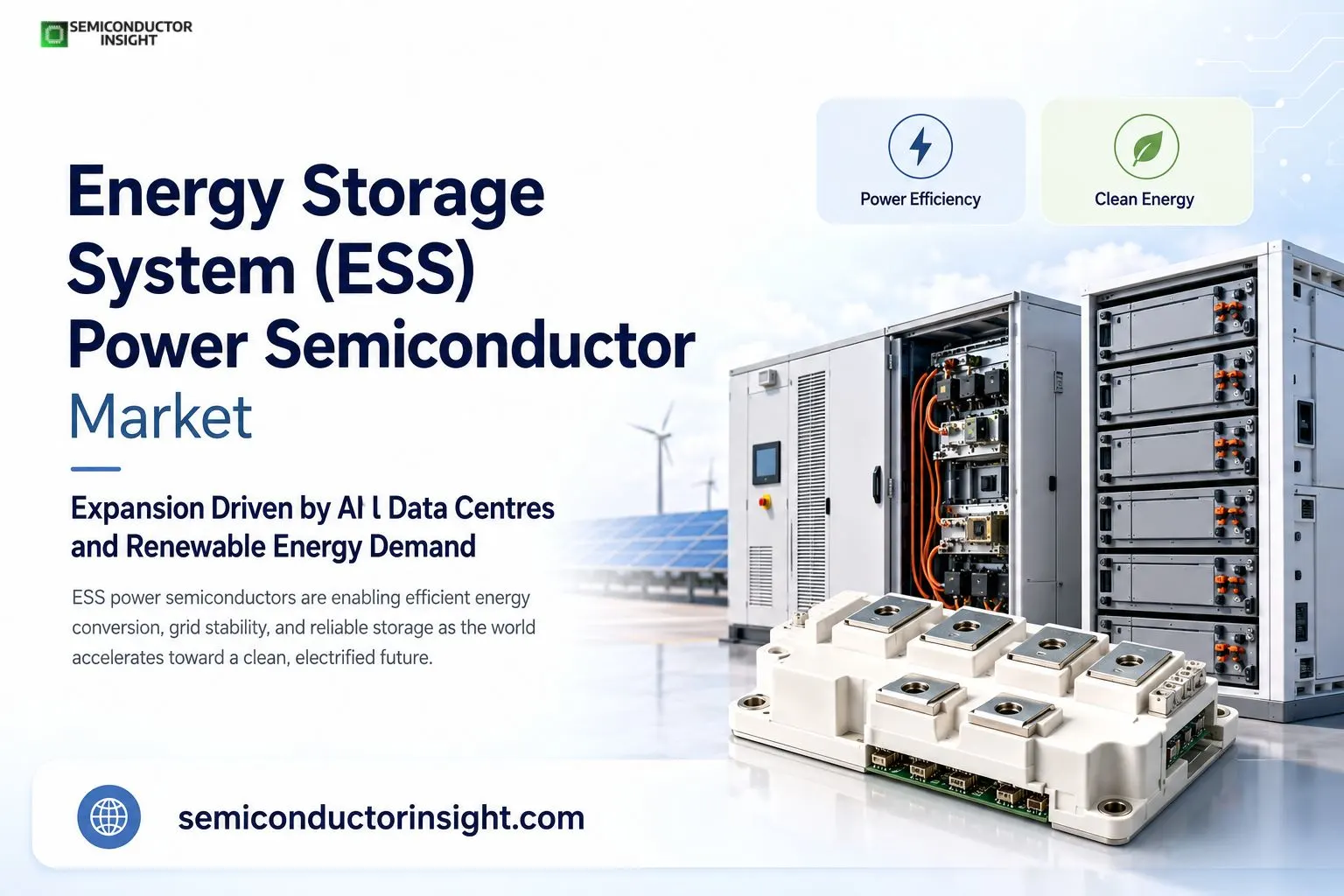
Energy Storage System ESS Power Semiconductor Market Expansion Driven by AI Data Centres and Renewable Energy Demand
The energy transition conversation is no longer centred only on renewable power generation. The real challenge now lies in storing, controlling, and distributing electricity efficiently across unstable demand cycles. This shift has pushed Energy Storage System ESS Power Semiconductor Market into the centre of global infrastructure planning.
From utility-scale battery farms in California to grid-balancing projects in China and Europe, power semiconductors are becoming the operational brain behind energy storage systems. These components regulate voltage, improve conversion efficiency, manage thermal performance, and enable bidirectional energy flow between batteries and the grid.
ESS power semiconductors function in challenging electrical conditions where dependability and energy efficiency directly impact grid operation, in contrast to traditional semiconductor debates that concentrate on processors or memory chips.
Utility-Scale Battery Installations Are Expanding Faster Than Transmission Networks
- Countries investing heavily in renewable energy are now facing a new bottleneck grid instability. Solar and wind generation fluctuate throughout the day, making large-scale storage essential for maintaining an uninterrupted electricity supply.
According to the International Energy Agency (IEA), global battery energy storage deployments crossed 85 GW in cumulative installed capacity during recent energy expansion cycles, with utility-scale projects representing a rapidly growing share.
Several national grids are now deploying storage systems exceeding 500 MWh in single-site installations.
- These projects rely heavily on insulated-gate bipolar transistors (IGBTs), MOSFETs, and silicon carbide power devices to control high-voltage switching and energy conversion processes.
- In Texas, large battery storage facilities connected to ERCOT have increasingly been used to stabilize electricity prices during peak demand periods. Similar deployments in Australia have demonstrated how advanced power electronics can respond to grid fluctuations within milliseconds.
Silicon Carbide Is Becoming the Preferred Material for High Voltage Efficiency
One of the strongest technology shifts inside the ESS power semiconductor ecosystem is the growing adoption of silicon carbide (SiC). Compared with traditional silicon-based devices, SiC semiconductors can operate at higher temperatures, switch faster, and reduce energy losses significantly.
This improvement matters because even minor efficiency gains become financially meaningful in multi-megawatt storage systems operating continuously.
Manufacturers including Infineon Technologies, Wolfspeed, and onsemi are expanding silicon carbide production capacity to meet rising ESS and electric vehicle demand.
Recent industrial announcements have shown billions of dollars being allocated toward wide-bandgap semiconductor fabrication facilities across the United States, Germany, and Japan. Governments are supporting these projects through semiconductor incentive programs tied to energy security strategies.
Stay connected for additional in-depth information right here: https://semiconductorinsight.com/report/energy-storage-system-ess-power-semiconductor-market/
Data Centres Are Quietly Becoming a Major ESS Semiconductor Consumer
The AI infrastructure boom has unexpectedly accelerated demand for energy storage semiconductors. Hyperscale data centres increasingly require backup battery systems capable of handling massive electricity loads without interruption.
Modern AI data centres can consume hundreds of megawatts of electricity annually, forcing operators to integrate battery energy storage systems directly into facility infrastructure. Semiconductor-controlled power conversion systems help maintain uptime while improving energy optimization.
Several cloud infrastructure companies are also experimenting with microgrid architectures that combine battery storage, renewable generation, and intelligent power management systems. This trend is creating additional opportunities for high-performance power modules and advanced inverter technologies.
Key Market Data Points
- The International Energy Agency reported global battery storage deployment growth reaching tens of gigawatts annually as renewable integration accelerates worldwide.
- Utility-scale energy storage projects exceeding 500 MWh are now operating across the United States, China, and Australia.
- Silicon carbide power devices can reduce switching losses substantially compared with conventional silicon-based components in high-voltage systems.
- Advanced solar inverters integrated with modern power semiconductors can achieve efficiency levels above 98% in optimized conditions.
- AI-focused hyperscale data centres are increasing investments in battery-backed energy infrastructure to maintain uninterrupted computing operations.
Fast Switching Devices Are Changing Renewable Energy Economics
Power conversion losses were once considered unavoidable in large renewable systems. Today, advanced semiconductors are reducing these losses substantially.
In solar-plus-storage installations, modern inverters equipped with next-generation semiconductors can achieve efficiency levels above 98% under optimized operating conditions. Faster switching speeds also reduce cooling requirements, lowering total operational costs for energy operators.
Japan and South Korea are actively deploying compact ESS architectures in urban environments where space efficiency matters. These systems depend heavily on smaller and thermally efficient semiconductor modules capable of operating reliably in dense infrastructure settings.
Meanwhile, Europe’s push for decentralized energy systems has increased investment in residential and commercial battery installations linked to rooftop solar systems. This is expanding demand for low-voltage power semiconductors used in smart inverters and battery management systems.
Semiconductor Manufacturing Is Becoming Part of National Energy Security Policies
- Power semiconductors are now viewed not only as industrial components but also as strategic infrastructure assets.
- Governments are linking semiconductor manufacturing expansion directly with renewable energy resilience and electrification goals.
- The United States CHIPS and Science Act, European semiconductor initiatives, and Japan’s advanced electronics funding programs all include support mechanisms benefiting power semiconductor ecosystems.
This policy alignment reflects a larger reality modern energy systems increasingly depend on semiconductor performance as much as generation capacity itself. Without efficient power conversion and intelligent energy control, renewable expansion alone cannot guarantee grid reliability.

Comments (0)