
Energy Profiles and Scaling Approaches within the Agentic AI Semiconductor Hardware Market
Agentic AI represents a significant step beyond traditional generative models. These systems plan, reason through multiple steps, use external tools, adapt to outcomes, and execute complex workflows with minimal ongoing human guidance. Running such capable agents at scale requires specialized semiconductor hardware that balances high-throughput parallel processing with low-latency sequential operations, substantial memory capacity, and efficient orchestration capabilities.
Agentic scenarios include frequent context change, tool calling, lengthy reasoning chains, and concurrent agent interactions, in contrast to pure training workloads that prioritise huge matrix operations. Hardware with robust single-thread performance and accelerator support is required for this. Recent designs address these by incorporating high core counts, expanded memory bandwidth, and hybrid compute units.
Core Processing Elements for Agentic Workloads
- Modern setups often combine general-purpose processors for control logic with specialized accelerators for heavy inference. CPUs handle orchestration, decision branching, and integration with external APIs or databases.
- Accelerators manage rapid token generation and embedding computations. Memory subsystems play a critical role, as agents maintain extensive context windows and intermediate states across multi-step tasks. Configurations reaching hundreds of gigabytes per node help reduce data movement bottlenecks.
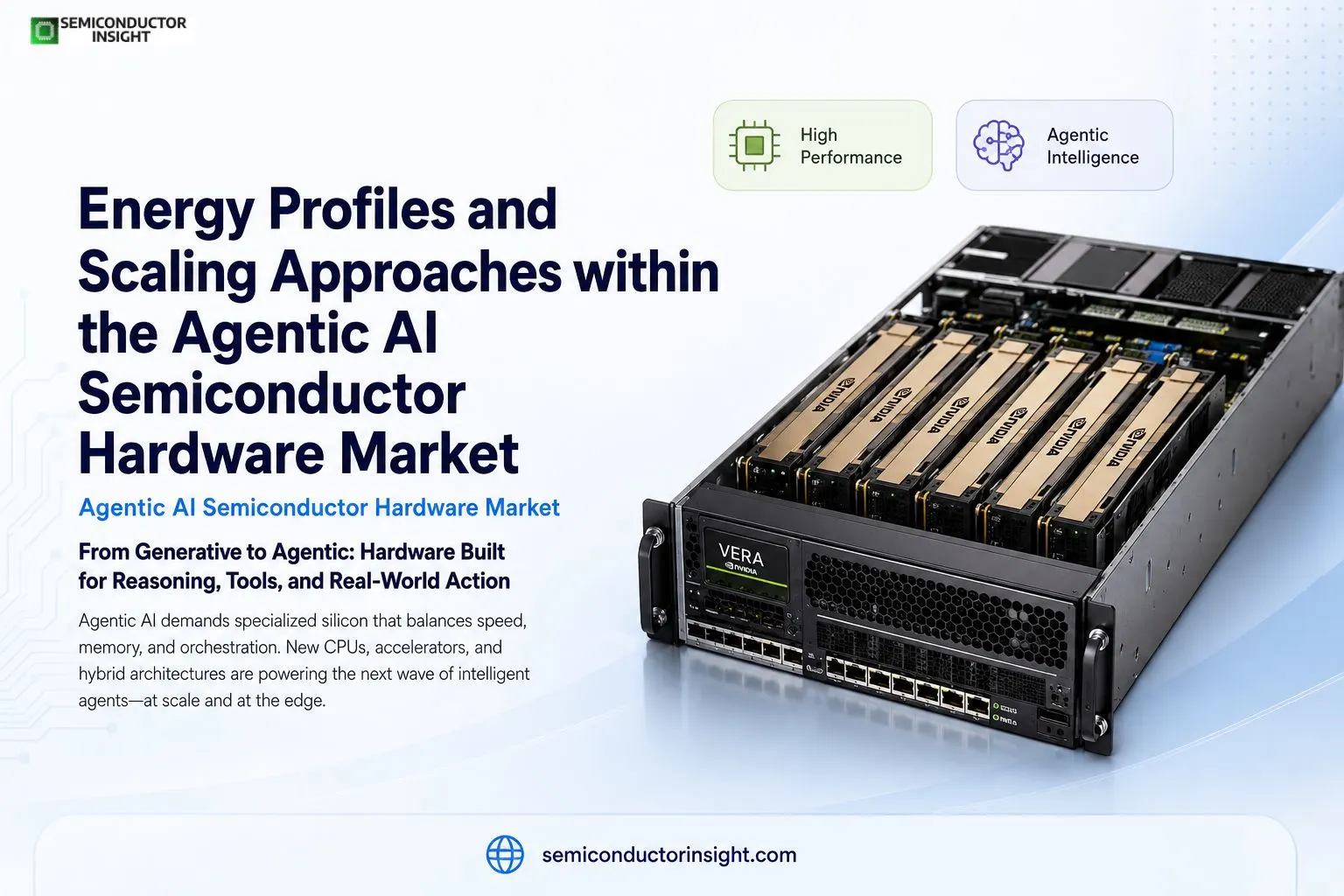
- One notable development involves purpose-built CPUs optimized for these demands. NVIDIA introduced the Vera processor, featuring 88 custom Arm-based cores in liquid-cooled racks capable of sustaining thousands of concurrent agent environments. Such systems prioritize low tail latency and high memory capacity to keep multiple agents responsive simultaneously.
- Google continues advancing its Tensor Processing Units (TPUs), with newer variants like the TPU v5 and subsequent generations delivering efficiency gains for large-scale inference.
- These chips power internal services and support external workloads, demonstrating sustained performance across reasoning-heavy applications. DeepMind’s AlphaChip has further shown how reinforcement learning can optimize layouts for tensor operations, accelerating the very design of AI hardware.
Illustrative Hardware Comparison Aspects
Agentic systems typically rely on a combination of specialized hardware components to support fast processing, long context handling, and efficient coordination across tasks. High-core CPUs, usually with 80 or more cores and high memory bandwidth, are well suited for orchestration, tool calling, and multi-agent coordination. AI accelerators such as GPUs and TPUs provide massive parallel processing through tensor cores, making them ideal for fast inference and embedding generation.
- Memory subsystems with 128 to 400+ GB per node help maintain context and manage state effectively, while custom RDUs and ASICs offer reconfigurable dataflow for specialized decode and hybrid workloads.
- Data drawn from technical overviews on platforms like IEEE and company engineering releases. Actual deployments vary by workload scale.
- Agentic AI also influences chip design processes themselves. Startups have demonstrated fully autonomous RISC-V core creation using agentic systems, completing complex workflows from high-level prompts in hours rather than months.
- Platforms like ChipAgents and Cadence’s ChipStack AI Super-Agent deploy multiple specialized agents for RTL generation, verification, debugging, and optimization, creating faster feedback loops in semiconductor development.
In data centres, hybrid architectures gain traction. SambaNova’s SN50 reconfigurable data unit targets agentic inference with claims of faster token generation and better cost profiles for decode-heavy tasks. These systems complement traditional GPUs by addressing bottlenecks in sequential reasoning phases.
To Stay Tuned with More meaningful and In-Depth Related Insights, Do Visit here: https://semiconductorinsight.com/report/semiconductor-chillers-and-heat-exchangers-market/
Global Context and Scale
The broader semiconductor ecosystem supports these advancements. Global chip sales reached approximately $630 billion in 2024, with projections indicating continued expansion driven largely by high-performance computing needs. AI-related accelerators represent a growing but still relatively small fraction of total unit volume estimated in the low tens of millions of advanced chips annually while commanding significant value due to their complexity and performance.
U.S. policy initiatives, including the CHIPS and Science Act authorizing substantial investments in domestic research and manufacturing, aim to strengthen supply chain resilience for these critical technologies. This supports both production capacity and workforce development in advanced nodes essential for agentic hardware.
Practical Deployment Flows
A typical agentic workflow might proceed as:
Goal intake → Planning agent decomposes tasks → Tool-use agents query databases or APIs → Inference accelerators process reasoning steps → Orchestration CPU integrates results and iterates → Action execution with verification.
Hardware must maintain responsiveness across this loop, often requiring tight integration between memory, compute, and networking fabrics.
Edge implementations add further considerations. Lower-power NPUs and specialized SoCs enable on-device agents for robotics, autonomous systems, or privacy-sensitive applications. Devices like NVIDIA Jetson platforms deliver hundreds of TOPS within constrained power envelopes, supporting local decision-making without constant cloud reliance.
As agentic capabilities expand into multi-agent orchestration and real-world tool use, semiconductor hardware continues evolving. From massive data centre racks sustaining thousands of concurrent agents to compact edge solutions, these architectures form the physical backbone enabling more autonomous and capable AI systems. Their ongoing refinement reflects the interplay between software innovation and silicon-level optimizations tailored to this new paradigm of intelligent action.

Comments (0)