

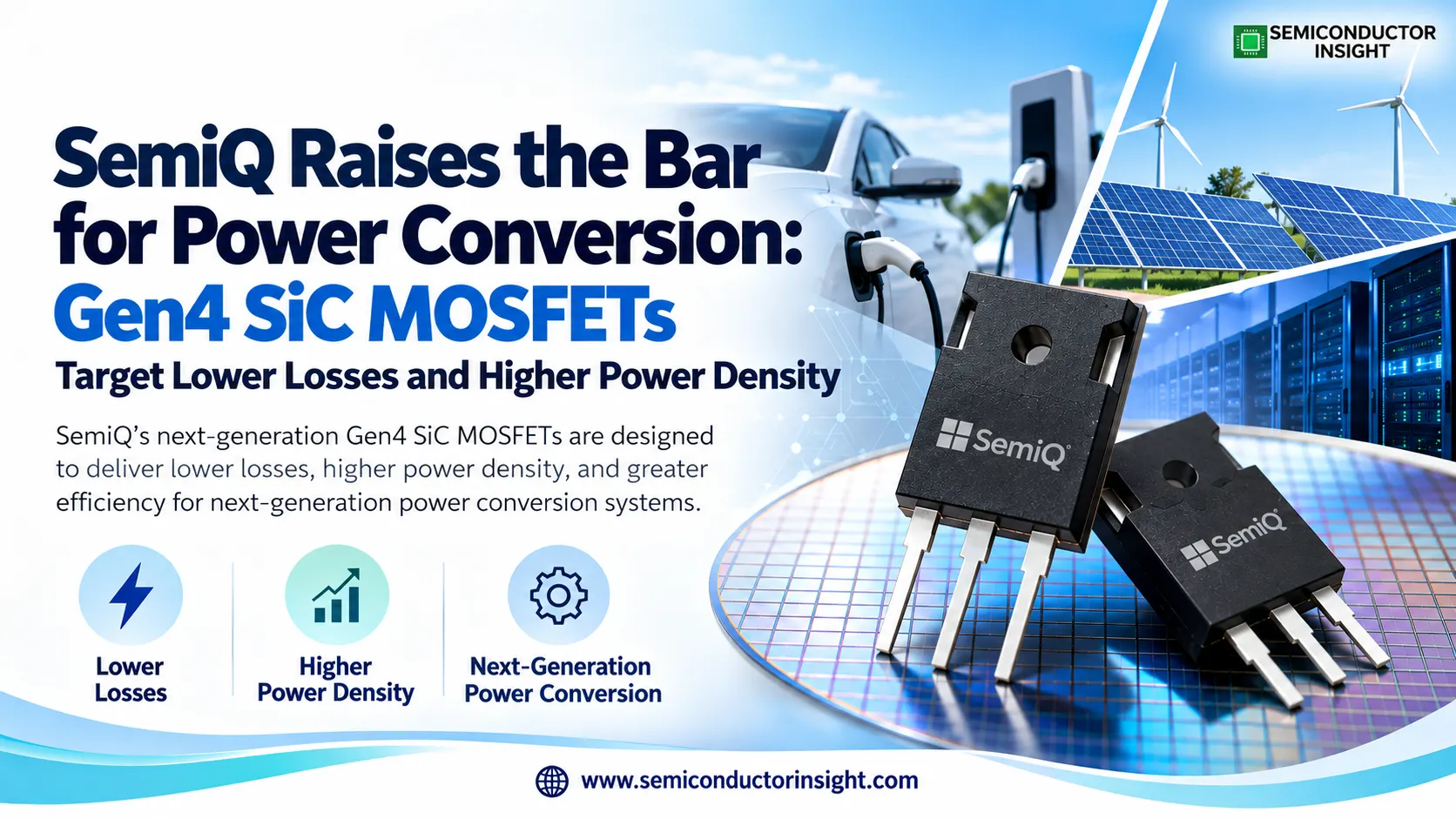
SemiQ Raises the Bar for Power Conversion: Gen4 SiC MOSFETs Target Lower Losses and Higher Power Density
The US semiconductor developer introduces 750V and 1200V silicon carbide devices with lower on-resistance and switching energy, targeting electric vehicle charging, renewable energy, and industrial power systems.
As power electronics manufacturers face growing demands for efficiency, thermal performance, and compact system designs, silicon carbide technology continues to attract attention across the global semiconductor industry.
US-based SemiQ Inc. has announced the availability of its fourth-generation QSiC power semiconductor portfolio, featuring new 750V and 1200V silicon carbide (SiC) MOSFETs and bare dies. The devices are designed to reduce conduction and switching losses while supporting higher current capability and improved power density.
The launch comes as SiC power devices gain importance in high-efficiency electricity conversion, including electric vehicle charging infrastructure, renewable energy systems, and industrial power equipment.
SemiQ’s latest generation focuses on improvements at the device-cell level rather than increasing the physical dimensions of the semiconductor.
The Gen4 technology incorporates an optimized cell topology, a 36% reduction in cell pitch, and refinements to JFET and P-well implantation. According to the company, these changes deliver a 23% reduction in specific on-resistance compared with the previous generation.
For power electronics designers, lower resistance can help reduce conduction losses, while improved switching characteristics can reduce energy dissipated during switching events. The resulting system-level benefits depend on operating conditions, circuit design, packaging, and thermal management.
Key Technical Highlights
- 23% lower specific on-resistance: Compared with previous-generation devices.
- 21% lower on-resistance: The 1200V Gen4 devices reduce the reported RDS(on) from 14 mΩ to 11 mΩ.
- More than 11% lower switching energy: The 1200V devices reduce the reported total switching energy from 1,677 µJ to 1,491 µJ.
- New 750V voltage class: Extends the Gen4 family with a device rated at 9 mΩ on-resistance.
- Unchanged 1200V die dimensions: The new 1200V device retains the previous generation’s 5 × 5 mm die size while improving its electrical performance.
Together, these changes are intended to help equipment manufacturers pursue more efficient power conversion without necessarily increasing the semiconductor footprint.
Why the New 750V Device Matters?
- One of the notable additions to the portfolio is the 750V SiC MOSFET, which was not part of SemiQ’s previous generation.
- The device offers a reported on-resistance of 9 mΩ and total switching energy of 871 µJ. This gives engineers another voltage option when selecting power switches for systems that must balance conduction losses, switching performance, and voltage requirements.
- The 1200V and 750V products address different design needs, and the appropriate selection will depend on the system’s DC-link voltage, transient conditions, switching frequency, current requirements, and safety margins.
- Rather than treating voltage ratings as interchangeable, designers must match device characteristics to the complete power-conversion architecture.
Where Could the Devices Find Their Applications?
SemiQ is targeting applications that depend on efficient, reliable conversion of electrical power.
- Electric vehicle charging infrastructure: High-power chargers require efficient conversion stages to limit losses and manage heat. SiC MOSFETs can help designers improve conversion efficiency and explore more compact power-stage architectures.
- Solar inverters and renewable energy: Solar installations rely on power electronics to convert generated electricity into usable AC power. Lower device losses can support efficiency improvements, although actual results depend on inverter topology and operating conditions.
- High-voltage DC/DC and DC/AC converters: These conversion stages are used across industrial power systems and energy infrastructure. Device performance can influence switching frequency, thermal requirements, and overall system design.
The common thread is the need to manage electrical losses and heat while maintaining the required voltage, current, and reliability characteristics.
Reliability Screening and Packaging Options
Performance improvements must be accompanied by appropriate device qualification and reliability testing, particularly in high-voltage applications.
SemiQ reports that the Gen4 MOSFET dies undergo wafer-level gate-oxide burn-in screening at voltages exceeding 1,400V for the 1200V devices and 800V for the 750V devices. Both device classes are also avalanche-tested to 800 mJ.
The products are available in a four-pin TO-247-4L package and as bare dies, giving engineers options for different integration and manufacturing requirements.
These testing specifications are useful indicators of the company’s screening approach, but they should not be interpreted as a guarantee of field reliability under every operating condition. Final performance depends on system design, assembly quality, thermal cycling, electrical stress, and application-specific qualification.
The Wider Industry Context: Efficiency Is Becoming a System-Level Priority
The launch reflects a wider evolution in the power semiconductor sector. Device manufacturers are competing not only on voltage ratings but also on resistance, switching behaviour, packaging, reliability, and the ability to support increasingly demanding power-conversion architectures.
This shift is particularly relevant as electric mobility, renewable energy, industrial electrification, and high-density computing increase the importance of efficient power delivery.
Recent industry developments illustrate the breadth of this demand. In September 2026, Infineon Technologies and Eaton announced a collaboration involving SiC devices for a medium-voltage solid-state transformer platform targeting 800V DC power distribution in AI data centers. The initiative highlights the growing role of SiC in infrastructure that must handle substantial electrical loads efficiently.
While SemiQ’s new devices are not specifically announced as part of that collaboration, both developments point to a common engineering priority: improving the efficiency, power density, and reliability of advanced power-conversion systems.
- SemiQ’s Gen4 release reinforces the importance of incremental device engineering in the wider transition towards high-efficiency power electronics.
- The combination of reduced specific on-resistance, improved switching performance, and an expanded voltage portfolio provides engineers with additional design options across EV charging, renewable energy, and industrial applications.
- The commercial significance will ultimately depend on how the devices perform within complete systems, how they compare with competing solutions, and how effectively manufacturers integrate them into production-ready designs.
For the global semiconductor industry, the message is clear: as power requirements increase, advances in semiconductor materials and device architecture will remain central to building more efficient and compact electrical systems.
Browse Our Thorough Related Sector Studies: https://semiconductorinsight.com/report/sic-mosfet-modules-market/

Comments (0)