
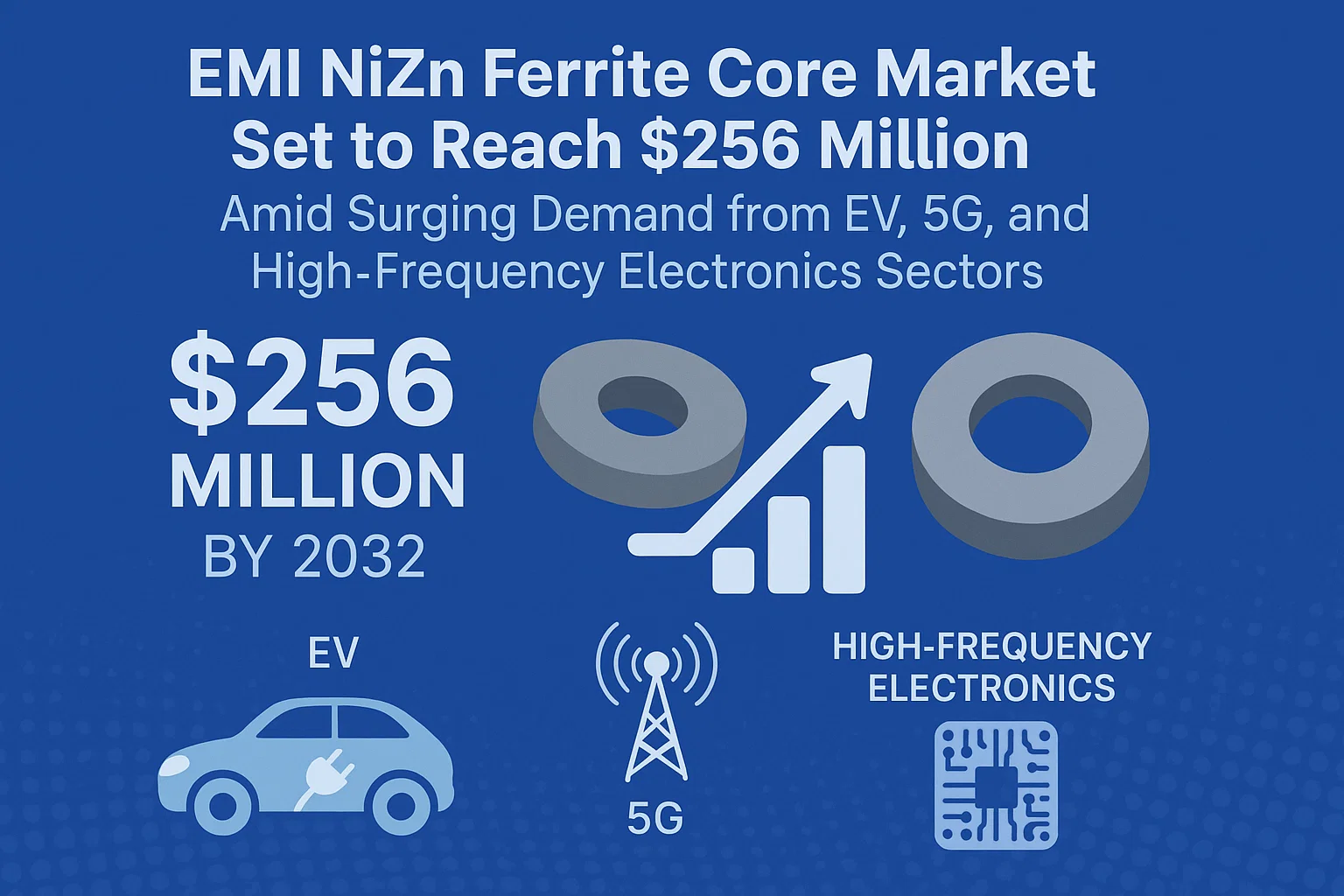
EMI NiZn Ferrite Core Market Set to Reach $256 Million by 2032 Amid Surging Demand from EV, 5G, and High-Frequency Electronics Sectors
In an age dominated by high-frequency electronics, compact devices, electric vehicles (EVs), and increasingly stringent electromagnetic compliance standards, Electromagnetic Interference (EMI) suppression components have become indispensable. Among these, Nickel-Zinc (NiZn) ferrite cores have emerged as a crucial material for attenuating high-frequency EMI. This blog delves deep into the recent developments, market trends, regional dynamics, and technological advancements shaping the EMI NiZn Ferrite Core market, which is poised to grow from US$ 189 million in 2024 to US$ 256 million by 2032, at a CAGR of 4.3% during 2025–2032.
Access Your Free Sample Report- EMI NiZn Ferrite Core Market
Understanding the Role of NiZn Ferrite Cores in EMI Suppression
NiZn ferrite cores are soft magnetic materials used in high-frequency applications due to their high resistivity and low eddy current losses. They are widely used in inductors, transformers, chokes, and filters that are integrated into circuits to mitigate EMI, especially in:
- Consumer electronics (smartphones, laptops, TVs)
- EV powertrain components and charging systems
- High-speed communication equipment
- Industrial automation systems
- IoT devices and wearables
Their effectiveness across a wide frequency range (typically from 1 MHz to several hundred MHz) makes them ideal for today’s increasingly congested and sensitive electromagnetic environments.
Global Market Snapshot: 2024–2032
According to the latest industry data, the EMI NiZn Ferrite Core market was valued at US$ 189 million in 2024. This market is projected to grow steadily and reach US$ 256 million by 2032, reflecting a compound annual growth rate (CAGR) of 4.3% from 2025 to 2032. Key drivers of this growth include:
- The rise of electrification in vehicles and renewable energy systems
- EMC compliance regulations in Europe and North America
- Increasing demand for miniaturized, lightweight, and efficient electronics
Notably, the United States accounted for 28% of global revenue in 2024, reflecting its robust electronics, aerospace, and automotive industries. Meanwhile, China is projected to grow at a faster rate, with a 5.3% CAGR through 2032, fueled by industrial policy support, 5G expansion, and growing domestic semiconductor capacity.
Technological Developments and Innovations
1. Advanced Ferrite Materials
Recent research has focused on enhancing NiZn ferrites with nanostructuring, doping, and improved sintering processes to boost magnetic permeability while minimizing power losses. Universities and corporate R&D labs in Japan, South Korea, and Germany have published new results on:
- Surface-modified ferrite powders for improved EMI absorption
- Nano-grained NiZn composites for extended bandwidth performance
- Lead-free, RoHS-compliant ferrite variants
These advances have enabled manufacturers to offer tailored ferrite solutions for high-speed USB interfaces, automotive Ethernet, and GaN/SiC-based power systems.
2. Miniaturization for Wearables and IoT
As wearable devices and IoT nodes shrink in size, ferrite cores must deliver effective EMI suppression in miniature packages. Companies such as Sunlord Electronics and TDK Corporation have introduced ultra-compact ferrite beads and multilayer chip components optimized for 1–100 MHz interference environments—ideal for wireless charging, smart watches, and home automation.
3. Embedded Ferrite Technologies
Emerging solutions now embed NiZn ferrite materials directly into PCB layers or connector housings. Würth Elektronik, for example, has released PCB-embedded EMI shielding ferrites, which eliminate the need for bulky through-hole ferrite chokes in ultra-thin devices.
Download Sample Report PDF- EMI NiZn Ferrite Core Market
Automotive Sector: A Major Growth Engine
With electric and hybrid vehicles rapidly gaining traction worldwide, the demand for effective EMI suppression components has skyrocketed. NiZn ferrite cores are used in:
- On-board chargers (OBCs)
- DC-DC converters
- Inverter systems
- EMI filters in infotainment and ADAS modules
Automotive OEMs are increasingly focused on ensuring compliance with CISPR 25 standards, which regulate EMI levels inside vehicles. As a result, major automotive suppliers are investing in automated ferrite core testing systems, temperature-resistant ferrites, and custom wound inductors that utilize NiZn materials.
Furthermore, EV charger OEMs are incorporating NiZn ferrite rings in both AC and DC charging lines to suppress high-frequency emissions and meet European EMC directives.
High-Frequency Communications and 5G Applications
The rollout of 5G infrastructure has prompted a massive demand for low-loss, high-frequency passive components. NiZn ferrite cores are particularly suitable for:
- Base station filters
- Power-over-Ethernet (PoE) circuits
- Antenna feedline suppression
Given the frequency bands used in 5G (up to 6 GHz), newer generations of NiZn ferrites with optimized permeability profiles and narrower loss tangents are being deployed. Manufacturers have begun offering multi-aperture NiZn toroids and multi-core bead arrays specifically for telecom and edge computing gear.
Recent Industry Highlights (2023–2025)
Sunlord’s Expansion in Asia-Pacific
Sunlord Electronics, a key player in EMI components, has significantly ramped up production capacity at its Shenzhen plant to meet demand from consumer electronics and telecom OEMs across India, Korea, and Southeast Asia.
TDK’s Eco-Friendly Ferrite Line
TDK recently introduced a new line of RoHS- and REACH-compliant NiZn cores that meet environmental guidelines without sacrificing thermal or frequency performance. These are being adopted in solar inverters and EV drive modules in Europe.
Würth Elektronik’s EMI Simulation Platform
The company has launched a cloud-based EMI simulation tool to help designers choose the right NiZn ferrite configurations for PCB-level noise suppression. This tool has been instrumental in streamlining product development for automotive Tier 1 suppliers.
Kitagawa Industries’ Noise Suppression Sheets
Kitagawa launched thin-film ferrite sheets based on NiZn compounds designed for flexible cable EMI control in laptops and tablets. These are now being tested by major Japanese PC brands for next-gen designs.
Regional Analysis
United States
- 2024 Market Share: 28% of global revenues
- Major demand from military electronics, EV manufacturing, and high-performance computing (HPC) centers.
- Compliance with FCC Part 15 and DoD EMI specs drives premium demand.
China
- Expected CAGR: 5.3% through 2032
- Expansion of 5G, domestic EV giants like BYD, and state-led chipmaking incentives are key growth pillars.
- Local ferrite makers gaining technological maturity and vertical integration.
Germany
- Focused on industrial automation and robotics, supported by strong R&D in magnetic materials.
- NiZn ferrites used in power modules and PLCs.
Japan
- Innovation leader in multilayer ferrite devices.
- Japanese firms are investing in noise-canceling technologies for smart mobility and autonomous driving.
India
- Growing demand due to mobile manufacturing under “Make in India.”
- New local manufacturers entering the EMI suppression space.
Challenges and Future Outlook
Challenges
- Rising raw material costs (nickel, zinc)
- Competition from alternative EMI suppression materials (MnZn ferrites, nanocrystalline alloys)
- Integration complexity in ultra-dense PCBs
- Global trade and supply chain vulnerabilities
Future Outlook
Despite these hurdles, the EMI NiZn Ferrite Core market is on a resilient upward path. The rise of smart factories, electrification, AI edge computing, and next-gen wireless all point to growing EMI challenges—and thus greater need for NiZn solutions. Moreover:
- The trend toward embedded EMI mitigation will favor compact and customizable ferrite forms.
- Increased AI/ML design automation tools for circuit EMI analysis will streamline core selection and usage.
- Sustainability goals will push manufacturers to offer recyclable, non-toxic ferrite materials.
Click Here To Download Full Sample Report- EMI NiZn Ferrite Core Market
Quietly Powerful in a Noisy World
NiZn ferrite cores may not make headlines like semiconductors or AI chips, but they are the silent protectors of signal integrity, safety, and performance in a modern electronic landscape flooded with electromagnetic activity. As global industries digitize, electrify, and connect, the EMI NiZn Ferrite Core market will continue to expand steadily, underpinned by technological evolution and compliance imperatives.
With robust growth projected through 2032—rising from US$ 189 million to US$ 256 million—and particularly strong momentum in China, 5G, and EV segments, it’s evident that the future of NiZn ferrite technology is magnetically aligned with the future of innovation itself.

Comments (0)