
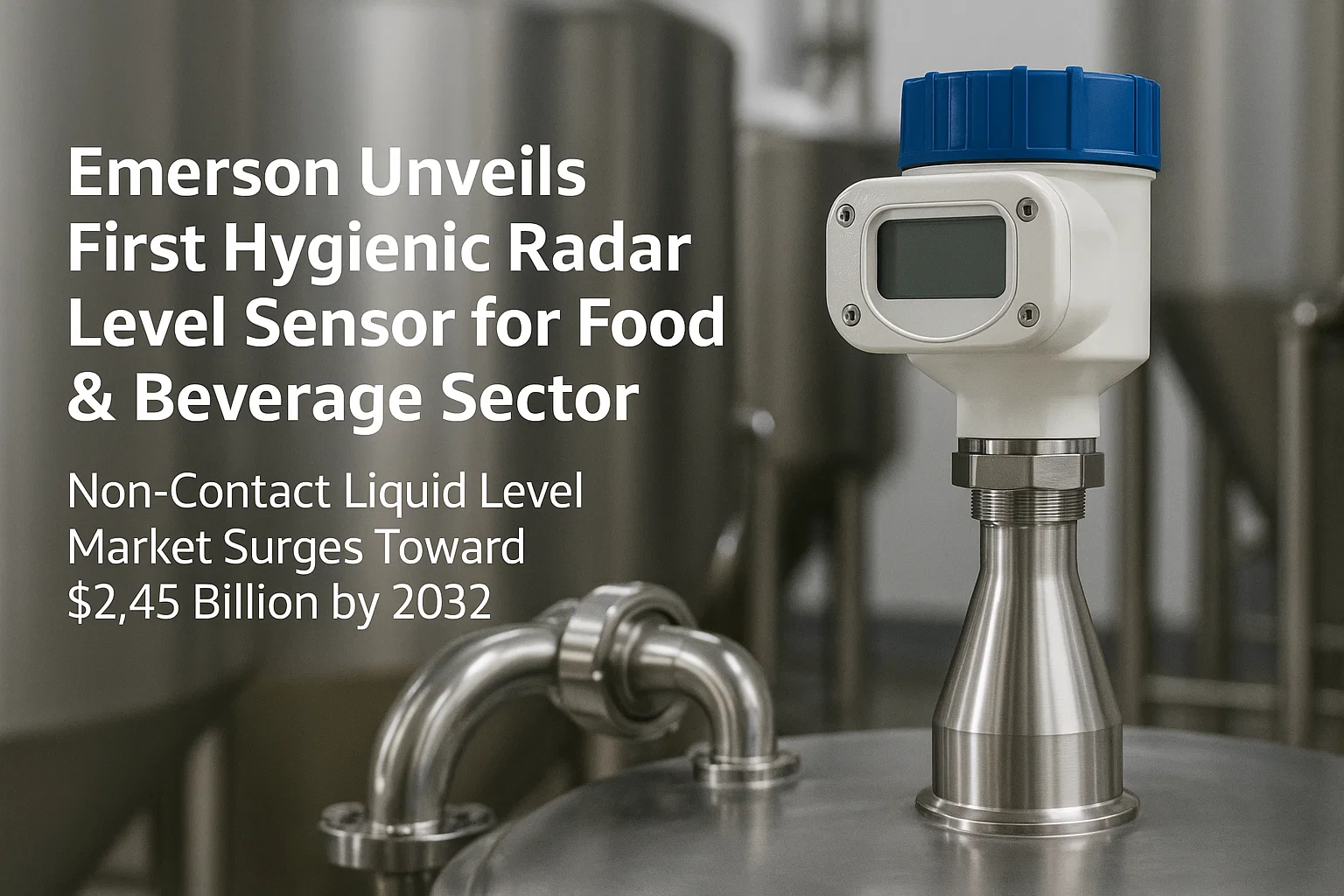
Emerson Unveils First Hygienic Radar Level Sensor for Food & Beverage Sector as Non-Contact Liquid Level Market Surges Toward $2.45 Billion by 2032
In a world increasingly defined by precision, automation, and hygienic safety, the importance of accurate liquid level monitoring cannot be overstated. Traditional contact-based sensors, though widely used, are being quickly outpaced by the innovation and versatility of non-contact liquid level sensors. These sensors, which detect liquid levels without making physical contact with the medium, are transforming industries as diverse as food and beverage, chemical processing, pharmaceuticals, water treatment, and even automotive engineering.
According to recent projections, the Non-contact Liquid Level Sensors Market, which was valued at US$ 1.56 billion in 2024, is set to grow robustly, reaching US$ 2.45 billion by 2032, expanding at a CAGR of 5.7% during the forecast period (2025–2032). This growth reflects a larger trend toward smart automation, Industry 4.0 integration, and more stringent hygiene and safety requirements across global markets.
Access Your Free Sample Report- Non-contact Liquid Level Sensors Market
What Are Non-Contact Liquid Level Sensors?
Non-contact liquid level sensors determine the presence or level of a liquid without physically touching it. They typically use techniques like:
- Radar (FMCW or pulse radar)
- Ultrasonic waves
- Capacitive field detection
- Optical reflection/refraction
These technologies offer distinct advantages:
- No contamination of the liquid
- Ideal for corrosive, high-pressure, or hazardous environments
- Better suited for sterile/hygienic applications
- Minimal maintenance due to lack of moving parts
Key Market Drivers:
- Growing Adoption of Automation and Smart Monitoring
- Stringent Hygiene and Safety Regulations
- Need for Precision in Harsh Industrial Environments
- IoT Integration and Predictive Maintenance
Major Industry Developments: 2024–2025
1. Baumer PL240 – A Game-Changer for Water-Based Fluids
In early 2024, Baumer introduced the PL240, a capacitive point-level sensor specifically designed for water-based liquids in sealed containers. What sets it apart?
- Mounts externally on plastic or glass walls (up to 6 mm thick)
- No contact with the liquid
- Training mode compensates for foam, film, or residue
- Quick installation with adhesives, screws, or ties
Use cases include dairy plants, cleaning fluid monitoring, chemical drums, and laboratory containers.
Why it matters: The PL240 empowers hygienic industries to detect levels without contamination risk—crucial for cleanroom and food-safe environments.
2. Emerson’s First Radar Transmitter for Food & Beverage
In a major innovation tailored for a specific sector, Emerson Automation Solutions launched a non-contact radar level transmitter customized for the food and beverage industry in April 2025.
Key Features:
- Built-in hygienic design (clean-in-place compliant)
- Radar technology unaffected by condensation or foam
- Seamless integration into digital food production lines
This is a first-of-its-kind innovation that caters to FDA and EU food safety compliance, making it ideal for milk, beer, syrups, sauces, and other sensitive products.
Industry Impact: Emerson’s move sets a precedent for sector-specific sensor design—emphasizing hygiene, durability, and digital compatibility.
3. ifm electronic LW2120 – Industrial Grade Precision
ifm electronic unveiled the LW2120, a radar-based level sensor operating at 80 GHz with ±2 mm accuracy, suitable for both tanks and open vessels.
Highlights:
- Withstands extreme industrial conditions
- Immune to vapor, foam, steam, and condensate
- Detection range from 0.01 m to 10 m
Industries Benefitting: Oil & gas, chemical storage, wastewater plants, breweries
Market Insight: Radar-based sensors like LW2120 are becoming go-to solutions for harsh or complex environments where traditional ultrasonic sensors fall short.
Download Sample Report PDF- Non-contact Liquid Level Sensors Market
Technology Spotlight: Radar vs. Capacitive vs. Ultrasonic
| Feature | Radar | Capacitive | Ultrasonic |
| Accuracy | Very High | High | Medium |
| Best for | Harsh & open tanks | Water-based fluids | General-purpose |
| Environmental Resistance | High | Medium | Medium |
| Cost | Higher | Moderate | Lower |
| IoT Compatibility | Strong | Moderate | Moderate |
Key Insight: Radar is emerging as the gold standard, especially for rugged, automated industries. Capacitive sensors dominate in food, beverage, and pharma, while ultrasonic remains the budget-friendly choice for simpler tasks.
Emerging Trends Shaping the Market
1. IoT & Industry 4.0 Integration
Sensors are increasingly being embedded with connectivity modules, enabling:
- Real-time cloud-based monitoring
- Predictive maintenance
- Remote diagnostics
- Seamless SCADA/PLC integration
2. Miniaturization & Flexibility
Advanced materials and microelectronic design have led to:
- Flexible non-contact sensors for small test tubes
- Integration into medical devices
- Wearable fluid sensors for biotech applications
3. Energy Efficiency & Sustainability
Newer models are:
- Low-power (for battery operation)
- Solar or energy harvesting enabled
- Used in water conservation systems and smart irrigation
4. Hygiene-First Designs
Driven by pharmaceutical and F&B demand, manufacturers are creating:
- Clean-in-place (CIP) compatible designs
- Sealed units with IP69K ratings
- Sensors that resist chemical sterilization agents
Global Adoption Patterns
| Region | Key Applications | Growth Insights |
| North America | Oil & gas, pharma, food | Strong demand for radar and smart sensors |
| Europe | Industrial automation, wastewater | Favoring regulatory-compliant, eco-friendly sensors |
| Asia-Pacific | Chemicals, F&B, automotive | Fastest-growing; driven by industrialization and smart factories |
| Middle East & Africa | Petrochemical, water treatment | Gradual uptake, especially in infrastructure projects |
Key Players Driving Innovation
- Baumer – Capacitive sensors tailored for hygienic use
- Emerson Automation Solutions – Sector-specific radar solutions
- ifm electronic – Rugged industrial radar sensors
- VEGA, Endress+Hauser, Siemens – Dominant in process automation with a growing non-contact portfolio
- Pepperl+Fuchs, Gems Sensors, Omron – R&D-focused players with modular, scalable options
Challenges & Opportunities Ahead
Challenges:
- Initial cost premium over contact sensors
- False positives in turbulent or mixed media
- Regulatory complexity in pharma and F&B sectors
- Data security in IoT-enabled devices
Opportunities:
- Smart city applications (e.g., water management)
- Medical diagnostics (non-invasive liquid monitoring)
- Wearable sensors in biotech and environmental testing
- OEM integration in industrial machines and vehicles
Click Here To Download Full Sample Report- Non-contact Liquid Level Sensors Market
The Future: From Measurement to Intelligence
Tomorrow’s non-contact sensors won’t just measure; they’ll analyze, predict, and automate.
Imagine:
- A sensor that alerts maintenance crews before a tank leak
- A brewing system where every fluid level is monitored and optimized remotely
- A lab beaker that sends real-time usage data to a centralized dashboard
This is no longer science fiction—it’s rapidly becoming standard practice.
As industries become smarter, cleaner, and more interconnected, the rise of non-contact liquid level sensors represents a pivotal shift in fluid management. From precise industrial control to hygienic monitoring in food and pharmaceuticals, these sensors are unlocking efficiency, accuracy, and safety like never before.
With continued innovation in radar technology, IoT integration, and sector-specific customization, the global market is poised not just for growth—but for transformation.
The future of liquid level sensing is touchless, intelligent, and integrated.

Comments (0)