
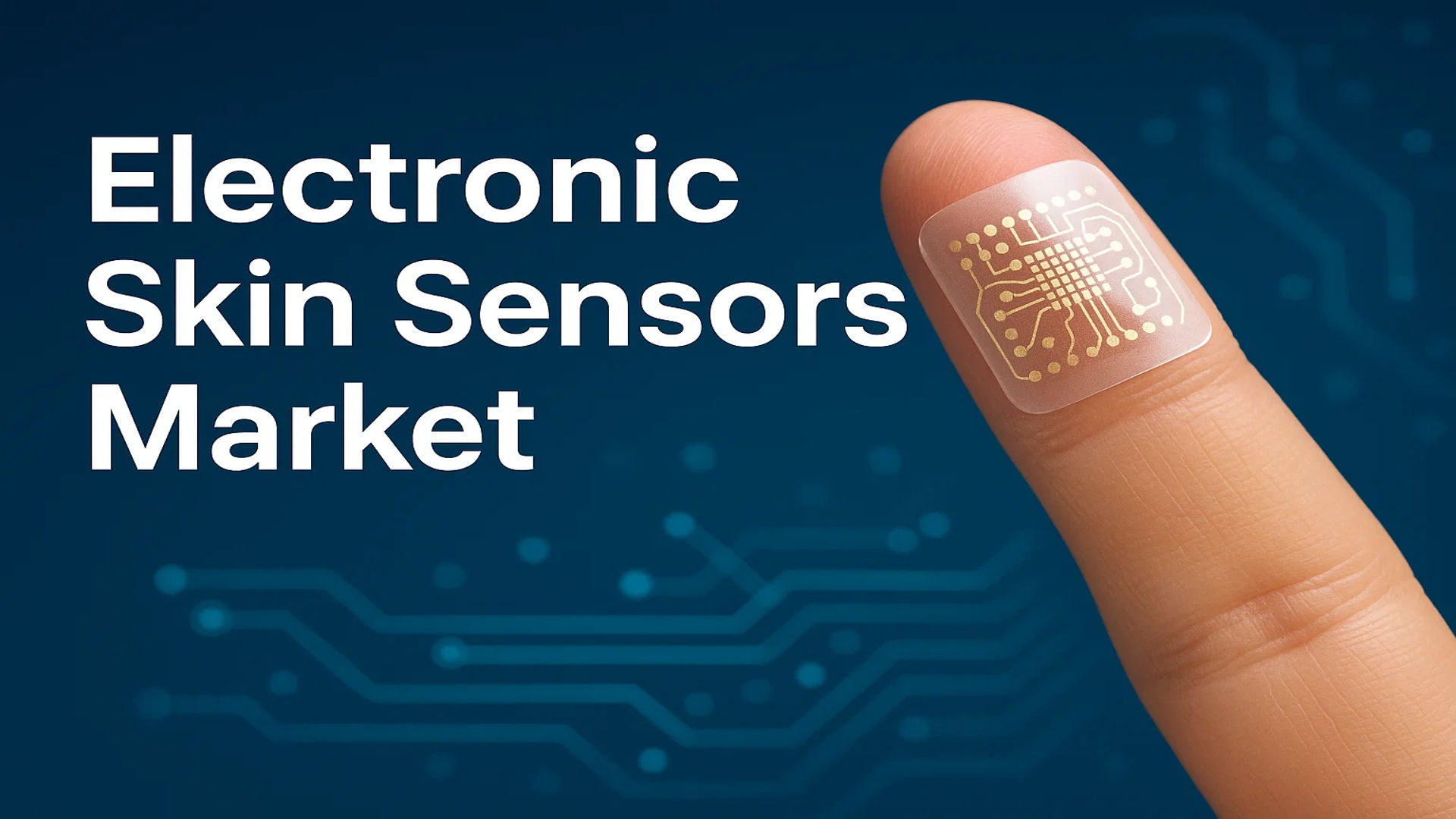
Electronic Skin Sensors Market Sees Breakthrough with Advanced Flexible and Self-Healing Materials Driving Next-Gen Wearable Tech
The Electronic Skin Sensors Market has entered a transformative growth phase, fueled by rapid technological innovations in healthcare, robotics, wearable devices, and human–machine interfaces. Valued at US$ 312 million in 2024, the market is projected to soar to US$ 889 million by 2032, registering an impressive CAGR of 16.1% during the forecast period 2025–2032.
Electronic skin sensors, or e-skins, are ultra-thin, flexible, and stretchable sensor systems that mimic the properties of human skin, including the ability to detect pressure, temperature, humidity, and strain. These systems integrate advanced materials, nanotechnology, and sensor networks to enable applications ranging from prosthetic feedback to robotic sensing, remote health monitoring, and human–machine communication.
This blog takes a deep dive into recent developments, driving forces, challenges, and opportunities in the electronic skin sensors market, offering a complete perspective for businesses, researchers, and investors.
Download Sample Report PDF- Electronic Skin Sensors Market
Recent Developments in the Electronic Skin Sensors Market
The electronic skin sensors market has witnessed groundbreaking advancements in materials science, AI integration, and multi-functional designs. Below are the most significant recent developments shaping the industry:
Breakthrough in Self-Healing E-Skins
In 2024, multiple research teams developed self-healing electronic skins capable of repairing themselves within minutes after physical damage. Using dynamic covalent polymers and conductive nanomaterials, these e-skins restore both mechanical structure and electrical conductivity, extending product lifespan and reducing replacement costs.
-
Example: The University of Colorado unveiled a recyclable, biodegradable self-healing e-skin, aligning with sustainability goals in electronics manufacturing.
AI-Powered Sensory Feedback Systems
Integration of artificial intelligence algorithms has transformed e-skin capabilities. New AI-powered e-skins can distinguish between multiple tactile sensations—such as sharp objects, softness, or temperature changes—and interpret them for real-time applications.
-
Example: A Japanese robotics company launched an AI-enhanced robotic hand with e-skin capable of learning touch patterns for improved dexterity in industrial assembly.
Biocompatible and Medical-Grade E-Skins
The push toward healthcare applications has led to the development of biocompatible e-skin sensors that can be worn for extended periods without irritation. These are crucial for remote patient monitoring and chronic disease management, particularly in cardiovascular and diabetic care.
-
Example: Philips introduced a skin patch embedded with e-skin sensors for continuous heart rate and blood oxygen monitoring, transmitting real-time data to cloud-based healthcare systems.
Multi-Functional E-Skin for AR/VR
In 2024, companies began integrating e-skin sensors into augmented reality (AR) and virtual reality (VR) wearables, enabling tactile feedback in immersive environments. This opens up new opportunities in gaming, training simulations, and telepresence robotics.
-
Example: Meta’s research team showcased an e-skin glove capable of delivering realistic touch sensations in VR gameplay.
Flexible Energy Harvesting Integration
Recent prototypes integrate energy-harvesting materials into e-skins, allowing them to power themselves through body heat, movement, or ambient light. This reduces dependence on external batteries and improves wearability.
-
Example: Korean researchers created a thermoelectric e-skin that generates electricity from skin temperature differences.
Market Size and Growth Outlook
-
2024 Market Size: US$ 312 million
-
2032 Market Size Projection: US$ 889 million
-
CAGR (2025–2032): 16.1%
The market’s rapid growth is driven by healthcare digitalization, robotics advancements, AI integration, and increasing adoption in consumer electronics. North America currently leads in market share due to strong R&D capabilities and early adoption in healthcare and robotics, while Asia-Pacific is expected to grow fastest due to manufacturing strength and government support for innovation.
Download Sample Report PDF- Electronic Skin Sensors Market
Key Market Drivers
Growing Adoption in Healthcare
E-skin sensors are revolutionizing remote patient monitoring, enabling continuous tracking of vital signs without bulky devices. This is particularly valuable for elderly care, post-surgery recovery, and managing chronic diseases.
Rise of Robotics and Automation
In industrial robotics, e-skins allow machines to “feel” and adapt to delicate handling tasks, enhancing safety and precision in manufacturing.
Wearable Technology Boom
With fitness trackers, smart patches, and AR/VR devices in high demand, e-skins are becoming essential for advanced biometric tracking and interactive experiences.
Advances in Material Science
The development of flexible, stretchable, and biodegradable electronics has enabled more durable and eco-friendly e-skin designs.
Demand for Human–Machine Interfaces
E-skins are bridging the gap between humans and machines, making control more intuitive through touch-based communication.
Challenges in the Electronic Skin Sensors Market
Despite rapid advancements, the industry faces several challenges:
-
High Production Costs: Advanced materials and fabrication processes remain expensive.
-
Durability Issues: While flexible, e-skins must withstand prolonged wear and environmental exposure.
-
Power Supply Limitations: Continuous operation requires efficient energy harvesting or battery solutions.
-
Data Privacy Concerns: Continuous biometric monitoring raises security and privacy risks.
-
Standardization Gaps: Lack of universal testing and safety standards slows mass adoption.
Opportunities for Growth
Healthcare Expansion
Opportunities lie in medical-grade e-skins for vital sign monitoring, wound healing tracking, and prosthetic integration.
Smart Textiles
Integrating e-skins into clothing for fitness, safety, and military applications presents a multi-billion-dollar opportunity.
AR/VR & Gaming
Immersive gaming with realistic touch feedback is set to become a major application for e-skin technology.
Environmental Monitoring
E-skins can be adapted for detecting pollutants, toxins, or temperature changes in environmental science.
Consumer Electronics
Future smartphones and smartwatches could feature e-skin-like surfaces for advanced haptic feedback.
Competitive Landscape
Key players in the market include:
-
MC10 Inc.
-
Xenoma Inc.
-
3M
-
Vivalnk
-
Philips
-
E-Skin Displays Co. Ltd.
-
ROHM Semiconductor
Most players are focusing on R&D investments, strategic partnerships, and patent acquisitions to strengthen market position.
Regional Analysis
North America
-
Leading due to strong R&D funding.
-
Healthcare and robotics industries drive adoption.
-
Major companies like MC10 and 3M headquartered here.
Europe
-
Significant growth in healthcare applications.
-
Strong academic research collaborations.
Asia-Pacific
-
Fastest-growing region due to manufacturing dominance in China, Japan, and South Korea.
-
Government investments in advanced electronics.
Middle East & Africa
-
Emerging market potential in healthcare and defense.
Click Here To Download Full Sample Report- Electronic Skin Sensors Market
Future Outlook
By 2032, electronic skin sensors will become mainstream across industries. Key future trends include:
-
Self-powered systems
-
AI-driven adaptive sensing
-
Eco-friendly biodegradable e-skins
-
Integration with IoT ecosystems
The transition from niche technology to everyday use is expected within the next decade, making early investment highly attractive.
FAQs
Q1: What are electronic skin sensors?
A: They are flexible, stretchable sensors that mimic the properties of human skin, detecting touch, temperature, and other stimuli.
Q2: Which industries use e-skin sensors?
A: Healthcare, robotics, wearables, AR/VR, environmental monitoring, and defense.
Q3: What drives the market’s growth?
A: Advancements in flexible electronics, healthcare demand, and robotics automation.
Q4: Which region will grow fastest?
A: Asia-Pacific, due to manufacturing and government investment.
Q5: What is the market forecast for 2032?
A: Expected to reach US$ 889 million, growing at 16.1% CAGR.

Comments (0)