

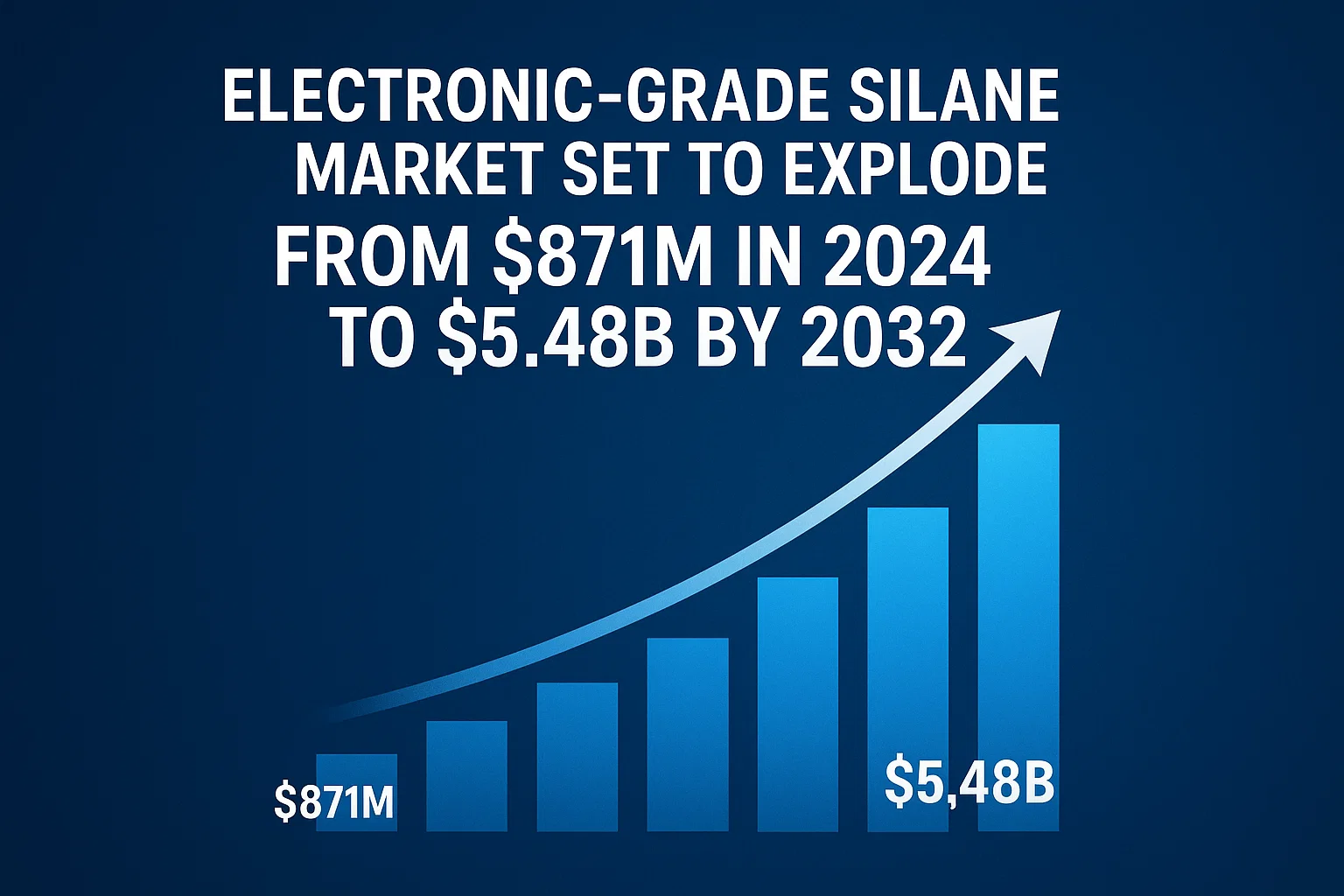
Electronic-Grade Silane Market Set to Explode from $871M in 2024 to $5.48B by 2032
When we talk about the backbone of the digital economy, our minds often jump to semiconductors, solar panels, and advanced display technologies. But behind the scenes lies a highly specialized gas electronic-grade silane (SiH₄) that makes these innovations possible.
In 2024, the electronic-grade SiH₄ silane gas market was valued at approximately USD 871 million, and industry projections suggest that it could soar to USD 5,481 million by 2032, representing a stunning CAGR of 32.5%. This meteoric growth is tied directly to the twin engines of technological advancement: semiconductor manufacturing and the global energy transition through solar photovoltaics (PV).
Access Your Free Sample Report- Electronic Grade SiH4 Silane Gas Market
The Semiconductor Boom: Why Silane Gas Matters
1. Fab Expansions by Tech Giants
Companies like TSMC, Intel, and Samsung are in the middle of historic expansion projects in the U.S., Europe, and Asia. These fabs require vast amounts of electronic-grade gases, with silane among the most critical for chemical vapor deposition (CVD) and epitaxial layer growth.
- TSMC is investing over $40 billion in Arizona, with silane procurement central to supporting advanced 3nm and 2nm process nodes.
- Samsung Electronics is doubling down in South Korea, particularly in its Pyeongtaek campus, ensuring a steady pipeline for electronic gases.
- Intel is rolling out new fabs in Ohio and expanding in Ireland, relying heavily on U.S.-based suppliers for high-purity silane.
Reports from Nikkei Asia and Bloomberg emphasize how chipmakers are diversifying supply to avoid bottlenecks like those seen during the 2020–2022 semiconductor shortage. Silane, due to its volatility and storage challenges, cannot simply be stockpiled, which makes localized production capacity even more important.
2. Supply Chain Security and the U.S. CHIPS Act
The CHIPS and Science Act (2022) is more than just a funding mechanism for fabs; it also signals a reshoring of critical materials like silane. The Wall Street Journal and Financial Times have highlighted how U.S. policymakers are urging companies like Air Products and Linde to increase domestic output.
This is not just about economics it’s about national security. With silane classified as both a hazardous and strategic material, governments are scrutinizing dependence on overseas suppliers.
Solar Energy: Silane’s Other Growth Engine
1. Thin-Film Solar Resurgence
While crystalline silicon dominates solar PV, thin-film solar cells particularly amorphous silicon (a-Si) and hydrogenated silicon (a-Si:H) are seeing a resurgence in applications where flexibility and cost-effectiveness matter.
Silane is indispensable in depositing thin silicon layers through plasma-enhanced chemical vapor deposition (PECVD). Recent coverage in the South China Morning Post points out that China and India are scaling solar deployments at breakneck speed, with silane demand surging as a result.
2. Energy Transition Policies
Global climate commitments, especially in the EU and Asia, are reinforcing demand for solar technologies. The International Energy Agency (IEA) has repeatedly flagged specialty gases like silane as critical bottlenecks for scaling renewable energy production.
Download Sample Report PDF- Electronic Grade SiH4 Silane Gas Market
Industry Leaders: Who’s Driving the Market?
1. Air Products & Chemicals
A long-time leader in specialty gases, Air Products has expanded silane production to support U.S. and Asian fabs. Their recent announcements, covered by Reuters, tie directly into large-scale supply contracts with Intel and Samsung.
2. Linde
Linde has invested in expanding its electronic materials footprint, notably in Taiwan and South Korea. The company is focusing on ultra-high purity silane that meets stringent requirements of next-gen semiconductors.
3. Shin-Etsu Chemical
Japan’s Shin-Etsu Chemical, better known for its semiconductor wafers, has also made major moves in electronic-grade gases. As Nikkei Asia reported, Shin-Etsu is building additional silane production capacity to serve domestic fabs and global clients.
4. SK Materials
South Korea’s SK Materials has aggressively expanded, investing in new silane plants and signing long-term contracts with Samsung. Local coverage in Yonhap News highlights its role in positioning Korea as a hub for high-purity gas production.
Safety and Environmental Concerns
While silane is indispensable, it’s also highly pyrophoric, igniting spontaneously in air. This makes storage, transportation, and handling particularly challenging. Industry leaders are investing heavily in:
- On-site generation technologies to minimize transport risks.
- Advanced cylinder and pipeline systems for safer delivery.
- Environmental compliance to address emissions during production.
Chemical & Engineering News (C&EN) has reported on ongoing R&D into more sustainable silane production methods that reduce carbon footprints while maintaining purity.
Strategic Geopolitics: Silane in the Crosshairs
Silane may not make headlines like rare earths or lithium, but its strategic importance is rising. Semiconductor and solar industries are considered geopolitical assets, and silane sits at the heart of both.
- S. vs. China tech rivalry: Washington has restricted exports of high-end semiconductor tools, while Beijing has ramped up local silane capacity to ensure self-sufficiency.
- Europe’s push for autonomy: With energy and semiconductor concerns intertwined, the EU is investing in local specialty gas capacity.
- Korea and Japan’s edge: Regional champions like SK Materials and Shin-Etsu are building global supply leadership.
Click Here To Download Full Sample Report- Electronic Grade SiH4 Silane Gas Market
Market Outlook: 2024–2032
The projected CAGR of 32.5% is among the fastest in the specialty chemicals sector. Key drivers include:
- Semiconductor scaling – More fabs, smaller nodes, higher purity demands.
- Solar PV acceleration – Particularly in Asia and emerging markets.
- Supply chain localization – Governments pushing for domestic silane production.
- Technological innovations – New silane handling and synthesis methods improving safety and efficiency.
The market’s projected growth from USD 871 million in 2024 to USD 5,481 million by 2032 is not just a number. It represents a profound shift in the way societies produce energy and information. With geopolitical, technological, and environmental forces converging, the silane industry will remain in the spotlight for years to come.

Comments (0)