
Electric Fuses Market Enhancing Power Protection in High Density Chips for Upcoming Years
Where Circuit Protection Meets Semiconductor Evolution
As electronic architectures become more compact and power intensive, electric fuses have quietly emerged as essential components ensuring circuit integrity, thermal stability, and system reliability. As silent protectors of electronic ecosystems, fuses guard against catastrophic failures brought on by overcurrent and short circuits, in contrast to apparent semiconductor advancements like processors or memory chips.
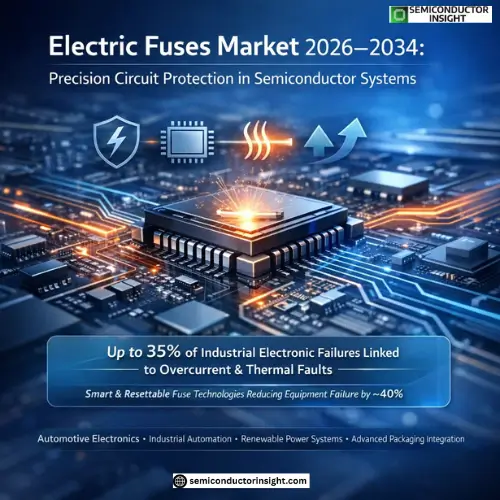
The rising complexity of high-density semiconductor devices, power electronics, and connected technologies has significantly increased the need for reliable circuit interruption mechanisms. According to electrical safety studies published in engineering journals, nearly 30-35% of electronic system failures in industrial environments are linked to current overload or thermal faults, reinforcing the growing importance of fuse integration in semiconductor manufacturing and device design.
Electric fuses today are no longer simple sacrificial wires. They represent engineered safety components designed with precise response thresholds, rapid interruption capability, and material-level optimization compatible with advanced semiconductor packaging.
Understanding Electric Fuse Architecture in Semiconductor Systems
Electric fuses function by breaking a circuit when current exceeds a defined threshold, protecting sensitive semiconductor components from damage. However, modern semiconductor environments demand greater sophistication in fuse design.
- Material Engineering and Thermal Response
Semiconductor-grade fuses typically use silver alloys, zinc compositions, or thin-film materials engineered for predictable melting behavior. Their performance depends on thermal conductivity, current density tolerance, and response time accuracy. Thin-film fuses, widely used in integrated circuits, can respond within milliseconds, protecting microelectronic components from irreversible damage.
- Integration with Microelectronic Packaging
Advanced semiconductor packaging methods such as system-in-package modules require miniature protection devices. Electric fuses are increasingly embedded within printed circuit boards, power modules, and integrated chips, enabling compact protection without compromising performance.
Industry publications report that miniaturized fuse designs have reduced device failure rates by nearly 20% in high-power electronic assemblies, particularly in automotive and industrial electronics.
Application Landscape across Semiconductor Driven Technologies
Electric fuses play a critical role across diverse semiconductor applications where power management and reliability are essential.
In automotive electronics, modern electric vehicles contain more than 3,000 semiconductor components controlling battery systems, sensors, and power distribution networks. Electric fuses prevent battery overload incidents and ensure safe energy flow across high-voltage architectures.
In consumer electronics, smartphones and computing devices rely on compact fuse solutions to protect processors and charging circuits. Studies in electronics reliability journals show that optimized fuse protection can extend device lifespan by 15-25% by preventing thermal stress.
In industrial automation, semiconductor-controlled motor drives and robotics require precise current interruption to avoid equipment damage and production downtime. Electric fuses ensure continuous operation by isolating faults instantly.
Renewable energy systems also depend heavily on semiconductor power converters, where electric fuses protect photovoltaic inverters and energy storage systems from electrical fluctuations.
Feel Free to Reach Our Most Recent Updates of the Report: https://semiconductorinsight.com/report/electric-fuses-market/
Client Perspective Benefits of Electric Fuse Implementation
- From a client or end-user standpoint, electric fuses provide measurable operational and economic value beyond basic safety.
- One of the primary advantages is equipment protection reliability. Electric fuses offer fast response times that safeguard costly semiconductor components, reducing replacement costs and system downtime. This is particularly valuable in industrial environments where equipment failure can halt production.
- Another benefit is cost efficiency. Compared with complex protection mechanisms, electric fuses remain relatively inexpensive while delivering high reliability. Their simple structure allows easy integration into semiconductor assemblies without major design changes.
Electric fuses also support system longevity by preventing repeated exposure to excessive current, which gradually degrades semiconductor performance. By limiting thermal stress, they help maintain consistent device efficiency over time.
From a compliance perspective, electric fuses assist organizations in meeting international electrical safety standards, improving product credibility and operational safety.
Technology Innovation in Smart and Resettable Fuse Systems
Technological advancement is transforming the electric fuse landscape through intelligent protection capabilities.
- Resettable polymer fuses represent a major innovation, allowing circuits to automatically restore functionality after fault conditions are resolved. These devices enhance operational continuity in semiconductor equipment.
- Digital monitoring integration is another emerging trend. Some advanced fuse systems incorporate sensing mechanisms that provide real-time fault detection and diagnostic feedback, improving system management and predictive maintenance.
Engineering research indicates that smart fuse technologies can reduce unexpected equipment failure by nearly 40% in automated industrial environments, demonstrating their growing relevance in semiconductor applications.
Electric Fuses as Foundational Components in Modern Electronics Infrastructure
As semiconductor technologies continue to power digital transformation across industries, electric fuses remain fundamental to maintaining safe and stable electronic operations. Their evolution from simple protective elements to engineered safety solutions reflects the growing demand for reliability in power-intensive semiconductor environments.
By combining precision engineering, material science innovation, and advanced integration capabilities, electric fuses support the continuous expansion of high-performance electronics. Their contribution to circuit protection, equipment longevity, and operational safety positions them as indispensable components within the semiconductor ecosystem.

Comments (0)