
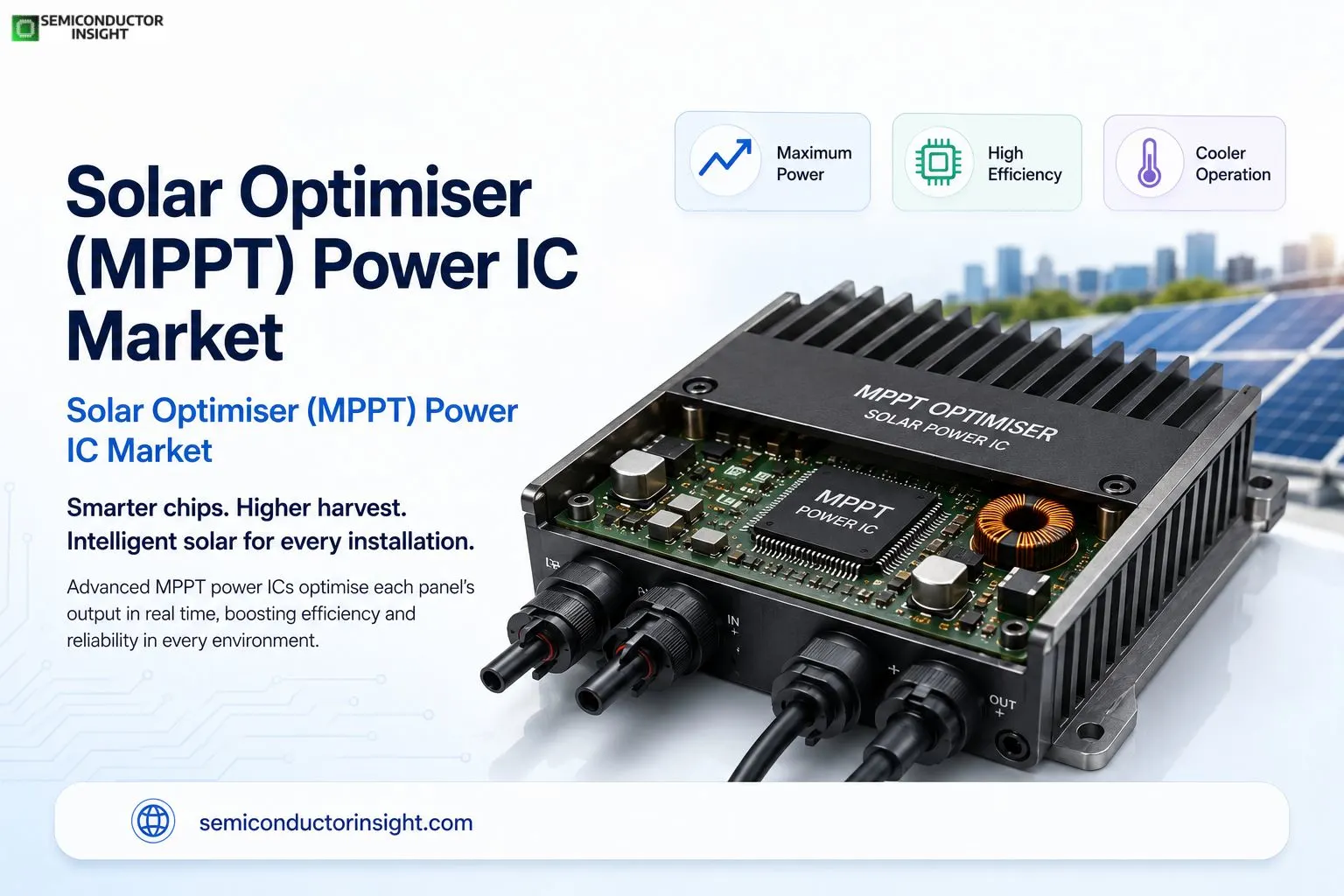
Efficiency Unleashed Inside Solar Optimiser (MPPT) Power IC Market Boom
Solar power systems are no longer operating as passive electricity generators. Across utility farms, commercial rooftops, smart factories, and residential installations, the industry is shifting toward intelligent energy conversion systems capable of monitoring, adjusting, and maximising power output every second. At the centre of this transformation sits Solar Optimiser (MPPT) Power IC Market, a semiconductor segment gaining attention for its role in extracting the highest possible efficiency from solar modules under changing environmental conditions.
- Modern MPPT power ICs enable optimisation at the individual panel level, in contrast to conventional solar designs that mostly rely on centralised inverters.
- As solar installations spread into busy urban roofs, shadowed industrial campuses, floating solar farms, and mixed-angle installations where sunshine conditions change continuously throughout the day, this has become more crucial.
- The momentum behind this technology is visible worldwide.
- According to the International Energy Agency, global renewable electricity additions crossed 560 GW in 2025, with solar photovoltaic installations accounting for the largest share.
China alone added more than 210 GW of solar capacity during the year, while Europe continued aggressive rooftop solar deployments driven by energy security concerns and grid modernisation programs. These large-scale installations are directly increasing demand for advanced semiconductor-based MPPT architectures capable of improving conversion efficiency while reducing heat losses inside solar electronics.
Take a Quick Glance at Our In-Depth Analysis Report: https://semiconductorinsight.com/report/solar-optimizer-mppt-power-ic-market/
Tiny Semiconductor Chips Solving Large-Scale Energy Problems
- One of the biggest engineering challenges in solar systems is power mismatch. A single shaded or dust-covered panel can reduce the performance of an entire string.
- Semiconductor companies are now designing highly integrated MPPT power ICs that continuously track voltage and current fluctuations at ultra-fast speeds, allowing each module to operate independently at its peak power point.
- This capability is becoming critical in dense urban projects. In cities such as Tokyo, Seoul, Amsterdam, and Singapore, rooftop solar systems are installed across irregular building layouts where sunlight exposure changes hour by hour.
- Semiconductor-driven solar optimisers help maintain stable output despite partial shading from surrounding infrastructure.
- Several recent deployments highlight this shift. In California, smart solar installations paired with module-level optimisation technologies are increasingly being integrated into battery-backed residential systems to maintain stable energy flow during grid instability.
- Similar adoption trends are appearing across Germany and Australia, where household solar plus storage combinations are becoming mainstream energy assets rather than backup systems.
Gallium Nitride and Silicon Carbide Are Changing the Efficiency Equation
Solar Optimiser (MPPT) Power IC Market is also benefiting from the rise of wide-band gap semiconductor materials such as Gallium Nitride and Silicon Carbide. Traditional silicon-based power ICs remain dominant, but next-generation materials are allowing smaller, cooler, and faster switching devices with significantly improved energy conversion capabilities.
Gallium Nitride-based power components are now appearing in compact solar optimiser modules where thermal efficiency is critical. These devices can operate at higher frequencies while reducing energy losses, making them ideal for modern distributed solar systems integrated with EV charging stations, portable energy storage units, and smart grid infrastructure.
Recent semiconductor product launches from global energy electronics companies have demonstrated optimiser solutions capable of exceeding 99% tracking efficiency under variable irradiance conditions. In utility-scale installations, even a one per cent gain in conversion performance can translate into several megawatt-hours of additional annual electricity generation.
Data Centres and AI Infrastructure Are Creating Unexpected Demand
- An emerging trend influencing the Solar Optimiser (MPPT) Power IC Market comes from the explosive expansion of AI data centres. Large technology companies are rapidly investing in renewable-powered infrastructure to support rising electricity consumption from AI workloads and cloud computing facilities.
- In the United States, hyperscale data centre campuses are increasingly adopting hybrid solar systems combined with battery storage and intelligent power management chips. These installations require advanced MPPT semiconductor solutions capable of balancing fluctuating energy loads while maintaining conversion efficiency under varying environmental conditions.
- The relationship between AI infrastructure and semiconductor-based solar optimisation is creating a new industrial ecosystem where energy electronics are becoming as strategically important as processors and memory chips. This is pushing semiconductor manufacturers to develop highly integrated IC platforms that combine power conversion, thermal monitoring, predictive diagnostics, and digital communication interfaces within a single compact architecture.
Solar Electronics Are Moving Toward Self-Adjusting Energy Networks
Modern MPPT power ICs are evolving beyond traditional energy tracking functions. New designs now incorporate embedded sensing technologies, wireless communication support, and real-time fault detection systems that enable predictive maintenance across large solar arrays.
This trend is especially visible in smart agriculture and remote industrial projects. In regions such as the Middle East and parts of Africa, solar-powered irrigation systems are increasingly relying on intelligent optimiser ICs capable of adapting to dust accumulation, extreme temperatures, and unstable environmental conditions without constant manual intervention.
- Industry engineers are also experimenting with AI-assisted MPPT algorithms that dynamically learn weather patterns and panel behaviour to improve long-term efficiency.
- As semiconductor integration deepens, the Solar Optimiser (MPPT) Power IC Market is gradually moving from simple power management toward autonomous solar intelligence systems capable of optimising energy generation at both micro and grid scales.
The semiconductor industry’s growing role in renewable infrastructure suggests that MPPT power ICs are no longer niche components hidden inside solar hardware. They are becoming foundational technologies supporting the next generation of intelligent energy systems worldwide.

Comments (0)