
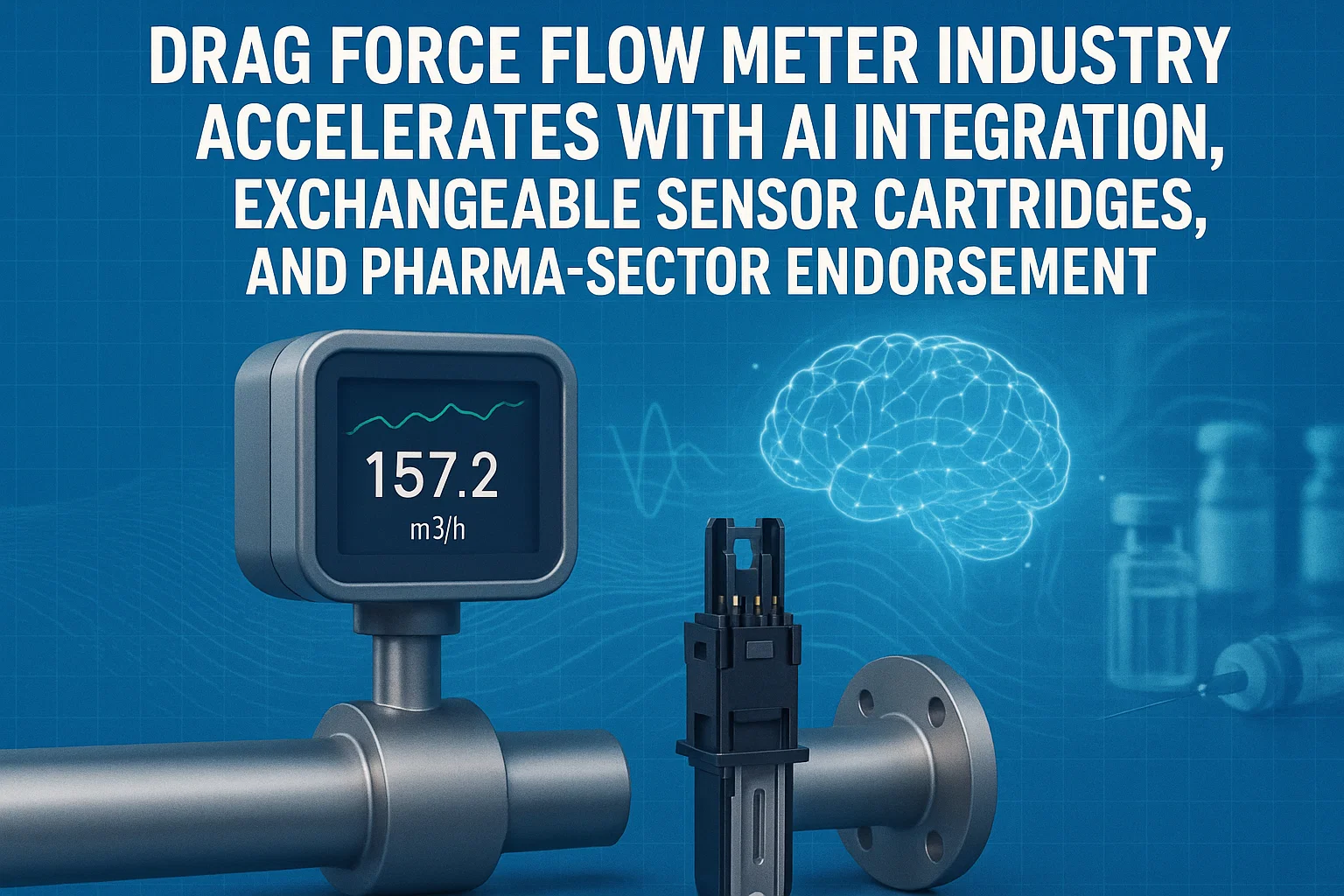
Drag Force Flow Meter Industry Accelerates with AI Integration, Exchangeable Sensor Cartridges, and Pharma-Sector Endorsement
The Drag Force Flow Meter (DFFM) market is undergoing a period of robust transformation, propelled by technological breakthroughs, cross-industry adoption, and the growing need for highly accurate flow measurement solutions. Valued at US$ 156 million in 2024, the global market is expected to reach US$ 251 million by 2032, registering a compound annual growth rate (CAGR) of 7.0% between 2025 and 2032.
This growth trajectory is underpinned by advancements such as exchangeable sensor cartridges, non-wetted electrode designs, AI and IoT integration, and the pharmaceutical industry’s adoption of Drag Flow Force technology. Collectively, these developments are redefining flow measurement capabilities across sectors like water management, oil and gas, pharmaceuticals, food processing, and chemical manufacturing.
Access Your Free Sample Report- Drag Force Flow Meter Market
Understanding Drag Force Flow Meters: The Basics
How They Work
Drag Force Flow Meters operate by placing a bluff body or sensor into the fluid stream, measuring the force exerted by the moving fluid. This drag force is directly related to the fluid’s velocity and density, allowing precise calculation of volumetric or mass flow rate.
Unlike turbine or electromagnetic meters, DFFMs excel in applications where low maintenance, resistance to fouling and stability under fluctuating flow conditions are essential.
Key Advantages
- High Sensitivity: Capable of detecting minimal flow changes, crucial in pharmaceutical and chemical processes.
- Robustness: Operates effectively in high-temperature and high-pressure environments.
- Low Maintenance: Few moving parts and self-cleaning potential reduce downtime.
- Versatility: Suitable for both liquids and gases, including viscous and particulate-laden flows.
Market Overview and Growth Outlook
The Drag Force Flow Meter market, valued at US$ 156 million in 2024, is projected to reach US$ 251 million by 2032. Several factors are driving this expansion:
- Process Automation Growth: As industries adopt Industry 4.0 principles, the demand for real-time flow monitoring increases.
- Regulatory Compliance: Sectors like pharmaceuticals and food processing require stringent flow control for quality and safety.
- Energy Efficiency: Accurate flow measurement helps optimize energy usage in pumping and distribution systems.
- Technological Upgrades: New product designs and smart capabilities are expanding the addressable market.
Key Recent Developments in the Drag Force Flow Meter Industry
Exchangeable Sensor Cartridges — Minimizing Downtime
In May 2025, VPInstruments unveiled flow meters with exchangeable sensor cartridges. This advancement enables operators to replace sensor units on-site without halting production, eliminating costly downtime associated with recalibration.
Impact on the Industry:
- Enhances operational efficiency.
- Reduces service costs and calibration turnaround time.
- Encourages adoption in sectors where downtime costs are significant, such as oil refineries and continuous chemical plants.
Yokogawa’s OpreX Magnetic Flowmeter CA Series
Although this development is in the magnetic flowmeter segment, it signals broader flow measurement innovation trends. Yokogawa’s OpreX Magnetic Flowmeter CA Series features non-wetted electrode technology that improves user-friendliness, maintainability, and accuracy.
Relevance to Drag Force Flow Meters:
- Indicates market-wide emphasis on low-maintenance designs.
- Sets benchmarks for ease-of-use that DFFM manufacturers can emulate.
- Highlights customer demand for reliability in mission-critical flow monitoring.
AI and IoT Integration in Flow Measurement
Flow meters across industries are being equipped with AI-driven analytics and IoT connectivity. The technology enables:
- Predictive Maintenance: Identifying sensor drift or buildup before failures occur.
- Self-Calibration: Automatically adjusting measurement parameters for optimal performance.
- Real-Time Anomaly Detection: Enhancing safety in critical processes like offshore oil drilling.
For DFFMs, this means integration into smart plant ecosystems, where flow data is aggregated, analyzed, and acted upon in near real time.
Indian Pharmaceutical Alliance Endorses Drag Flow Force Technology
In July 2024, the Indian Pharmaceutical Alliance (IPA) officially recognized Lenterra’s Drag Flow Force (DFF) sensor as a sensitive and precise Process Analytical Technology (PAT) tool for monitoring high-shear granulation in pharmaceutical manufacturing.
Why This Matters:
- Establishes regulatory credibility for DFFMs in pharma.
- Opens opportunities in real-time quality control during drug formulation.
- Demonstrates versatility beyond traditional industrial flow applications.
Download Sample Report PDF- Drag Force Flow Meter Market
Sector-Specific Adoption Trends
Oil and Gas
Drag Force Flow Meters are increasingly used for:
- Monitoring gas lift operations.
- Measuring injection water flow rates.
- Optimizing refinery steam distribution.
The industry’s need for rugged devices capable of withstanding extreme conditions aligns perfectly with DFFM capabilities.
Water and Wastewater Management
Municipalities are adopting DFFMs for:
- Non-intrusive flow monitoring in aging infrastructure.
- Detecting leaks in smart water networks.
- Measuring treatment plant output to meet environmental compliance.
Pharmaceutical and Biotech
With IPA’s endorsement, pharmaceutical adoption will expand, particularly in:
- Granulation processes.
- Continuous manufacturing lines.
- Sterile liquid filling systems requiring precise flow regulation.
Food and Beverage
Applications include:
- Monitoring flow in pasteurization lines.
- Ensuring consistent dosing in flavor or additive injection systems.
- Verifying CIP (clean-in-place) fluid flow for sanitation compliance.
Regional Market Dynamics
North America
- Mature market with high penetration in oil & gas and water sectors.
- Increasing adoption of smart flow meters in municipal infrastructure upgrades.
Europe
- Strong push for energy efficiency and industrial automation.
- Regulatory frameworks in pharmaceuticals and food drive adoption.
Asia-Pacific
- Fastest growth rate, driven by industrial expansion in China, India, and Southeast Asia.
- Government initiatives for smart manufacturing and smart cities boost demand.
Competitive Landscape
Leading players in the Drag Force Flow Meter space include:
- Lenterra
- VPInstruments
- Emerson Electric Co.
- Siemens AG
- ABB Ltd.
Competition is centered on:
- Sensor accuracy and sensitivity.
- Integration with plant-wide control systems.
- Maintenance-friendly designs.
Future Outlook and Opportunities
The next decade for Drag Force Flow Meters will be shaped by:
- Advanced materials to handle corrosive and high-temperature fluids.
- Miniaturization for portable or embedded applications.
- Hybrid technologies combining drag force sensing with ultrasonic or magnetic measurement for higher accuracy.
Manufacturers who invest in AI-powered analytics, cybersecurity for IoT-enabled devices, and cross-sector customization will be best positioned to capture market share.
Click Here To Download Full Sample Report- Drag Force Flow Meter Market
The Drag Force Flow Meter industry is on a path of sustained growth—from US$ 156 million in 2024 to US$ 251 million by 2032—thanks to innovations that enhance reliability, reduce downtime, and integrate smart capabilities. Developments like exchangeable sensor cartridges, non-wetted electrode designs, and pharma-sector endorsement are not just incremental improvements—they are reshaping market expectations.
As industries demand more precise, reliable, and connected flow measurement solutions, DFFMs are emerging as a key enabler of efficiency, compliance, and operational excellence.

Comments (0)