
Digital Array Microphone Market 2026: 71.5 dB SNR, 130 dBSPL and the New Era of AI Audio Capture
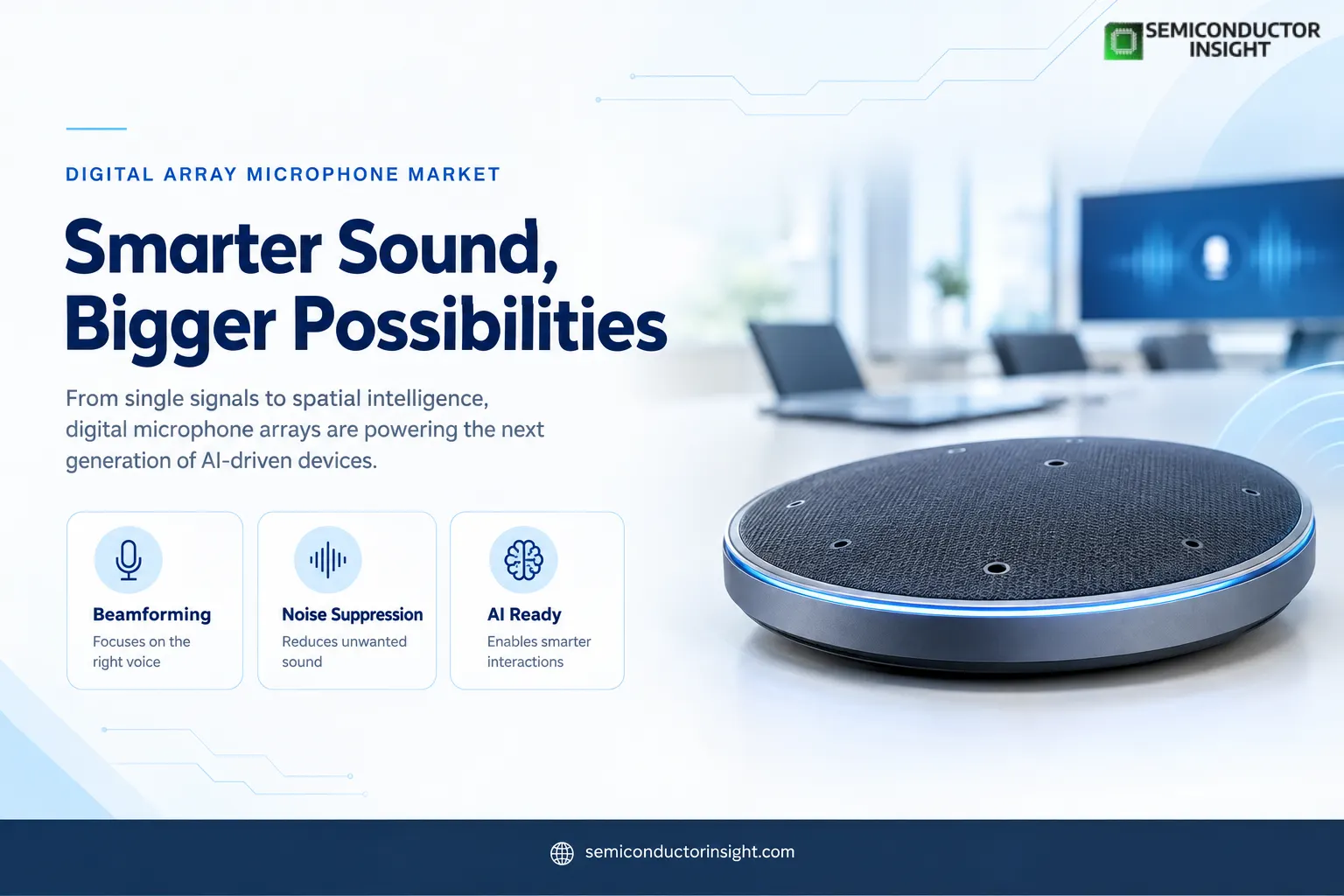
A microphone used to have one straightforward job: convert sound into an electrical signal. That definition is becoming outdated. Modern digital microphone arrays combine several MEMS microphones with signal processing, beamforming, acoustic echo cancellation and noise suppression so that a device can determine not only what was said, but increasingly where the sound came from.
This shift is particularly important for AI-enabled headphones, conference equipment, smart speakers, automotive cabins, laptops, robots, televisions and edge devices. TDK noted in January 2026 that products are increasingly incorporating multiple microphones as AI-driven voice interfaces become more sophisticated.
From one listening point to spatial hearing
The defining feature of a digital array is the relationship between multiple microphones. Each sensor receives the same acoustic event at a slightly different time and level. Digital signal processing uses these differences to emphasize a target speaker while reducing unwanted sound.
Sound source → Multiple MEMS microphones → PDM data → Beamforming → Noise suppression → Voice extraction → AI processing
This architecture allows the microphone subsystem to become an input layer for speech recognition and contextual AI rather than simply an audio recording component.
The numbers tell the hardware story
- Technical specifications reveal how quickly the underlying semiconductor components are advancing.
- Infineon’s IM72D128V, introduced as part of its expanded 2025 XENSIV portfolio, delivers a 71.5 dB(A) SNR, operates at 430 µA in high-performance mode, and has a package measuring only 4 × 3 × 1.2 mm³.
- Its low-power mode reduces consumption to 160 µA.
- Infineon’s IM69D129F is even smaller at 3.5 × 2.65 × 0.98 mm³, while delivering 69 dB(A) SNR and supporting multi-microphone designs.
- These specifications matter because arrays require several sensors, making package size, matching, power consumption and phase consistency increasingly important.
Why matching between microphones matters
An array cannot simply combine several inexpensive microphones and expect accurate beamforming. Differences in sensitivity and phase can distort spatial calculations.
This is why manufacturers are focusing on tight component tolerances. Infineon highlights ±1 dB sensitivity tolerance and tight phase matching for multi-microphone applications. The company’s microphone portfolio specifically targets beamforming, source separation and audio zoom functions.
The engineering priority is therefore changing from “How loud is the microphone?” to “How consistently do several microphones behave together?”
2026 brings AI closer to the microphone
AI is changing the role of microphone arrays. TDK’s 2026 discussion highlights acoustic activity detection, ultra-low-power operation and beamforming as important technologies for always-on and edge-AI systems. Acoustic activity detection can allow a device to remain in a low-power state and react when meaningful sound is detected.
This creates a new processing chain:
Always listening → Detect acoustic event → Wake system → Locate speaker → Suppress interference → Recognize speech → Trigger AI response
The result is particularly useful for battery-powered devices where continuously running a large processor would consume too much energy.
To find out more, feel free to browse our latest updated report: https://semiconductorinsight.com/report/digital-array-microphone-market/
Conference rooms are becoming an important proving ground
The technology is no longer restricted to consumer electronics. Shure’s June 2026 launch of the MXA925 ceiling array microphone shows how beamforming and intelligent audio processing are being applied to professional meeting environments. The company positioned the system for conference and discussion spaces, including difficult acoustic environments.
Shure’s Microflex Advance platform uses beamforming and digital signal processing to capture specific areas of a room while reducing unwanted noise and echo. This demonstrates how microphone arrays can replace the conventional assumption that speakers must sit close to a microphone.
Automotive cabins are becoming another acoustic battlefield
Inside a vehicle, microphones have to contend with road noise, ventilation systems, passengers, music and changing cabin conditions. Infineon identifies automotive applications alongside voice interfaces, industrial automation and home automation for its MEMS microphone technology.
The opportunity is broader than hands-free calling. Arrays can support voice-controlled infotainment, passenger-specific voice capture, acoustic event detection and increasingly sophisticated human-machine interaction.
What is changing inside the semiconductor package?
The latest generation of digital microphones combines the MEMS sensing element with electronics such as amplifiers and sigma-delta converters before delivering digital output. PDM interfaces are particularly useful for compact multi-microphone architectures because microphone signals can be transferred digitally into the host processing chain.
Infineon’s IM69D130, for example, provides 69 dB(A) SNR, 130 dBSPL acoustic overload capability, a 4 × 3 × 1.2 mm³ package and digital PDM output.
That combination of tiny geometry, high dynamic range and digital connectivity is helping microphone arrays become practical in increasingly small devices.
The new definition of a microphone array
The digital array microphone market is increasingly less about selling a collection of microphones and more about building an acoustic perception layer.
Sensor density + matching + low power + digital interfaces + beamforming + AI
That combination is moving microphones into a new category of semiconductor-enabled sensing. As voice interfaces spread across personal devices, vehicles, conference systems, robots and edge-AI products, the value of the array increasingly comes from what the system can understand from sound rather than simply how accurately it can record it.

Comments (0)