
Demand Forecast for Automotive Seat MCU Market and the Evolution of Automotive Chips in Smart Car Interiors
The automotive industry is rapidly shifting toward software-defined vehicles, connected interiors, and intelligent comfort systems, placing the Automotive Seat Microcontroller (MCU) Market at the centre of next-generation vehicle electronics. Automotive seat MCUs are specialized semiconductor chips that control seat positioning, heating, ventilation, massage functions, and memory adjustment while ensuring safety, efficiency, and seamless integration with vehicle networks.
This market is expanding rapidly as vehicles evolve into digital mobility platforms where comfort, personalization, and smart interior experiences define consumer value. With growing adoption of electric vehicles, premium cabins, and automated driving features, automotive seating systems are becoming intelligent control nodes powered by high-performance microcontrollers.
Don’t Forget to Surf Our Updated Report for More Detailed Analysis:
https://semiconductorinsight.com/report/automotive-seat-microcontroller-mcu-market/
The silent semiconductor powering modern vehicle comfort
Automotive seat MCUs function as the central processing unit of intelligent seating systems, managing sensors, motors, and communication modules. These chips process real-time data to control lumbar support, temperature regulation, headrest movement, and posture optimization.
Modern seat controller solutions integrate multiple semiconductor components including pressure sensors, temperature sensors, accelerometers, and motor drivers. The microcontroller processes these inputs to ensure smooth seat adjustment, safety monitoring, and personalized memory positioning.
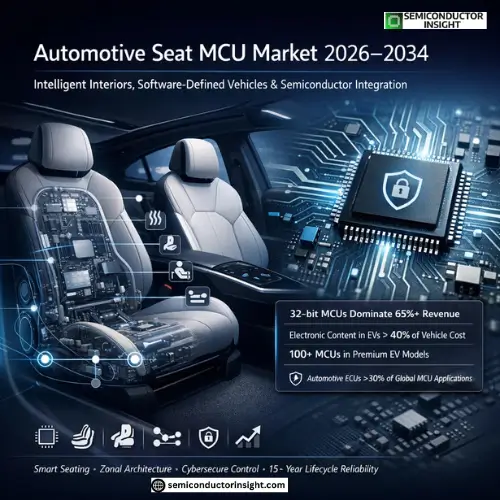
Today, more than 65% of automotive MCU revenue is dominated by 32-bit architectures, reflecting the need for higher processing power in advanced automotive applications.
The growing demand for premium comfort features is reshaping vehicle interiors into digitally controlled environments where semiconductor-driven seating becomes a key differentiator.
Smart vehicle interiors reshaping semiconductor demand
Vehicle interiors are becoming digital living spaces, and intelligent seating is a major part of this transformation. Automotive seat MCUs enable features such as:
- Memory seat positioning for personalized comfort
- Thermal seat regulation systems for climate control
- Massage and posture support technologies
- Safety alerts and motor stall prevention
The shift toward electric vehicles and connected mobility is increasing electronic content per vehicle from nearly 20% of total vehicle cost in 2010 to over 40% in modern EVs, significantly driving semiconductor demand.
As manufacturers compete on cabin experience rather than mechanical performance alone, semiconductor-based comfort systems are gaining strategic importance.
Vehicle electrification accelerating automotive MCU integration
- The transition toward electric mobility is one of the strongest growth accelerators for automotive seat microcontrollers. Electric vehicles require significantly more electronic control units compared to conventional vehicles, sometimes exceeding 100 microcontrollers per vehicle in premium EV models.
- Electrification introduces advanced power management systems, intelligent cabin controls, and integrated body electronics that rely heavily on automotive-grade microcontrollers.
- Passenger vehicles currently represent the largest application segment, driven by increasing adoption of premium interior features and intelligent comfort systems.
- This shift indicates that semiconductor innovation is directly linked with the evolution of vehicle interior experiences.
Zonal vehicle architecture and seat MCU integration
The automotive industry is transitioning from distributed electronic control units to zonal computing architectures, where multiple vehicle functions are consolidated into centralized processors.
This shift requires microcontrollers with higher processing capabilities and enhanced communication protocols. Zonal controller platforms are projected to grow rapidly, creating strong opportunities for advanced automotive semiconductor development.
Seat control systems are increasingly integrated into these centralized architectures, allowing synchronized operation with cockpit systems, safety modules, and vehicle networks.
Semiconductor innovation transforming intelligent seating experiences
Recent semiconductor developments continue to reshape the automotive seat MCU landscape. New automotive-grade microcontrollers with enhanced safety, security, and performance capabilities are entering the market, supporting advanced vehicle electronics and domain controllers.
Industry innovation focuses on: high-performance processing for intelligent comfort algorithms, enhanced cyber security protection for connected vehicles, integrated sensor fusion capabilities, long lifecycle semiconductor reliability exceeding 15 years. These advancements are enabling automotive manufacturers to deliver highly personalized passenger experiences.
Strategic importance of automotive seat MCUs in software defined vehicles
Automotive electronics are evolving toward software-defined architectures where vehicle functionality is determined by programmable hardware. Seat microcontrollers represent key nodes in this ecosystem, supporting digital personalization, remote configuration, and integrated vehicle intelligence.
The automotive MCU ecosystem itself is expanding rapidly, with automotive electronic control units accounting for over 30% share of microcontroller applications globally, highlighting their central role in vehicle innovation.
As vehicles transition into connected mobility platforms, intelligent seating systems will continue to serve as a crucial interface between passengers and digital vehicle environments.
Industry significance and value chain impact perspective
Rather than focusing only on future predictions, the automotive seat MCU market demonstrates a broader transformation across the automotive semiconductor value chain. From chip fabrication to vehicle integration, this market reflects how semiconductor innovation directly shapes passenger comfort, safety, and vehicle differentiation.
The increasing complexity of vehicle interiors, growing electronic content, and rising consumer expectations for personalized driving experiences position automotive seat microcontrollers as a strategic component of next-generation automotive design.
As automotive manufacturers prioritize intelligent interiors and digital user experiences, the demand for advanced automotive semiconductor solutions in seating systems is expected to remain a critical growth pillar for the global automotive electronics ecosystem.

Comments (0)