
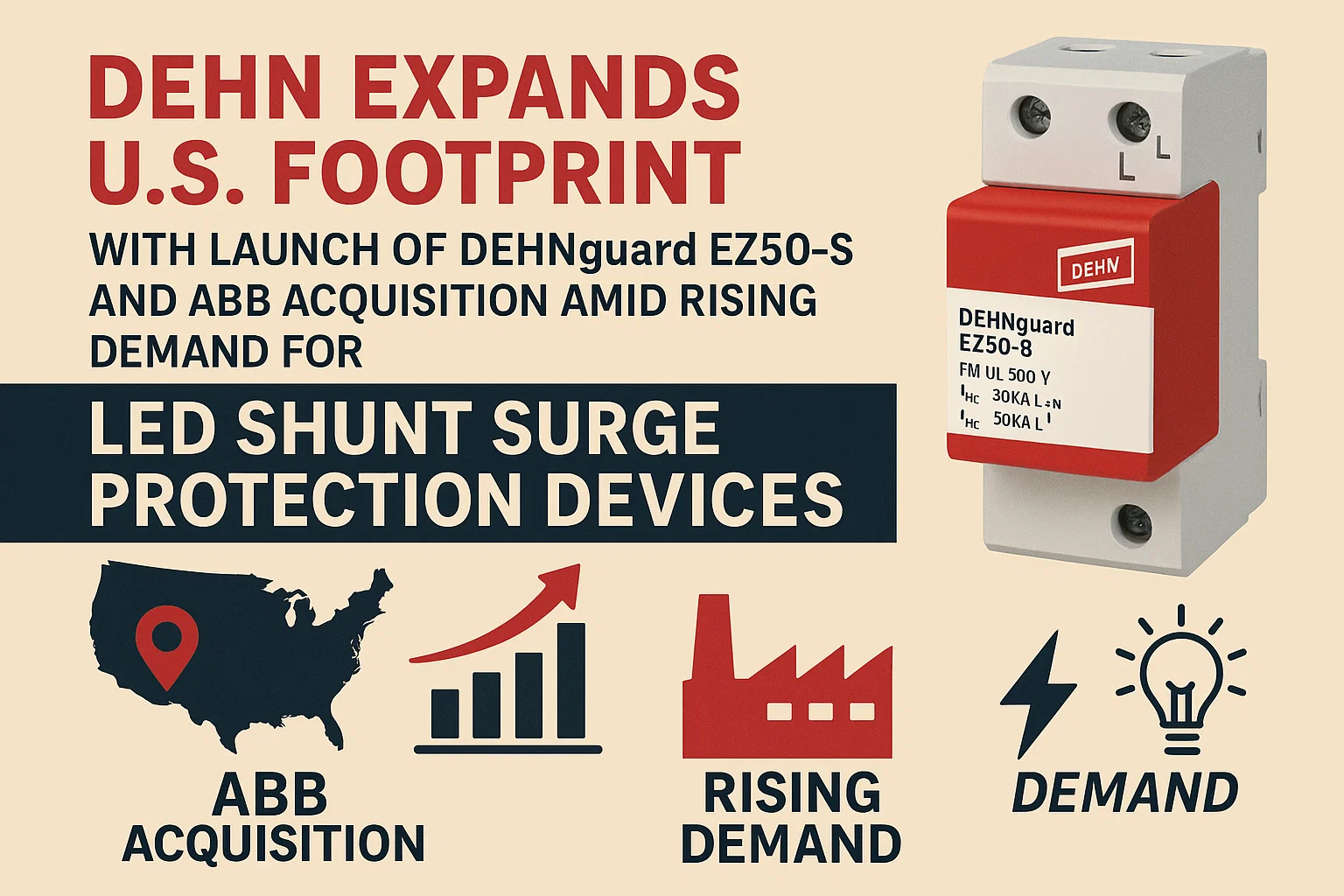
DEHN Expands U.S. Footprint with Launch of DEHNguard EZ50-S and ABB Acquisition Amid Rising Demand for LED Shunt Surge Protection Devices
The global lighting landscape has seen a remarkable transformation over the last two decades, with light-emitting diodes (LEDs) at the core of this evolution. Known for their energy efficiency, long lifespan, and environmentally friendly attributes, LEDs have become the go-to choice for lighting in residential, commercial, and industrial applications. However, as LED adoption surges, so does the need for protecting these sensitive devices from unexpected electrical anomalies—especially voltage surges. This is where LED shunt surge protection devices (SPDs) come into play.
In recent years, LED shunt SPDs have emerged as an essential component in lighting systems, providing a safeguard against transient overvoltage events that can degrade or destroy LED drivers. As the lighting industry leans increasingly into smart and connected systems, the importance of robust surge protection has never been greater.
According to current market insights, the LED Shunt Surge Protection Device market was valued at USD 156 million in 2024 and is projected to reach USD 267 million by 2032, growing at a Compound Annual Growth Rate (CAGR) of 8.0% between 2025 and 2032. This upward trajectory reflects rising global demand, innovative product developments, and an increasing number of regulatory mandates surrounding energy safety and grid reliability
Access Your Free Sample Report- LED Shunt Surge Protection Device Market.
Understanding LED Shunt Surge Protection Devices
Before diving into recent developments, it’s important to grasp the function and significance of these devices. LED shunt surge protection devices act as a fail-safe in LED lighting circuits. When a surge occurs—typically from lightning strikes, power grid switching, or electrostatic discharges—these devices shunt the excess energy away from the LED load, allowing the luminaire to continue functioning without degradation.
Without such protection, an LED may fail permanently after a single surge event. LED shunt protectors not only prevent system-wide failure but also enhance overall lighting system resilience—especially in outdoor, industrial, and mission-critical environments such as hospitals, airports, and defense facilities.
Recent Developments Shaping the Industry
DEHN Launches DEHNguard EZ50-S in the U.S. Market
One of the most notable developments in the surge protection domain came from DEHN, a German-based global leader in lightning and surge protection. In 2024, DEHN launched the DEHNguard EZ50-S in the U.S. market, specifically engineered for advanced surge protection across LED installations in infrastructure-heavy environments.
This Type 1 device boasts a NEMA 4X rating, making it highly resistant to water and dust—ideal for outdoor or high-humidity settings. It features integrated thermal disconnection and visual indicators for surge status monitoring. The product launch reflects DEHN’s strategic investment into the North American market, where demand for surge protective devices is growing rapidly due to the expansion of electric vehicle charging stations, data centers, and smart city projects.
The DEHNguard EZ50-S is also praised for its tool-less installation system, providing quick integration into existing electrical systems without the need for extensive rewiring—a feature that appeals to both OEMs and retrofit contractors.
DEHN Acquires ABB’s Surge Protection Business in the U.S.
In a move that underscores the rising competitiveness of the surge protection segment, DEHN also announced its acquisition of select assets from ABB’s U.S. surge protection business. This acquisition not only strengthens DEHN’s foothold in the American market but also allows it to leverage ABB’s well-established distribution and customer base across various sectors—particularly industrial and energy.
The deal is seen as a strategic alignment, given the growing demand for energy-efficient and resilient lighting systems that comply with evolving electrical codes, such as UL 1449 and IEC 61643. With LED usage surging across both urban and rural infrastructures, the collaboration could further accelerate innovation and distribution of LED shunt SPDs with enhanced performance metrics.
Bourns Expands LED Shunt Protector Portfolio
Bourns Inc., a prominent manufacturer of circuit protection solutions, continues to expand its LSP (LED Shunt Protector) portfolio. The company’s latest shunt protectors are engineered to work even under high-temperature conditions, with integrated thermal management and ultra-low resistance paths to ensure minimal power loss.
Noteworthy features in Bourns’ new product line include:
- High current capability (up to 1.5A)
- Fast switching response (<100 ns)
- Surface-mount compatibility for compact designs
These advancements make Bourns’ products ideal for compact, high-performance LED modules used in medical devices, automotive headlamps, and aerospace lighting. The company’s ongoing investment in R&D also reflects the increasing demand for high-reliability LED shunt SPDs in critical infrastructure and smart building environments.
IoT-Enabled Surge Diagnostics Gain Momentum
Emerging trends suggest that manufacturers are incorporating IoT capabilities into their surge protection devices. These smart systems can monitor surge events in real-time, analyze fault histories, and even communicate with building management systems (BMS) to enable predictive maintenance.
Companies are integrating Bluetooth or Zigbee modules into their SPD platforms to support connectivity with lighting controllers and cloud platforms. This innovation is particularly valuable in commercial and industrial facilities that require constant uptime and predictive asset management.
Download Sample Report PDF- LED Shunt Surge Protection Device Market
Market Size and Forecast: A Deep Dive
As of 2024, the global LED shunt surge protection device market was estimated to be worth USD 156 million, driven primarily by increasing LED installations across developing and developed nations alike. This growth is fueled by several macroeconomic and technological drivers:
Urbanization and Smart Cities
Rising urban populations and the development of smart cities are amplifying the deployment of LED street lighting, traffic management systems, and signage—all of which require reliable surge protection to ensure continuity and energy efficiency.
Electrification and Renewable Integration
As the global power infrastructure becomes more decentralized, with solar and wind farms feeding energy back into the grid, there is increased exposure to voltage fluctuations and harmonics. LED shunt SPDs are instrumental in mitigating these risks, especially in hybrid energy systems.
Stricter Safety Regulations
Global safety standards such as IEC 61643, UL 1449, and EN 61643 are pushing OEMs and electrical contractors to integrate certified surge protection into lighting systems to ensure compliance and reduce liability.
Energy Efficiency Initiatives
Governments across Europe, Asia, and North America are incentivizing energy-efficient building upgrades through tax credits and subsidies. These programs often require the integration of energy-saving LEDs and protective components like SPDs to ensure system longevity.
By 2032, the market is expected to reach USD 267 million, growing at a CAGR of 8.0% between 2025 and 2032. While North America and Europe remain major revenue contributors, Asia-Pacific is expected to witness the highest growth rate due to rapid industrialization, smart grid investments, and increasing infrastructure modernization across China, India, and Southeast Asia.
Regional Breakdown and Growth Drivers
North America
- Strong regulatory environment (UL and NEC compliance)
- High adoption of smart buildings and lighting control systems
- Significant investment in EV charging and urban lighting networks
Europe
- High deployment of LED systems in historical and government buildings
- Emphasis on sustainability and EU Green Deal commitments
- Presence of major SPD manufacturers like DEHN and Phoenix Contact
Asia-Pacific
- Accelerated LED adoption in smart cities and highway infrastructure
- Government-led initiatives such as India’s UJALA scheme
- Large-scale manufacturing hubs for LED components in China, Japan, and Taiwan
Rest of the World (Latin America, Africa, Middle East)
- Increasing electrification and grid expansion
- Rising demand for resilient lighting in off-grid applications
Challenges and Constraints
Despite the positive outlook, the market does face some constraints:
- Price Sensitivity: In cost-competitive markets, LED manufacturers may skip surge protection to save costs, despite the long-term risks.
- Low Awareness: End-users and small contractors often underestimate the importance of SPDs in LED systems.
- Supply Chain Volatility: Component shortages and geopolitical trade barriers may impact production and availability of SPD components.
Key Players and Competitive Landscape
Some of the leading manufacturers in the LED shunt surge protection device space include:
| Company | Notable Offerings |
| DEHN | DEHNguard series, hybrid surge solutions |
| Bourns Inc. | LSP series for high-temperature LED applications |
| Littelfuse | SPD modules with integrated temperature sensing |
| Phoenix Contact | SPD modules for industrial LED systems |
| EPCOS (TDK Group) | Compact surge arresters for PCB-level integration |
These players are continuously innovating in materials (e.g., MOVs, TVS diodes), thermal management, and form factors to meet the evolving needs of lighting designers, electrical contractors, and system integrators.
Click Here To Download Full Sample Report- LED Shunt Surge Protection Device Market
Future Outlook and Opportunities
Looking ahead, the LED shunt SPD market holds considerable promise, especially in emerging application areas such as:
- Electric vehicle charging stations
- Offshore oil platforms and marine navigation systems
- Aerospace and defense lighting
- Smart agriculture (LED grow lights)
In addition, regulatory pressure to reduce electrical fires and outages caused by surge events is likely to push further adoption of surge protection standards across sectors.
As global energy systems become more complex and interconnected, the need for robust, intelligent, and adaptable surge protection is more critical than ever. LED Shunt Surge Protection Devices are not just optional add-ons—they’re essential components for modern lighting systems that demand resilience, longevity, and smart integration.
With recent developments such as DEHN’s U.S. expansion, strategic acquisitions, and Bourns’ next-gen shunt protectors, the industry is clearly moving toward innovation and scalability. Backed by an estimated CAGR of 8.0%, the market is on a strong growth trajectory through 2032.
In a world increasingly dependent on resilient infrastructure and efficient lighting, LED shunt surge protection is poised to become a cornerstone of sustainable energy management.

Comments (0)