
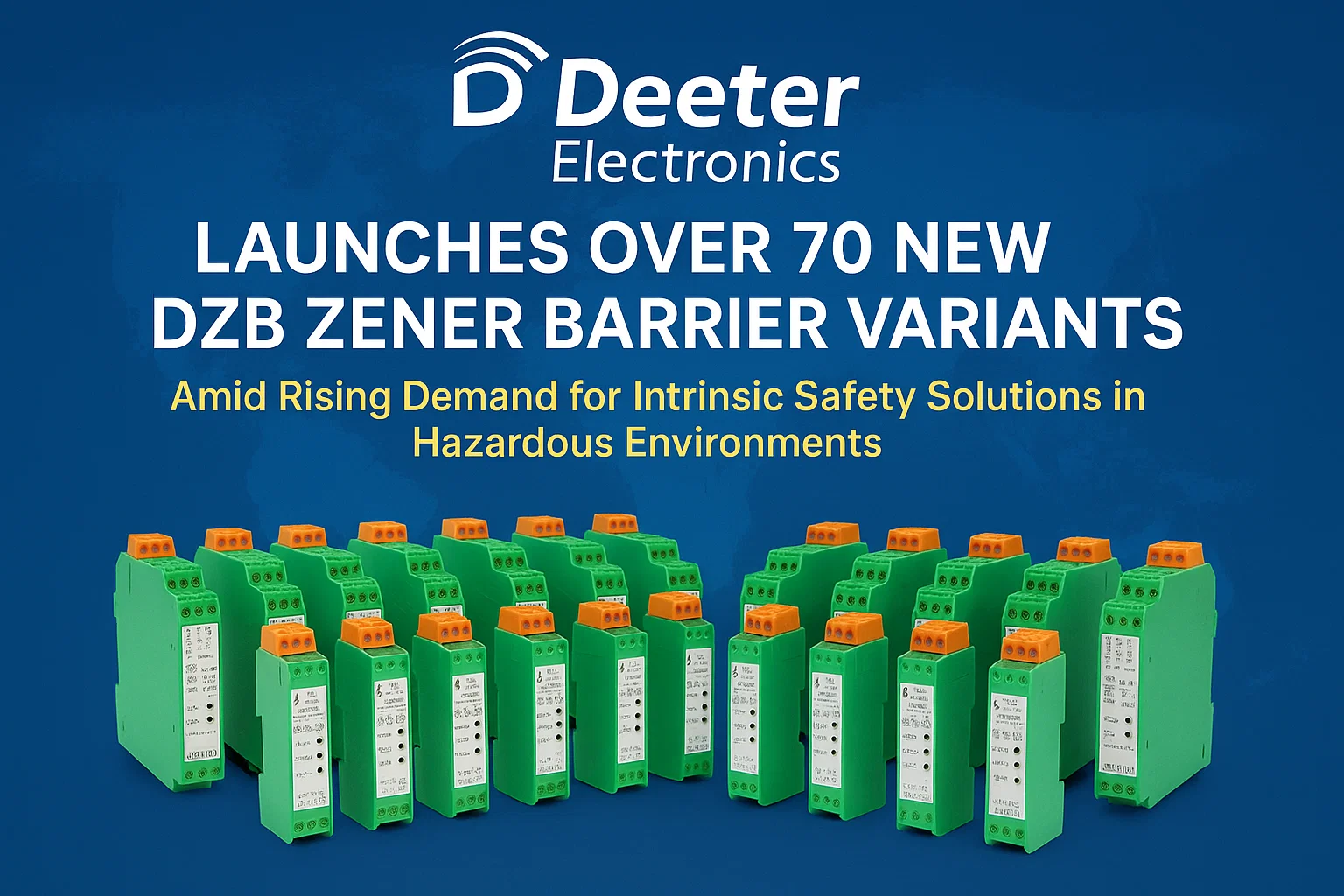
Deeter Electronics Launches Over 70 New DZB Zener Barrier Variants Amid Rising Demand for Intrinsic Safety Solutions in Hazardous Environments
In the ever-evolving landscape of industrial safety and automation, few components are as critical—yet as often overlooked—as the Zener barrier. These compact, efficient devices play a pivotal role in ensuring intrinsic safety for electrical equipment operating in hazardous environments, such as those found in oil refineries, chemical processing plants, mining operations, and energy facilities.
As industries across the globe prioritize safety, regulatory compliance, and digital transformation, the Zener Barrier market is experiencing a notable upswing. Valued at US$ 234 million in 2024, the global Zener Barrier market is projected to reach US$ 378 million by 2032, growing at a compound annual growth rate (CAGR) of 7.0% between 2025 and 2032.
Access Your Free Sample Report- Zener Barrier Market
Understanding Zener Barriers: Core of Intrinsic Safety
A Zener barrier is an intrinsic safety device used to limit energy—both voltage and current—transmitted into a hazardous area, thus preventing the ignition of flammable gases or dust. It uses Zener diodes, resistors, and fuses to provide a simple, cost-effective, and passive safety mechanism.
Unlike galvanic isolators, Zener barriers require a dedicated ground connection and are typically preferred in installations where cost-effectiveness and simplicity outweigh the flexibility of isolation.
Recent Industry Developments Driving Market Momentum
- Pepperl+Fuchs Expands Its Zener Barrier Portfolio
Pepperl+Fuchs, a recognized leader in intrinsic safety technology, continues to dominate the Zener barrier space by updating its product line to match the rising complexity of modern automation systems. The company’s recent releases offer:
- Compact DIN-rail-mounted designs
- Increased channel density
- Optimized for Industry 4.0-readiness
- Enhanced diagnostics for fault detection
These newer models are particularly useful in retrofit applications and distributed control systems (DCS), allowing customers to integrate intrinsic safety without a complete redesign of existing infrastructure.
- Deeter Electronics Launches DZB Series Zener Barriers
Deeter Electronics, a UK-based provider of sensor and control technologies, has launched an expanded DZB Series of Zener barriers, signaling a renewed push for modular and customizable safety systems. Key features include:
- Over 70 product variations covering single-, dual-, and triple-channel barriers
- Fully ATEX and IECEx certified
- Designed for DIN-rail mounting
- Options for both voltage and current-limiting needs
This breadth of options empowers engineers to precisely match barrier specifications to application demands, whether in chemical storage tanks, gas flow sensors, or automated safety interlocks.
- Turck Inc. Advances Compact Intrinsic Safety Modules
U.S.-based Turck Inc. is another noteworthy player in the Zener barrier segment. It has introduced compact, plug-in-style Zener barriers designed for space-constrained control cabinets. These developments align with broader market demands for:
- Miniaturization
- Easy module replacement
- Integrated diagnostics
- Plug-and-play compatibility
The aim is to eliminate wiring complexity and reduce downtime during maintenance—a key factor in petrochemical and offshore oil platform environments.
Technological Innovations: Moving Beyond Traditional Barriers
While the foundational design of Zener barriers remains relatively unchanged, recent technological strides are opening new doors:
- IoT-Enabled Safety Monitoring
Vendors are increasingly exploring digital diagnostics and remote monitoring features embedded within Zener barrier assemblies. Though still in nascent stages, IoT-connected barriers could enable:
- Real-time barrier health monitoring
- Predictive maintenance alerts
- Integration with SCADA systems
This evolution is expected to gain traction by 2027 as part of the broader Industry 4.0 ecosystem.
- Enhanced Surge Protection and Component Tolerances
Improved resilience to transient voltages and surges has become a priority. Vendors are developing new circuit configurations and robust component sourcing strategies to reduce failures due to electrical spikes, especially in volatile oil & gas or marine applications.
Download Sample Report PDF- Zener Barrier Market
Market Growth Drivers
Several macro- and micro-economic factors are driving the sustained growth of the Zener Barrier market:
- Stringent Safety Regulations
Governments and regulatory bodies such as IEC, ATEX, UL, and NEC continue to enforce strict mandates on explosion-proof and intrinsically safe system designs. Zener barriers are central to meeting these requirements.
- Rise in Oil & Gas Exploration Projects
New energy exploration projects in regions like the Middle East, South America, and Southeast Asia are fueling demand for intrinsically safe automation solutions. Zener barriers are an economical choice for many installations in Zone 0 and Zone 1 hazardous areas.
- Industrial Automation in Emerging Economies
The Asia-Pacific (APAC) region is seeing rapid digitization of manufacturing and processing sectors. As companies automate field-level processes, demand for safe instrumentation, including Zener barriers, has surged.
- Cost-Efficient Safety Strategy
Compared to galvanic isolators, Zener barriers remain more affordable and easier to install, particularly when ground points are already available. This makes them attractive in price-sensitive markets such as India, Africa, and Eastern Europe.
Challenges and Constraints
Despite positive momentum, the Zener Barrier market faces certain hurdles:
- Earthing Requirements: Proper earthing is non-negotiable. In facilities with poor ground infrastructure, deploying Zener barriers becomes impractical.
- Limited Functional Flexibility: Unlike galvanic isolators, Zener barriers don’t provide electrical isolation between input and output, limiting their application scope.
- Replacement Complexity: While simpler in structure, Zener barriers require entire circuit redesigns if newer functionalities are needed post-installation.
Vendors are actively addressing these challenges with hybrid models, modular units, and enhanced service support for installers and system integrators.
Regional Market Analysis
- North America
North America remains a mature but stable market. The U.S. and Canada continue to upgrade legacy systems, especially in energy and water treatment sectors. Federal investments in renewable energy safety infrastructure are providing new growth avenues.
- Europe
Germany, UK, and France are at the forefront of R&D in Zener barrier technologies. Stringent EU ATEX regulations, coupled with a renewed focus on circular economy safety protocols, are propelling the region’s uptake.
- Asia-Pacific
APAC is the fastest-growing region, driven by:
- Expanding chemical manufacturing hubs in China and India
- Rapid urban infrastructure development
- Strong government push for hazard mitigation protocols
- Latin America & Middle East
Both regions are driven by oil & gas and mining operations. Projects in Brazil, UAE, and Saudi Arabia are embracing cost-effective solutions for explosion protection.
Competitive Landscape
Some of the key players in the Zener Barrier market include:
- Pepperl+Fuchs
- Turck Inc.
- Deeter Electronics
- Eaton Corporation
- R. Stahl AG
- Phoenix Contact
- Rockwell Automation
These firms compete based on product reliability, certification support, technical service availability, and innovation in design.
Click Here To Download Full Sample Report- Zener Barrier Market
Future Outlook: Toward Smarter Safety Integration
The next wave of growth in the Zener Barrier market will be shaped by:
- Integration with smart field devices
- AI-powered fault prediction
- Hybrid safety systems combining Zener and galvanic features
- Customization for industry-specific use cases (e.g., pharma cleanrooms, LNG terminals)
By 2032, experts predict that Zener barriers will not only be safety components but also data sources for plant-level operational intelligence.
The Zener Barrier market is undergoing a quiet but powerful transformation. As industries modernize their processes and prioritize operational safety, Zener barriers are proving to be indispensable in bridging the gap between legacy infrastructure and modern automation.
From innovations like the DZB Series by Deeter Electronics to IoT-enabled solutions by Pepperl+Fuchs, the evolution of these safety components reflects broader shifts in how we approach hazard management in industrial environments.
With a solid CAGR of 7.0% from 2025 to 2032, the market is not just growing—it’s evolving. Engineers, OEMs, and facility managers would be wise to track this sector closely, as it becomes increasingly relevant in a world where safety, reliability, and cost-efficiency are non-negotiable.

Comments (0)