

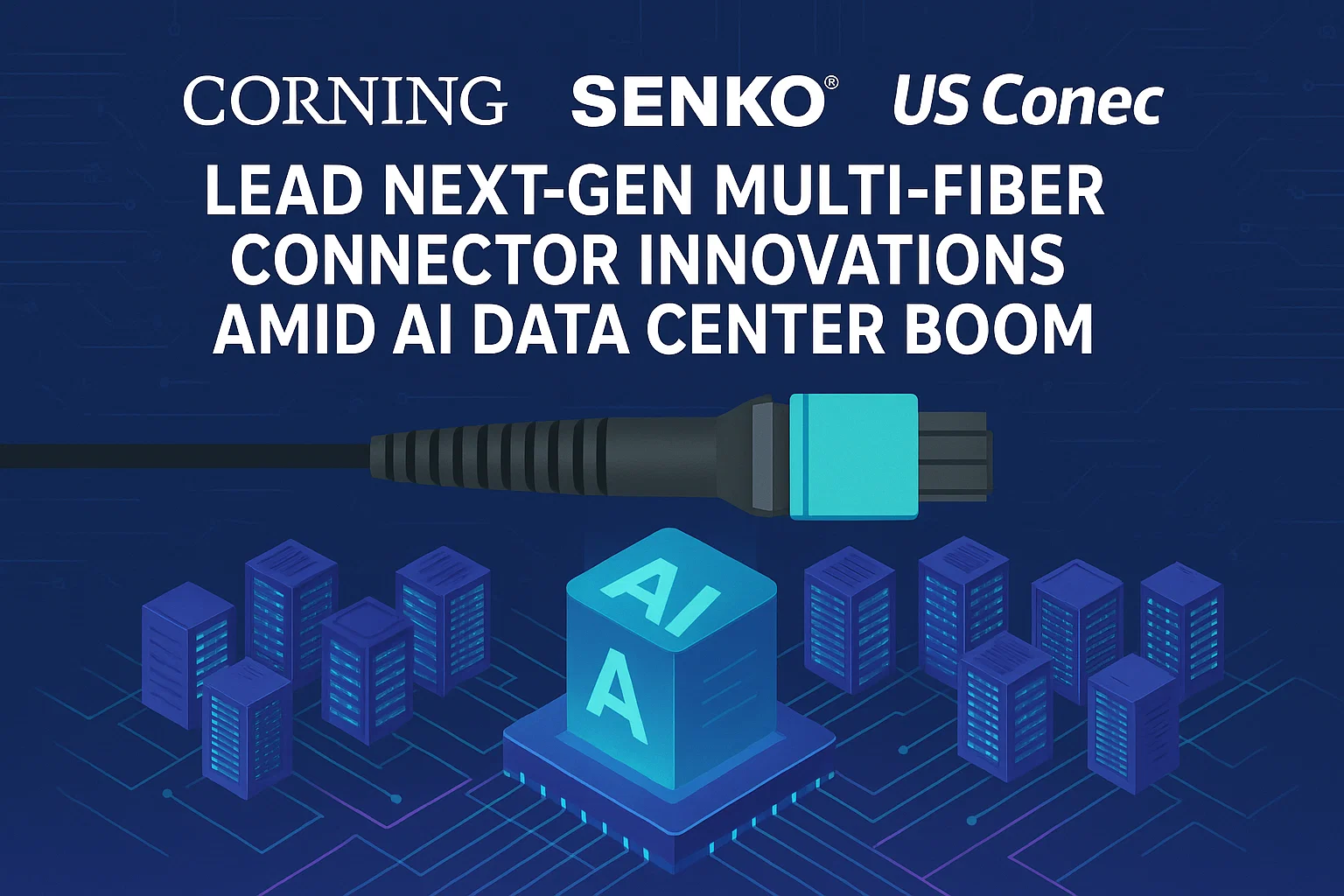
Corning, Senko, and US Conec Lead Next-Gen Multi-Fiber Connector Innovations Amid AI Data Center Boom
The global digital landscape is evolving at an unprecedented pace. From hyperscale cloud computing to the rapid adoption of artificial intelligence (AI), from next-generation 5G deployments to massive expansions in fiber-to-the-home (FTTH), the demand for faster, denser, and more efficient connectivity solutions has never been greater.
At the heart of this transformation lies an unassuming yet critical piece of infrastructure: the multi-fiber connector. Commonly known by their standard types such as MPO (Multi-Fiber Push-On) and MTP® (Mechanical Transfer Push-On) connectors, these components are the unsung heroes of high-speed networks.
The numbers speak for themselves. The global Multi-Fiber Connector market was valued at USD 759 million in 2024 and is projected to reach USD 1.94 billion by 2032, expanding at a CAGR of 14.7% during the forecast period. This remarkable growth trajectory underscores just how essential these connectors are in building the backbone of modern digital infrastructure.
Access Your Free Sample Report- Multi-Fiber Connector Market
1. Understanding Multi-Fiber Connectors
Before diving into the industry updates, let’s briefly recap what multi-fiber connectors are and why they matter.
Traditional fiber optic networks often relied on single-fiber connectors, which are fine for moderate traffic. However, as bandwidth requirements surged—driven by cloud computing, video streaming, and now AI workloads—engineers needed a way to pack more fibers into smaller spaces without sacrificing performance.
This gave rise to multi-fiber connectors, which can house 12, 24, 48, or even 72 fibers in a single compact connector. The most widely used are:
- MPO (Multi-Fiber Push-On) – standardized connector widely deployed in data centers.
- MTP® (Mechanical Transfer Push-On) – a high-performance version of MPO developed by US Conec.
- SN-MT and MDC connectors – newer form factors designed for higher density and flexibility.
The advantage? These connectors enable massive parallel transmission, making them perfect for 400G, 800G, and soon 1.6T data rates.
2. Market Outlook and Growth Projections
The growth story of multi-fiber connectors is closely tied to the explosive expansion of data generation and consumption worldwide.
- Market Size (2024): USD 759 million
- Forecast (2032): USD 1.94 billion
- CAGR (2024–2032):7%
Key Growth Drivers:
- AI Workloads – Training and running AI models requires enormous bandwidth, fueling demand for high-speed interconnects.
- Cloud & Hyperscale Data Centers – Expansion by AWS, Microsoft Azure, Google Cloud, and Meta is driving exponential connector deployments.
- 5G Rollouts – Multi-fiber connectors play a critical role in fronthaul and backhaul connections.
- FTTH Expansion – Fiber-to-the-home projects in Europe and Asia are accelerating adoption.
- Next-Gen Ethernet (400G/800G/1.6T) – Increasing need for higher-density cabling solutions.
With such powerful tailwinds, it’s clear why the industry is gearing up for transformative growth.
3. Recent Industry Developments (2023–2024)
Let’s explore the key updates and innovations shaping the market today.
3.1 Data Center Boom and Multi-Fiber Demand
- Hyperscalers like Google, AWS, Microsoft, and Meta are scaling out massive AI-driven data centers in 2024.
- Multi-fiber connectors are essential in structured cabling systems that support 400G and 800G Ethernet links.
- Data Center Dynamics (July 2024) highlighted that demand for MPO/MTP connectors is surging as companies race to optimize space and reduce latency.
3.2 Corning Expands Optical Connectivity (May 2024)
- Corning, a leader in optical fiber, announced new high-density connector solutions tailored for hyperscale networks.
- These innovations are designed to support AI and cloud workloads that demand ultra-fast interconnects.
- Lightwave Online and Fierce Telecom covered how Corning is addressing the bandwidth bottleneck challenge.
Download Sample Report PDF- Multi-Fiber Connector Market
3.3 Breakthroughs at OFC 2024 (March 2024)
- The Optical Fiber Communication Conference (OFC) showcased next-generation connectors optimized for 800G and 1.6T transmission speeds.
- Players like US Conec, Senko, Corning, and Sumitomo demonstrated solutions geared toward Co-Packaged Optics (CPO)—a major trend in reducing power consumption in high-performance computing.
3.4 Senko’s Next-Gen Connector Launches (2024)
- Senko Advanced Components rolled out MPO Plus and SN-MT connectors.
- These feature smaller footprints and higher fiber counts, addressing the space constraints in dense data centers.
- According to Cabling Installation & Maintenance, these products are designed to simplify cabling management while boosting capacity.
3.5 US Conec’s Enhanced MTP® Solutions
- US Conec continues to push innovation with its MTP® brand connectors.
- Their MXC and MDC connectors are gaining popularity for high-density interconnects.
- OFC 2024 highlighted their role in supporting AI-driven workloads.
3.6 Telecom & 5G Rollouts in Europe
- Telecom operators in Germany, the UK, and France are accelerating fiber-to-the-home (FTTH) and 5G backhaul projects.
- Multi-fiber connectors are increasingly used in outside-plant deployments, where ruggedness and reliability are critical.
- com and Fierce Telecom reported that multi-fiber solutions are reducing deployment time and cost.
4. Key Trends Driving Innovation
4.1 AI and Machine Learning
The rise of AI applications like ChatGPT, autonomous vehicles, and predictive analytics is fueling massive increases in compute and storage requirements. AI workloads demand low-latency, high-bandwidth interconnects, making multi-fiber connectors indispensable.
4.2 Co-Packaged Optics (CPO)
CPO is reshaping how switches and optics are integrated, reducing power consumption and footprint. Multi-fiber connectors are critical in making these systems practical at scale.
4.3 Space Optimization in Data Centers
Operators are under pressure to pack more capacity into smaller spaces. High-density connectors like SN-MT and MDC are emerging as the go-to solutions.
4.4 Sustainability and Energy Efficiency
As energy costs rise, data centers are prioritizing efficient optical interconnects that reduce both footprint and power draw. Multi-fiber connectors are more sustainable compared to bulky copper alternatives.
4.5 FTTH and 5G Convergence
The global push for universal broadband and low-latency 5G networks ensures steady demand for multi-fiber connectors in both consumer and enterprise contexts.
5. Challenges in the Multi-Fiber Connector Industry
Despite rapid growth, the industry faces some hurdles:
- Precision Manufacturing: High-fiber-count connectors require exact alignment to avoid signal loss.
- Cost Pressures: Rising raw material and manufacturing costs could affect adoption.
- Compatibility Issues: Different connector types and form factors can create interoperability challenges.
- Skilled Labor Shortage: Installation and maintenance require specialized skills, which are in short supply globally.
Click Here To Download Full Sample Report- Multi-Fiber Connector Market
6. Future Outlook
Looking ahead, the multi-fiber connector industry is poised for a transformative decade.
- By 2032, the market is projected to hit USD 1.94 billion, fueled by AI, cloud, and 5G expansion.
- Next-generation connectors will support 6T and beyond, ensuring networks are future-ready.
- Innovations in miniaturization and rugged outdoor solutions will expand applications beyond data centers into telecom, FTTH, and even aerospace/defense.
In essence, multi-fiber connectors will continue to be the critical enablers of the digital economy.

Comments (0)