
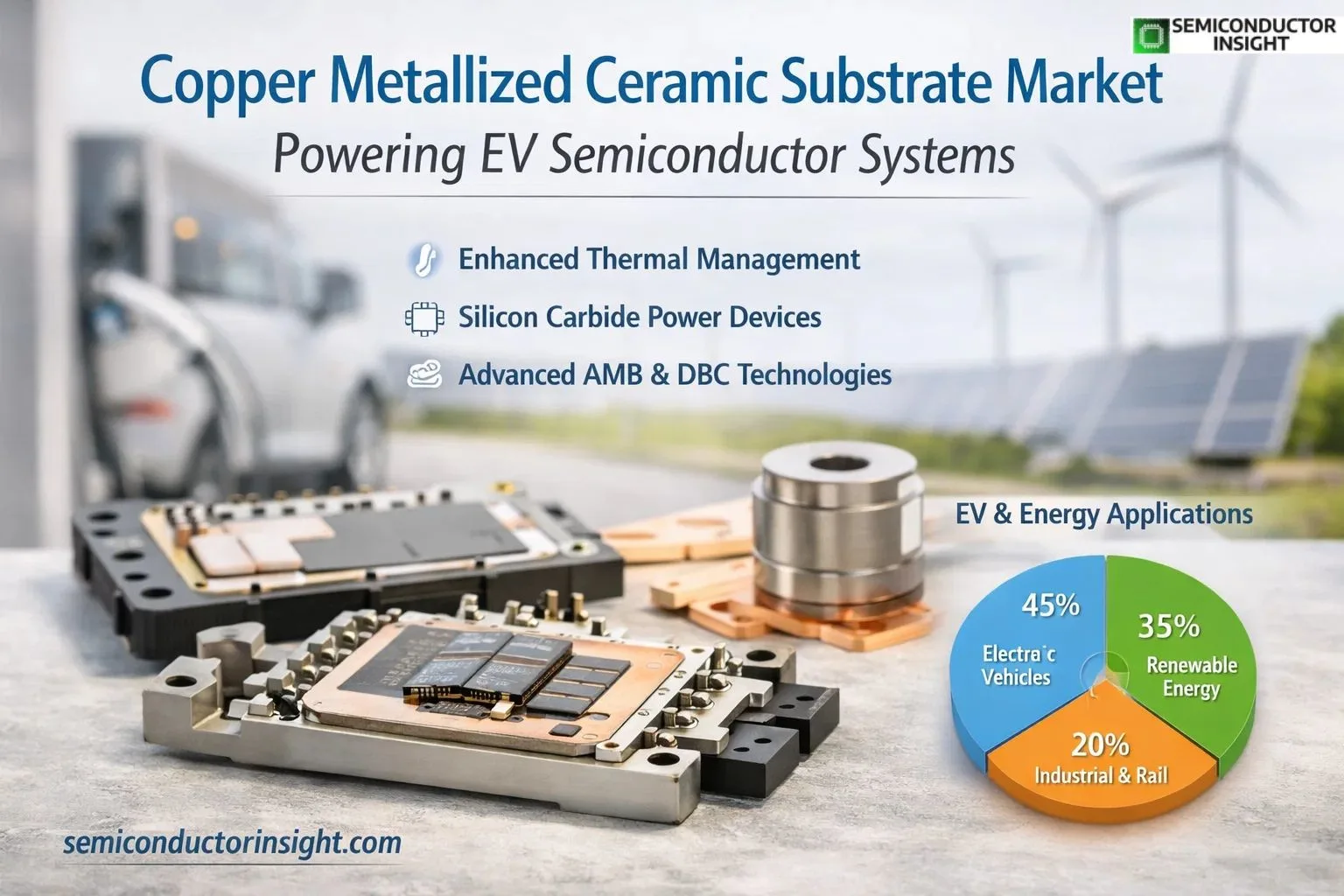
Copper Metallized Ceramic Substrate Market Powering EV Semiconductor Systems
In modern semiconductor systems, performance is no longer limited by transistor density alone it is increasingly defined by how efficiently heat is managed. This is exactly where the copper metallized ceramic substrate market steps into a critical role. These substrates act as the backbone of power modules, quietly handling extreme thermal loads while maintaining electrical insulation and mechanical stability.
As chip architectures become more compact and power-dense, traditional materials struggle to keep up. Copper metallized ceramics especially Direct Bonded Copper (DBC) and Active Metal Brazed (AMB) substrates are now central to enabling high-power reliability in environments where failure is not an option.
Power Electronics Expansion across EV and Energy Systems
- The rapid electrification of transportation and energy infrastructure has significantly elevated the importance of advanced substrates.
- Electric vehicles, in particular, rely on power modules for inverters and converters that operate under high voltage and temperature conditions.
- Recent disclosures from automotive semiconductor supply chains indicate that next-generation EV platforms are pushing module temperatures beyond 200°C operating thresholds, forcing manufacturers to adopt ceramic substrates with superior thermal conductivity and expansion matching.
- Leading automotive players have increasingly shifted toward silicon carbide (SiC)-based power devices, which generate higher thermal loads.
- Copper metallized ceramic substrates provide the necessary interface to dissipate this heat efficiently, ensuring long-term durability. This transition reflects a broader move toward high-efficiency power architectures.
Material Engineering Shifts from DBC to AMB Technologies
The evolution from traditional DBC to more advanced AMB substrates reflects a deeper shift in material science. While DBC substrates have been widely used due to their cost efficiency and reliable bonding, AMB substrates offer improved adhesion and compatibility with advanced ceramics like silicon nitride.
Silicon nitride substrates, in particular, are gaining traction due to their superior mechanical strength and thermal cycling performance. This makes them ideal for applications involving frequent temperature fluctuations, such as automotive power modules.
Manufacturers are now focusing on material optimization, balancing conductivity, durability, and cost. The ability to fine-tune these properties is becoming a competitive advantage in semiconductor packaging.
Semiconductor Packaging Meets Thermal Precision
As advanced packaging technologies evolve, the role of substrates is becoming more complex. Modern semiconductor packages require precise thermal paths, minimal electrical resistance, and compatibility with high-density integration.
Copper metallized ceramic substrates are increasingly being integrated into multi-layer packaging designs, supporting better heat distribution and electrical performance. This is particularly important in AI hardware and high-performance computing systems, where thermal bottlenecks can limit processing efficiency.
Industry case studies have shown that optimized substrate designs can improve module efficiency by 15–20% in high-power applications, highlighting their impact on overall system performance.
Automation and Scale in Substrate Manufacturing
Scaling production while maintaining precision is one of the biggest challenges in this market. The metallization process requires exact bonding conditions, controlled atmospheres, and high-quality raw materials.
Manufacturers are investing in automation to improve yield consistency and reduce defects. Advanced inspection systems, including AI-driven quality control, are being deployed to ensure uniformity across batches.
This shift toward automated production is not just about efficiency it is about achieving process stability in a market where even minor inconsistencies can lead to significant performance issues.
Explore the complete report to access in-depth findings designed for informed business decisions: https://semiconductorinsight.com/report/copper-metallized-ceramic-substrate-market/
Industry Applications Converting Technology into Scalable Growth
- The real strength of the copper metallized ceramic substrate market lies in its diverse applications.
- From electric vehicles and renewable energy systems to industrial drives and aerospace electronics, these substrates are enabling technologies that power modern infrastructure.
- In wind energy systems, for example, power converters rely on robust substrates to handle fluctuating loads and harsh environmental conditions.
- In rail transportation, they ensure reliable operation under continuous stress.
What stands out is their ability to perform consistently in demanding conditions, making them indispensable in sectors where reliability and efficiency are non-negotiable. This growing reliance is positioning the market as a core enabler of next-generation semiconductor ecosystems.

Comments (0)