
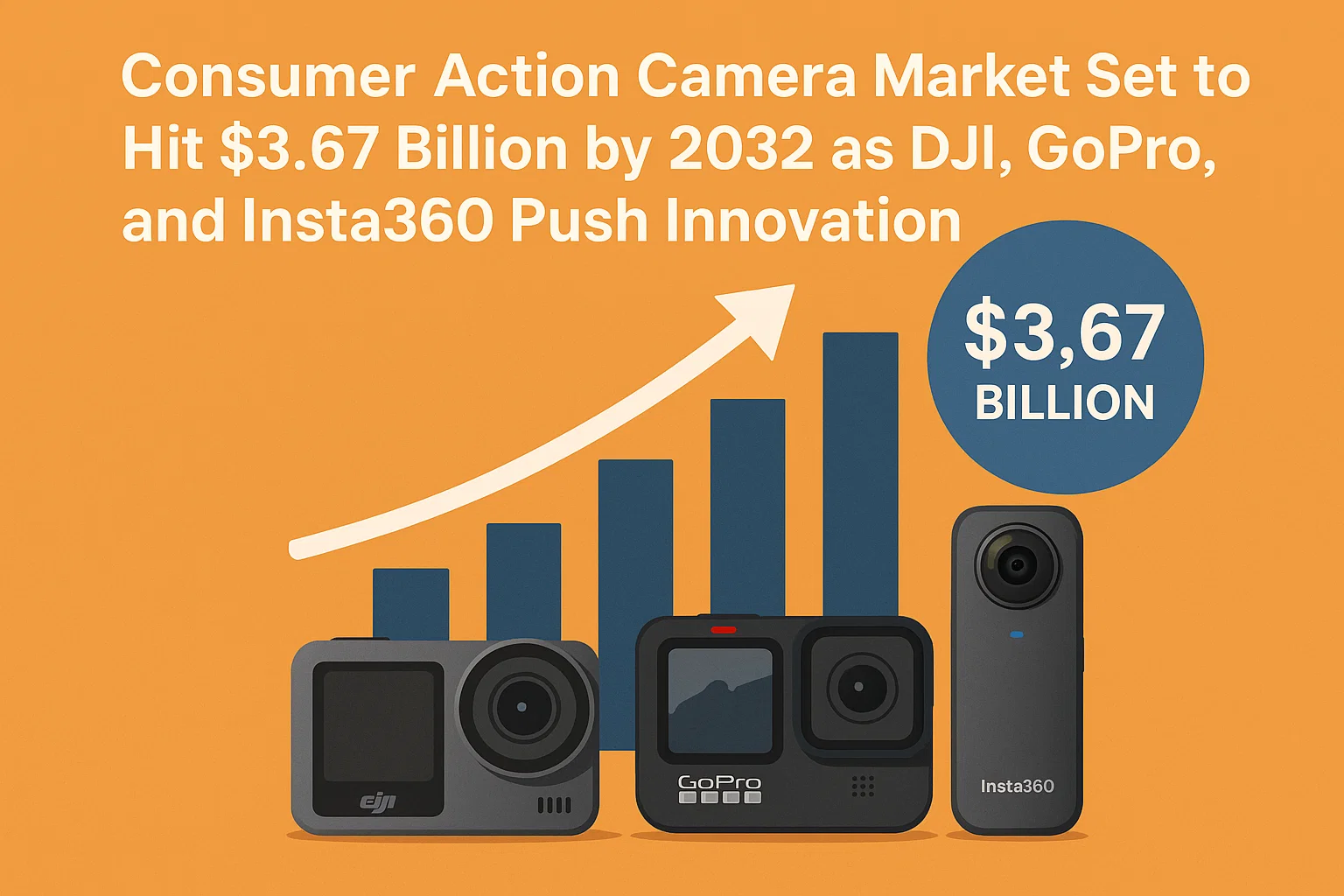
Consumer Action Camera Market Set to Hit $3.67 Billion by 2032 as DJI, GoPro, and Insta360 Push Innovation
The consumer action camera industry has always been a playground for innovation. From GoPro’s early dominance to the rise of Insta360 and DJI, this space thrives on compactness, durability, and creative capture capabilities. Today, the industry is undergoing yet another transformation. Recent launches and rumors point to a new era of 360° imaging, AI-powered shooting, and ecosystem-driven experiences.
The market is not just growing in terms of innovation it’s expanding financially as well. According to recent industry data, the consumer action camera market was valued at US$ 2.34 billion in 2024 and is projected to reach US$ 3.67 billion by 2032, growing at a CAGR of 6.7% between 2025 and 2032. This steady rise reflects increasing consumer demand, the popularity of short-form video content, growth in outdoor sports, and adoption in professional filmmaking.
Access Your Free Sample Report- Consumer Action Cameras Market
DJI Osmo 360: A Disruptive Launch
In July 2025, DJI launched the Osmo 360, a bold entry into the growing 360-degree action camera space. This release has the potential to reshape the market landscape, especially as it positions DJI head-to-head with Insta360, which has led the 360° segment for years.
Key Features That Redefine Expectations
- 8K Video at 50fps
Most consumer 360° cameras max out at 5.7K or 6K video. The Osmo 360’s ability to shoot 8K at 50fps is a leap forward for creators seeking cinematic quality. - Dual 1/1.1-Inch HDR Sensors
Larger sensors mean better low-light performance, detail capture, and dynamic range. For adventure sports, vlogging at dusk, or underwater scenes, this could prove a critical advantage. - RockSteady Stabilization
DJI has integrated its renowned stabilization technology, ensuring buttery-smooth footage even during fast-paced action like mountain biking or skydiving. - Improved Battery Life
Perhaps the most eye-catching spec is the 110 minutes of 8K/30p recording, compared to Insta360’s X5 which offers only around 52 minutes. For action enthusiasts, less battery swapping means more freedom. - Ecosystem Integration
DJI has built the Osmo 360 to share batteries, accessories, and wireless mics with its other products, from drones to handheld gimbals. This creates a seamless creative workflow a competitive edge that GoPro lacks.
Why the Osmo 360 Matters
The Osmo 360 isn’t just another product launch it’s a strategic push by DJI into an emerging niche. By combining 8K capture, robust stabilization, and ecosystem synergy, DJI is targeting both hobbyists and professionals who want future-proof footage without the bulk of traditional gear.
If DJI manages aggressive pricing (which it often does), this camera could eat into Insta360’s market share and force GoPro to rethink its strategy in the 360° space.
GoPro: Rumors, Refreshes, and the Fight for Relevance
For years, GoPro defined the action camera market. Its Hero series remains iconic, but competition has eroded its dominance. With DJI and Insta360 innovating aggressively, GoPro is now under pressure to reinvent itself.
What’s Expected in 2025
According to industry rumors, GoPro is preparing multiple launches:
- GoPro Hero 14 Black: Likely to feature incremental upgrades such as higher resolution, AI-assisted shooting modes, and better low-light performance.
- GoPro Max 2 (360°): A much-needed successor to the original Max, with rumors suggesting improved stabilization, 6K or 8K capture, and enhanced editing software.
- GoPro Helmet Concept: A wearable design directly integrated into helmets, appealing to cyclists, skiers, and motorsports enthusiasts.
The Challenges for GoPro
GoPro’s biggest obstacle is differentiation. While its build quality and ecosystem are trusted, competitors are outpacing it in sensor size, software features, and battery performance. If the Max 2 delivers significant upgrades, GoPro can reclaim relevance in 360° filming but if not, DJI and Insta360 may cement their lead.
Download Sample Report PDF- Consumer Action Cameras Market
Insta360: Innovation Meets Pressure
Insta360 has carved a strong identity with modular cameras (One R, One RS) and compact innovations like the Go series. However, with DJI’s Osmo 360 on the market, Insta360 faces a direct challenge.
Rumored Launch: Insta360 Go 4
The Insta360 Go 4 is expected to arrive in late 2025. Key rumors suggest:
- A non-modular design that’s waterproof out of the box.
- Improved resolution (potentially 4K or beyond).
- AI-powered auto-editing for instant social media sharing.
This could resonate with vloggers and TikTok/Instagram creators who value simplicity over modular complexity.
Insta360’s Advantage
Despite pressure, Insta360 still enjoys strong brand recognition in the 360° niche, particularly among YouTubers and adventure travelers. Its editing software is industry-leading, often making footage production faster than GoPro or DJI alternatives.
But to stay competitive, Insta360 must push beyond incremental updates and deliver groundbreaking features like DJI has.
Sony, Canon, and Nikon: Broadening the Market
While not traditionally “action camera” brands, Sony, Canon, and Nikon continue to influence the market by pushing hybrid and compact gear.
- Sony A7 V (rumored): A full-frame camera expected to offer 44MP stills, 4K/120fps video, and advanced AI autofocus. While not an action camera per se, its durability and performance appeal to professionals who use action cams alongside bigger gear.
- Canon & Nikon: Expected to introduce cinema-capable hybrids in 2025, raising the bar for high-resolution video capture.
Their role in the industry is indirect but important: by driving expectations around resolution and AI features, they set benchmarks that action cameras must eventually meet.
Market Growth: From $2.34 Billion to $3.67 Billion
Beyond product launches, the financial outlook for the consumer action camera industry is strong.
- Market Size 2024: US$ 2.34 billion
- Projected Size 2032: US$ 3.67 billion
- CAGR: 6.7% (2025–2032)
Drivers of Growth
- Rise of Social Media Content Creation
Short-form video platforms like TikTok, Instagram Reels, and YouTube Shorts are fueling demand for lightweight, high-quality cameras. - Outdoor Sports & Travel
Surfing, mountain biking, skiing, diving action cameras remain the go-to gear for adventure documentation. - Professional Adoption
Increasingly, filmmakers and commercial creators are using action cameras for unique angles, crash cams, and immersive 360° storytelling. - Technological Advances
Longer battery life, AI auto-editing, 8K resolution, and better low-light performance are expanding use cases. - Ecosystem Lock-In
DJI’s ecosystem approach could reshape consumer habits, much like Apple’s iOS ecosystem keeps users loyal.
Regional Trends
- North America & Europe: Mature markets with strong adoption among vloggers and outdoor enthusiasts.
- Asia-Pacific: Fastest-growing region, driven by travel culture, esports, and rising disposable incomes.
Challenges Ahead
Despite growth, the industry faces hurdles:
- Smartphone Cameras: Modern smartphones already shoot high-quality 4K/8K video, making standalone action cams less essential for casual users.
- Price Pressure: As features expand, keeping action cameras affordable will be key.
- Battery Tech Limits: While DJI has improved endurance, true all-day recording without swapping batteries remains out of reach.
- Market Saturation: With so many models, differentiation is harder than ever.
Click Here To Download Full Sample Report- Consumer Action Cameras Market
The Road to 2032: Predictions
Looking at trends, here’s what the action camera industry might look like by 2032:
- AI-Centric Editing
Cameras will likely come with real-time AI post-processing, producing ready-to-upload videos seconds after recording. - Full VR/AR Integration
With metaverse and VR content demand growing, 360° and immersive video will become mainstream. - Ultra-Compact Wearables
Devices like the Insta360 Go may shrink further, enabling hands-free filming without accessories. - Professional-Grade in Pocket Size
8K/120fps, raw capture, and cinema-grade stabilization could all be standard by the early 2030s. - Subscription Ecosystems
Just as Adobe ties users with Creative Cloud, brands may offer cloud storage, AI editing, and exclusive accessories via subscriptions.
The consumer action camera market is entering a new phase of competition and innovation. DJI’s Osmo 360 sets a fresh benchmark, GoPro is preparing long-awaited updates, and Insta360 is being pushed to evolve beyond its modular strengths. Meanwhile, broader camera industry innovations are shaping expectations around resolution, AI, and hybrid shooting.
Financially, the sector’s growth trajectory from $2.34 billion in 2024 to $3.67 billion by 2032 at a 6.7% CAGR underscores its resilience and expanding relevance in content creation.

Comments (0)