
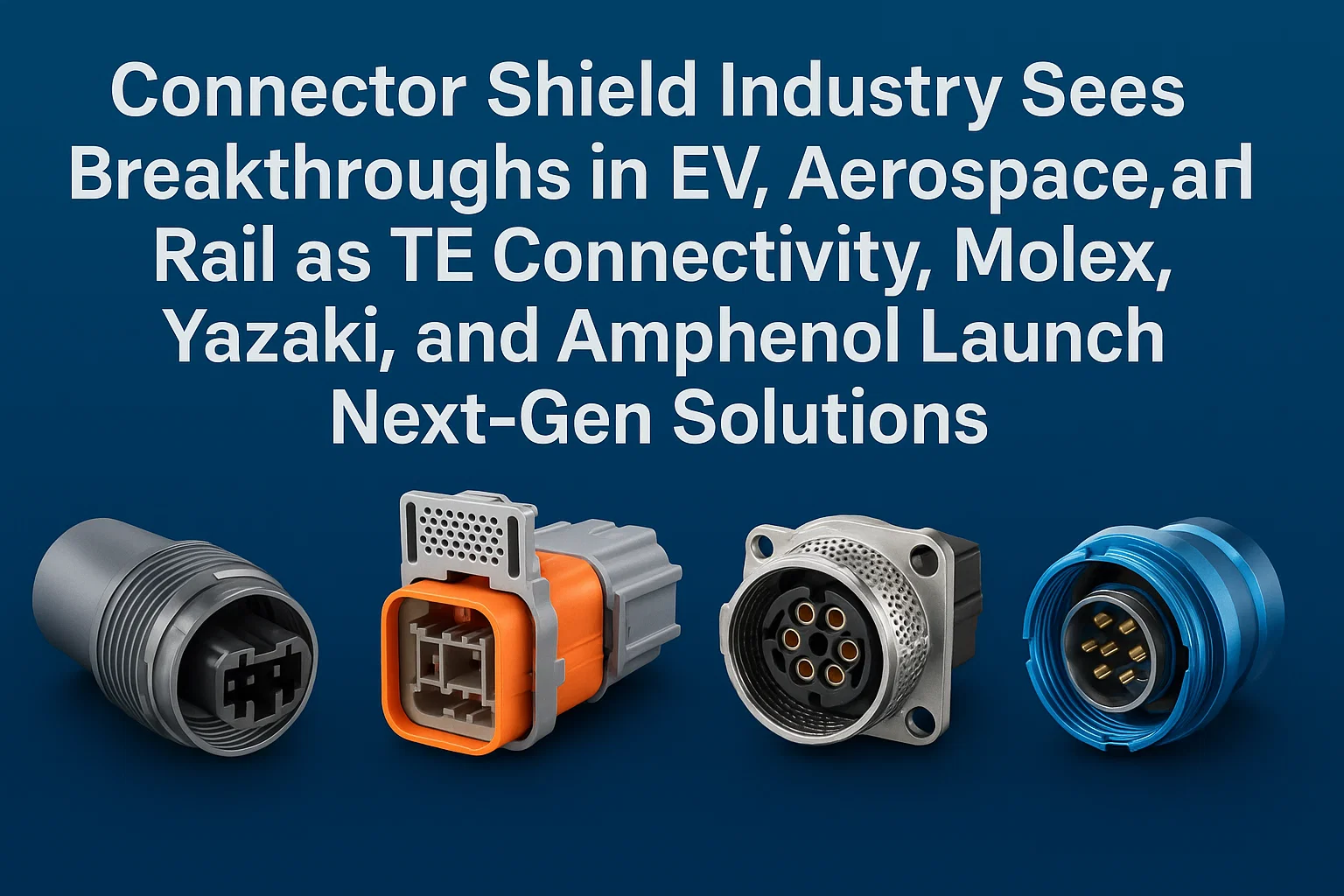
Connector Shield Industry Sees Breakthroughs in EV, Aerospace, and Rail as TE Connectivity, Molex, Yazaki, and Amphenol Launch Next-Gen Solutions
In the vast and ever-evolving world of electronics, some components are headline grabbers — think processors, high-capacity batteries, and AI chips. Others, while far less glamorous, are equally essential to the reliability and safety of modern devices. Connector shields fall firmly into that latter category.
At first glance, a connector shield is simply a protective covering for the point where two cables or electronic systems meet. In reality, it’s a critical barrier against electromagnetic interference (EMI) and radio-frequency interference (RFI). Without proper shielding, data corruption, signal degradation, or even complete system failure can occur — consequences that no engineer, airline, automaker, or defense contractor wants to face.
As our world becomes more electrified, connected, and automated, connector shielding is no longer just a best practice — it’s a necessity. The explosion of electric vehicles (EVs), high-speed rail projects, 5G-enabled industrial automation, and aerospace advancements is putting shielding technology front and center.
The market reflects this urgency. Valued at US$ 673 million in 2024, the global connector shield industry is projected to reach US$ 1.02 billion by 2032, growing at a CAGR of 5.3% from 2025 to 2032. This is not merely incremental growth — it’s the acceleration of a technology that underpins the performance and safety of the systems that define modern life.
Over the past year, a series of high-profile product launches, regulatory changes, and manufacturing investments have set the stage for a transformative decade. From TE Connectivity’s next-generation EV connectors to Molex’s weight-saving aerospace designs, the innovations happening in this “quiet corner” of the electronics sector could have ripple effects across industries.
Access Your Free Sample Report- Connector Shield Market
Market Snapshot & Growth Outlook
The connector shield market might not be as visible as consumer gadgets, but it’s equally tied to global megatrends — electrification, connectivity, automation, and sustainability.
Drivers of Growth
- Electromagnetic Compatibility Regulations – Stricter EMC standards, especially in the EU and Asia, are forcing manufacturers to adopt better shielding solutions.
- Electrification of Transport – EVs, electric buses, and even electric aircraft require high-voltage systems that generate significant EMI, demanding advanced shielding.
- 5G & Industry 4.0 – High-speed industrial networks are more susceptible to interference, increasing demand for hybrid shielded connectors.
- Aerospace Weight Reduction Goals – Every gram saved in aerospace systems reduces fuel burn and increases payload capacity. Lightweight shielding materials are a big part of this.
The 5.3% CAGR forecast reflects not only organic demand but also the introduction of value-added shielding designs that carry higher margins for manufacturers. The market’s growth is not simply about volume — it’s about the shift to more complex, more capable, and more regulatory-compliant solutions.
Key 2024–2025 Developments
1. TE Connectivity’s EV EMI-Shielding Leap
With EV adoption surging globally, the electrical environment inside a modern vehicle is increasingly crowded. High-voltage battery systems, power electronics, infotainment units, and ADAS sensors are all producing and receiving electromagnetic signals — and if these signals interfere with each other, safety systems could be compromised.
TE Connectivity’s latest shielded automotive connectors tackle this head-on. Designed for compliance with the EU’s 2025 EMC Directive updates, these connectors feature multi-layer shielding that combines aluminum foil, braided copper mesh, and conductive polymer coatings.
Key advantages:
- Enhanced Noise Immunity – Reduces susceptibility to EMI from high-voltage lines.
- Durability – Withstands vibration and thermal cycling common in EV environments.
- Modular Design – Adaptable to different harness configurations, reducing manufacturing complexity for automakers.
TE’s approach isn’t just about shielding — it’s about ensuring signal integrity at higher voltages and frequencies, which will become critical as EV platforms integrate more sensors and autonomous driving capabilities.
2. Molex’s Aerospace Weight-Saving Innovation
In aerospace engineering, weight is the enemy. Every additional kilogram on a satellite or unmanned aerial vehicle (UAV) can cost thousands of dollars over its operational lifetime.
Molex’s new aluminum-based connector shielding offers a 20% weight reduction compared to traditional copper braiding without sacrificing performance. By leveraging high-conductivity aluminum alloys and a proprietary corrosion-resistant coating, Molex has achieved EMI/RFI protection suitable for extreme environments — including low Earth orbit.
This development is especially timely given the rise of small satellite constellations for global communications. These satellites have strict mass budgets, making lightweight shielding a competitive advantage.
3. Yazaki’s Thai Manufacturing Push for EV Harnesses
Yazaki Corporation, a major global supplier of wiring harnesses, is investing $150 million in a new facility in Thailand dedicated to shielded harness production for EVs.
Why Thailand?
- Strategic location close to major EV manufacturing hubs in Southeast Asia.
- Competitive labor costs combined with growing engineering talent pools.
- Trade agreements that reduce tariffs for exports to Japan, the EU, and the US.
This facility will focus on shielded harness systems designed for high-voltage EV architectures, meeting Japan’s upcoming EMC standards for connected and autonomous vehicles. The investment signals a shift toward regionalized, compliance-focused production — a necessity as regulatory frameworks diverge globally.
Download Sample Report PDF- Connector Shield Market
4. Amphenol’s Hybrid Fiber-Optic/Copper Shielding in Industry 4.0
Amphenol Industrial Operations is addressing one of the thorniest challenges in industrial automation: how to transmit both high-speed data and high-power signals in the same connector without crosstalk.
Their solution: a hybrid connector that integrates fiber-optic data channels with copper conductors for power — all wrapped in a multi-stage shielding system.
Benefits for Industry 4.0 environments:
- Reduced Crosstalk – Separation of optical and electrical paths with targeted shielding.
- Space Efficiency – One connector instead of two, reducing panel space.
- Flexibility – Can be adapted for harsh environments, from oil rigs to automated warehouses.
As smart factories scale up, the demand for EMI-proof, multi-function connectors will only grow.
5. EU’s New Shielding Regulations for Rail and Defense
The European Commission’s update to the EN 50121 standard mandates enhanced shielding for connectors in railway and defense systems.
The key driver: the rollout of 5G-based railway communications and military-grade secure networks. Both require extremely low interference environments, especially in mission-critical applications.
Manufacturers supplying to these sectors now face short compliance timelines — meaning a scramble to upgrade product lines. While challenging, this regulatory push is expected to accelerate innovation in connector shielding across European suppliers.
Technological Trends Shaping Connector Shields
- Advanced Materials – Shift from traditional copper braiding to lightweight alloys, conductive polymers, and even graphene-enhanced shielding.
- Miniaturization – As devices shrink, so do connectors, requiring thinner yet more effective shielding layers.
- Hybrid Designs – Combining optical and electrical transmission in one connector without interference.
- Sustainability – Using recyclable materials and eco-friendly manufacturing processes to meet ESG goals.
Challenges Ahead
- Regulatory Complexity – Multiple global EMC standards require region-specific designs, increasing costs.
- Cost Pressures – Advanced shielding materials can be expensive, challenging OEM margins.
- Performance vs. Weight Trade-Offs – Particularly in aerospace, where every gram counts.
Click Here To Download Full Sample Report- Connector Shield Market
Future Outlook
By 2032, connector shields will likely be smaller, lighter, smarter, and more integrated. Self-monitoring shielding — capable of detecting and reporting degradation — could become a reality, especially in aerospace and defense.
With the market projected to surpass US$ 1 billion, the role of shielding will expand beyond interference prevention into holistic system reliability, integrating with IoT-based maintenance systems.
Connector shields may not get the attention of flashy consumer tech, but without them, the modern electronics ecosystem would grind to a halt. The developments of 2024–2025 — from TE Connectivity’s EV advances to Molex’s aerospace breakthroughs — show that this “hidden” sector is innovating at a rapid pace.
As regulations tighten, systems electrify, and data speeds increase, the humble connector shield will remain a silent guardian of performance, safety, and reliability. And in doing so, it will quietly power the future.

Comments (0)