

Communication Interface Board in 2026 Market with High-Speed Data Links, Modular I/O and the New Industrial Connectivity Layer
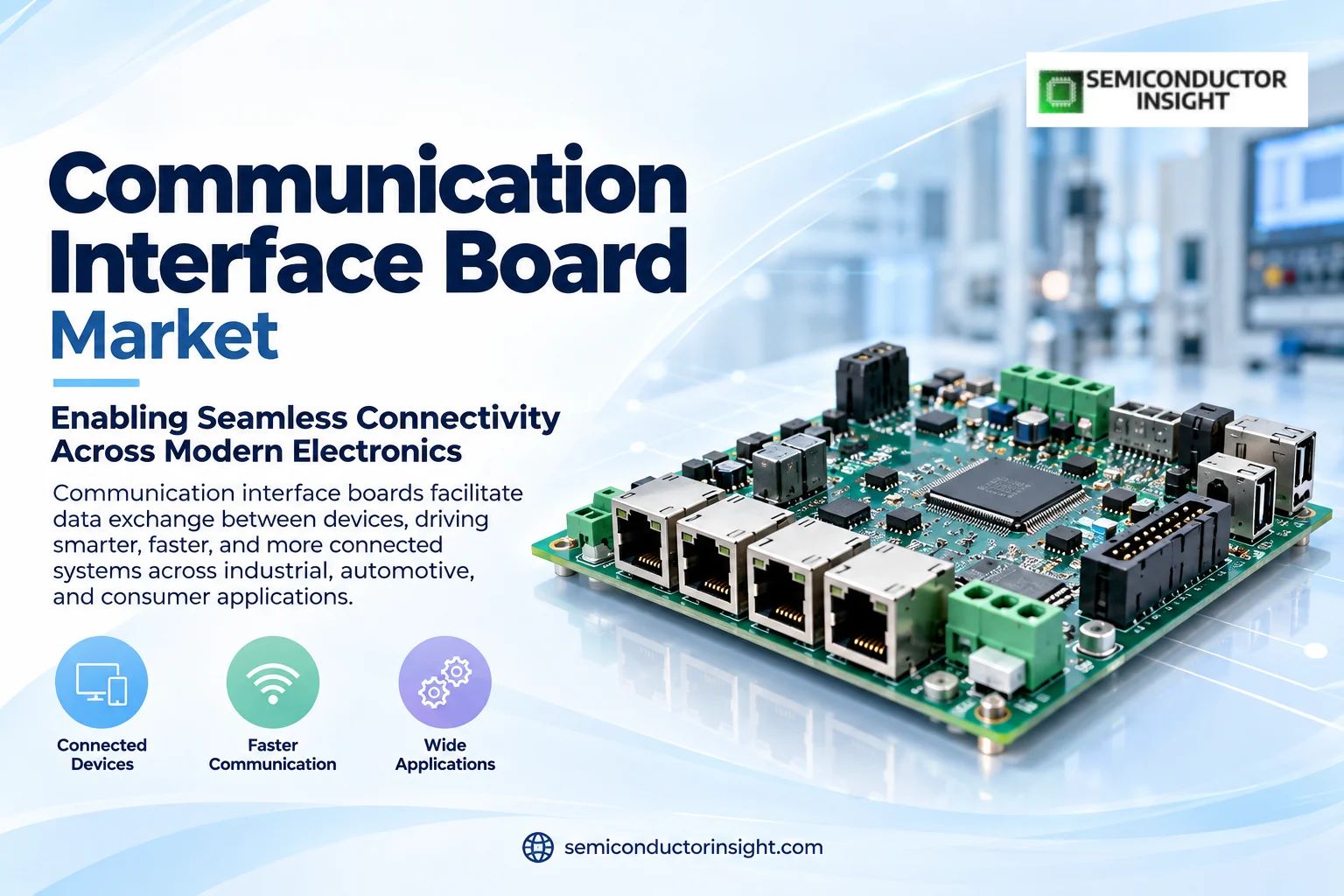
Communication interface boards are becoming an increasingly important bridge between processors, machines, sensors, storage devices and networks. The hardware can combine controllers, transceivers, connectors, isolation circuits and protocol interfaces on a single expansion board or modular card.
The speed of the underlying interfaces is changing rapidly. PCI-SIG specifies PCIe 6.0 at 64.0 GT/s, delivering up to 256 GB/s of bidirectional bandwidth through an x16 configuration. The organization has also approved PCIe 7.1, showing how quickly board-level connectivity is moving toward higher data rates.
What Is Driving the Technology Shift in Communication Interface Boards?
- The answer is increasingly diverse connectivity requirements.
- A factory controller may need Ethernet, EtherCAT, CAN, RS-485 and USB connections simultaneously, while an embedded computing platform may require PCIe, Gigabit Ethernet or higher-speed serial links.
- Advantech’s current industrial communication portfolio illustrates this diversity with PCIe and M.2 modules supporting RS-232, RS-422/485, CAN, Gigabit Ethernet, PROFINET, EtherCAT and EtherNet/IP.
- Some of its current modules use PCIe x1 or USB-based interfaces for system expansion.
- This modular approach allows equipment manufacturers to change communication capabilities without redesigning an entire computing platform.
Where Board-Level Connectivity Is Heading in 2026
The first major change is the migration toward higher-speed PCIe architectures. PCIe 6.0 introduces PAM4 signalling, lightweight forward error correction and 256-byte Flit-based data transfer to handle the reliability requirements associated with 64 GT/s operation.
The second is the expansion of USB4. USB4 Version 2.0 supports up to 80 Gbps through USB Type-C, while its architecture can simultaneously handle data and display protocols and tunnel PCIe traffic.
The third is industrial Ethernet. NXP’s 2026 TJF1103, for example, is a 100BASE-T1 PHY designed for industrial single-pair Ethernet applications.
The fourth is time-sensitive networking. TSN is bringing deterministic Ethernet characteristics into industrial systems where timing and predictable data delivery are important. NXP’s reference architecture combines TSN with processors, Ethernet switching and industrial networking components.
You Can Freely Surf Our Latest Updated Report Here: https://semiconductorinsight.com/report/communication-interface-board-market/
PCIe and USB Standards Are Raising the Board-Level Bandwidth Ceiling
Two standards developments are particularly relevant to communication interface hardware in 2026.
PCI-SIG’s approved PCI Express Base Specification Revision 7.1 was published on September 17, 2026, while PCIe 6.5 is also listed as an approved revision. This continuing progression creates a roadmap for increasingly demanding accelerators, networking equipment, storage platforms and embedded systems.
USB-IF has also continued expanding USB4 compliance infrastructure. Its 2026 documentation includes USB4 Version 2.0 specifications and Gen4 80 Gbps compliance testing, indicating that higher-speed external connectivity is moving deeper into standardized product validation.
PCIe vs. Traditional Serial Interfaces in Communication Boards
- PCIe is increasingly suited to applications where bandwidth, low latency and direct integration with computing platforms matter.
- Traditional RS-232, RS-422 and RS-485 interfaces remain important where machines, controllers and legacy equipment require established serial communication.
- Advantech’s current PCIe communication cards demonstrate this coexistence. Its four-port PCIE-1612C-AE supports RS-232/422/485, PCI Express 2.0 and transmission speeds up to 921.6 kbps, while providing 3 kV isolation.
- The market is therefore not simply replacing older interfaces. Instead, communication boards increasingly act as translators between generations of equipment.
The Modular Board Architecture
Processor → PCIe or M.2 Host Link → Interface Controller → Transceiver → Isolation → External Connector → Machine or Network
This architecture allows manufacturers to separate the computing platform from the communication layer. An industrial computer can therefore be configured with different modules depending on whether the application requires CAN, Ethernet, fieldbus, serial communication or wireless connectivity.
NI provides a practical example through its embedded platforms. Its sbRIO-9628 combines Gigabit Ethernet, RS-232, RS-485 and CAN connectivity with a real-time processor and FPGA on a single PCB.
Signal Integrity Becomes a Design Priority
Higher data rates are making board design considerably more demanding. PCIe 6.0’s use of PAM4 is a clear example because the signalling approach increases bandwidth while also creating greater sensitivity to errors. PCI-SIG therefore incorporates FEC and CRC mechanisms into the specification.
At the physical layer, connectors, traces, impedance, isolation, electromagnetic compatibility and thermal conditions can all affect communication reliability. TE Connectivity’s high-speed Sliver interconnect family, for example, supports PCIe Gen3/4, Ethernet and other protocols with 12G and 25G options.
Industrial Systems Are Becoming Protocol-Rich
Modern automation equipment rarely operates around one communication standard. A single machine can combine fieldbus equipment, Ethernet controllers, sensors, cameras and higher-level enterprise connectivity.
NI’s CompactRIO ecosystem currently supports protocols including EtherCAT, EtherNet/IP, Modbus, OPC UA, CAN and RS-232/RS-485. This illustrates why adaptable communication hardware is increasingly valuable in brownfield factories where new equipment must communicate with existing infrastructure.
The communication interface board is consequently evolving from a simple expansion card into a critical connectivity layer between semiconductor processing platforms and the physical world. PCIe 7.1, USB4 80 Gbps, industrial Ethernet, TSN, CAN and modular M.2 architectures are pushing this category toward faster, more flexible and increasingly protocol-aware designs.

Comments (0)