

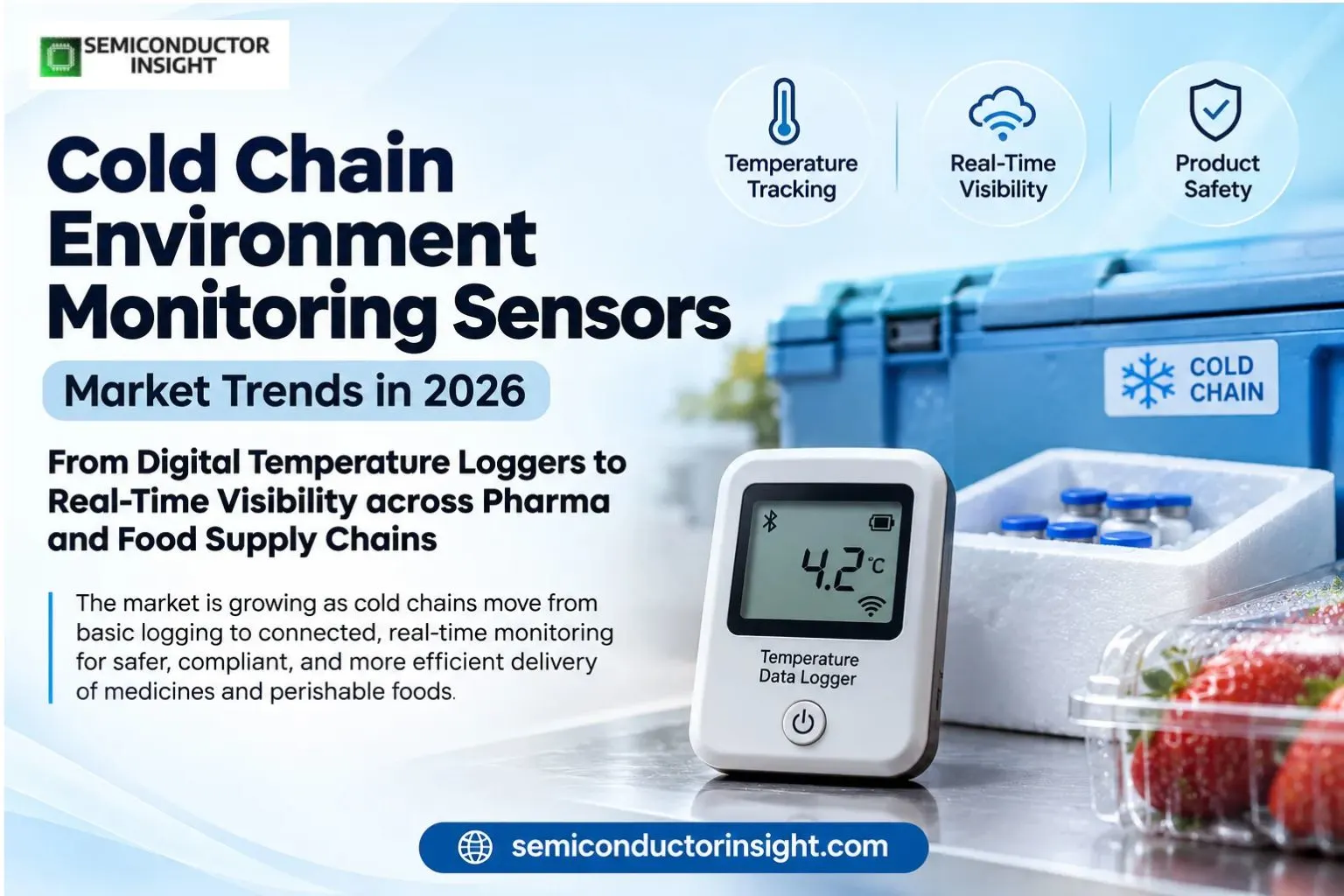
Cold Chain Environment Monitoring Sensors Market Trends in 2026 from Digital Temperature Loggers to Real-Time Visibility across Pharma and Food Supply Chains
Cold chain environment monitoring sensors are becoming essential components of temperature-controlled logistics, where even a short environmental deviation can affect product quality, safety and usability. These systems combine temperature sensors, humidity detectors, data loggers, wireless connectivity and cloud-based monitoring platforms to track conditions inside refrigerated warehouses, medical storage facilities, transport containers and delivery vehicles.
Their applications extend across vaccines, biologics, clinical trial materials, frozen foods, dairy products and specialty pharmaceuticals. The technology is also evolving beyond basic temperature measurement, with operators increasingly seeking continuous visibility into the conditions experienced by products throughout their journey.
Vaccine Refrigeration Enters a Connected Monitoring Phase
- A significant development in 2026 is the World Health Organization’s transition towards equipment monitoring systems for vaccine refrigeration.
- WHO states that all new vaccine refrigerators have required an Equipment Monitoring System since 2024, with the requirement extending to all vaccine refrigerators from 2026.
- These systems can combine temperature records with equipment information such as voltage input, humidity and compressor performance.
- This creates opportunities for semiconductor-based sensing components, including precision temperature sensors, humidity sensors, microcontrollers and wireless communication modules.
- Manufacturers supplying monitoring hardware must increasingly consider long-term reliability, data consistency and compatibility with standardised monitoring platforms.
The Thirty-Minute Data Window Is Raising Sensor Expectations
Monitoring frequency is becoming an important specification for healthcare applications. The US Centers for Disease Control and Prevention recommends digital data loggers for vaccine storage, with readings recorded at intervals of at least every 30 minutes. Its guidance also recommends temperature accuracy within approximately ±0.5°C and alarms for out-of-range conditions.
This requirement highlights why sensor systems need more than a simple display. They must preserve historical readings, identify how long a temperature excursion lasted and provide information that supports corrective action. Buffered probes are also important because they can provide a better indication of product temperature than measurements of surrounding air alone.
Shipment-Level Tracking Is Becoming More Intelligent
Cold chain monitoring is extending from storage facilities into multimodal transportation. Pharmaceutical shipments can pass through refrigerated warehouses, airport handling areas, aircraft, road vehicles and final delivery locations. A sensor that records conditions only at dispatch and arrival may miss important deviations during intermediate handling.
- The OECD’s 2026 analysis of European medical supply chains describes how DHL uses RFID sensors and its LifeTrack platform to provide shipment status, environmental histories and chain-of-custody information.
- Such applications demonstrate how sensor data can be connected with logistics systems to improve visibility and support faster responses when shipment conditions change.
For semiconductor suppliers, this creates demand for compact sensing elements, low-power wireless chips, RFID components and integrated circuits designed for reliable operation across long transport routes.
You can freely browse our most recent updated report to learn more about it before scrolling further: https://semiconductorinsight.com/report/cold-chain-environment-monitoring-sensors-market/
Multi-Parameter Monitoring Moves beyond Temperature Alone
- Temperature remains the central measurement, but modern cold chain systems increasingly incorporate humidity, light exposure, shock, location and door-opening events. These additional readings help operators understand whether a product has experienced handling conditions that may compromise its quality.
- Humidity monitoring is particularly relevant to certain pharmaceutical packaging and food storage applications, while shock and tilt sensors can help identify rough handling during distribution. GPS-enabled devices add location context, allowing logistics teams to connect an environmental alert with a specific shipment location or transport stage.
- The shift towards multi-parameter devices is also changing product design. Manufacturers must balance sensor accuracy, battery life, wireless range, data storage and device size without making monitoring equipment difficult to deploy.
Smart Labels and Reusable Loggers Serve Different Logistics Needs
Single-use electronic indicators and smart labels are useful for shipments where a compact device can accompany the product from dispatch to delivery. Reusable data loggers, meanwhile, suit repeated transportation routes and facility monitoring programmes where historical data can be downloaded and reviewed.
WHO’s E006 classification covers temperature monitoring devices ranging from freeze indicators and electronic shipping indicators to programmable remote monitoring systems. Its framework recognises both basic recording devices and networked systems capable of transmitting information to remote platforms.
This distinction gives sensor manufacturers room to develop products for different shipment durations, storage environments and monitoring budgets rather than relying on a single device architecture.
Sensor Calibration and Data Integrity Become Procurement Priorities
- As monitoring systems become more connected, buyers are paying closer attention to calibration records, measurement accuracy, alarm configuration and data retention.
- A sensor that generates frequent false alerts can create unnecessary operational work, while an inaccurate device may fail to identify a genuine temperature excursion.
- For pharmaceutical applications, digital records must also be dependable enough to support quality investigations and distribution documentation.
- Manufacturers are therefore expected to demonstrate consistent performance across operating temperatures, battery conditions and communication environments.
Where Semiconductor Innovation Fits Into the Next Upgrade Cycle
The cold chain monitoring landscape is creating opportunities across semiconductor components, including MEMS-based sensors, temperature measurement ICs, low-power microcontrollers, wireless connectivity chips and power-management devices. Integration of multiple sensing and communication functions into compact modules could simplify installation across vehicles, storage units and shipping containers.
The next phase will not be defined by temperature measurement alone. It will depend on how accurately sensors capture environmental events, how reliably devices transmit information and how quickly operators can turn that information into action. For semiconductor companies, cold chain monitoring represents a specialised application where precision, low power consumption and dependable connectivity are becoming central product requirements.

Comments (0)