
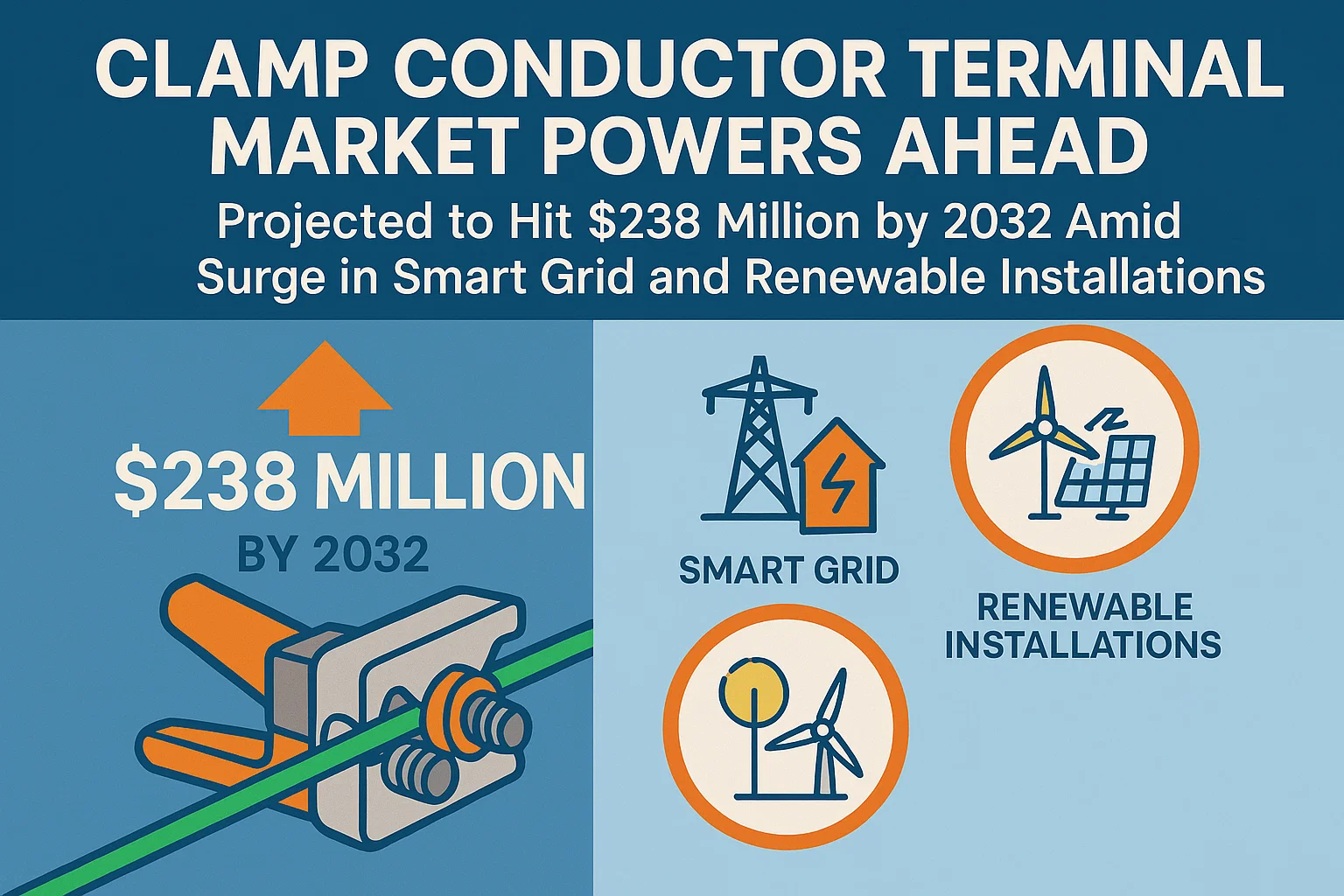
Clamp Conductor Terminal Market Powers Ahead: Projected to Hit $238 Million by 2032 Amid Surge in Smart Grid and Renewable Installations
As the global electrical infrastructure surges forward—driven by renewable energy, smart grids, and industrial automation—one essential yet often overlooked component is quietly gaining momentum: the clamp conductor terminal. These compact, highly efficient connectors serve as critical junctures in electrical systems, ensuring safe, reliable, and durable electrical connections across various sectors. From solar farms and wind turbines to data centers and EV charging stations, clamp conductor terminals form the silent backbone of modern electricity flow.
The global Clamp Conductor Terminal Market was valued at approximately USD 159 million in 2024. According to industry insights, the market is expected to grow at a steady CAGR of 6.1%, reaching an estimated USD 238 million by 2032. This growth is propelled by an accelerating transition toward clean energy, the rising adoption of smart grid infrastructure, increasing demand from industrial automation, and ongoing advancements in material science and design.
Access Your Free Sample Report- Clamp Conductor Terminal Market
Understanding Clamp Conductor Terminals: What They Are and Why They Matter
Clamp conductor terminals are mechanical connectors used to securely clamp electrical conductors (wires or cables) to terminals in a variety of electrical systems. Unlike soldered or compression terminals, clamp terminals offer greater ease of installation and reusability, which makes them particularly desirable in dynamic or modular applications.
Their significance stems from several unique advantages:
- High mechanical and electrical integrity
- Ease of maintenance and modularity
- Resistance to corrosion and harsh environments
- Compact and reliable for both low and high-voltage use cases
They are widely used in:
- Power distribution networks
- Renewable energy systems (solar, wind)
- Switchgear and transformer connections
- Railways and transportation electrification
- Heavy industrial equipment and automation panels
Recent Developments Fueling Market Expansion
While the market has been steady for decades, several emerging trends and recent industry shifts are creating new momentum for clamp conductor terminals:
- Electrification and Renewable Energy Integration
The global push toward decarbonization has turbocharged the installation of renewable energy assets such as solar photovoltaic (PV) systems and wind farms. In these high-voltage applications, clamp conductor terminals provide quick, field-ready installation and reliable electrical performance.
Many solar EPC companies are switching from traditional screw terminals to self-locking clamp terminals to reduce maintenance cycles and system downtime. Similarly, in wind farms, especially offshore, the demand for corrosion-resistant, high-performance terminals has grown significantly.
- Expansion of Smart Grids and Utility Infrastructure
As traditional grids evolve into smart grids, the need for modular, intelligent, and reliable connectors has grown. Clamp conductor terminals are widely favored for their ability to enable plug-and-play architecture, allowing technicians to add or replace components without system-wide shutdowns.
Recent projects in Germany, the UK, and India’s power sectors have highlighted the use of clamp terminals in transformer substations and circuit breaker panels, enhancing operational flexibility and reducing system interruption risks.
- Electrification of Transport & EV Infrastructure
With electric vehicles (EVs) entering the mainstream, the growth of EV charging infrastructure—especially fast chargers—demands reliable electrical connections. Clamp conductor terminals, particularly high-current push-in types, are increasingly used in EV chargers and battery storage modules.
Several OEMs are now incorporating smart monitoring capabilities into terminals, providing real-time data on connection status, temperature, and potential failure risks.
- Industrial Automation & Industry 4.0
Manufacturing and industrial automation demand components that are easy to maintain, modular, and compatible with digital interfaces. Clamp terminals, especially those with spring-clamp or lever-actuated mechanisms, are widely used in industrial control panels, programmable logic controllers (PLCs), and distributed I/O systems.
Smart factories in East Asia and Europe are adopting digitally addressable terminals integrated with RFID tags or QR-coded interfaces for faster diagnostics and maintenance.
Download Sample Report PDF- Clamp Conductor Terminal Market
Innovation Spotlight: Smarter, Safer, and Smaller Terminals
The clamp conductor terminal market is undergoing a quiet transformation driven by innovation:
– Smart Terminals with IoT Capabilities
Some manufacturers are developing terminals equipped with built-in sensors that detect temperature rise, contact resistance, or conductor slippage. These smart terminals are proving valuable in critical environments such as substations, data centers, and renewable farms.
– Miniaturization for Compact Systems
With the growth of compact electrical systems (e.g., mobile power stations, home inverters), terminals are being redesigned for high current density in smaller form factors without compromising safety or durability.
– Tool-Free Lever and Push-In Systems
WAGO and Phoenix Contact, for example, have released next-gen lever-actuated terminals that allow tool-free, secure, and error-proof installation—a boon for fast-paced industrial settings.
– Materials Engineering for Harsh Environments
Manufacturers are investing in terminals made from nickel-plated brass, stainless steel, and reinforced polyamide, ensuring performance in extreme environments such as marine, desert, and sub-zero installations.
Regional Market Insights: Who’s Driving Growth?
North America
The U.S. is witnessing increased adoption in energy storage systems, grid modernization, and EV charging networks. Federal incentives like the Inflation Reduction Act are boosting renewable projects, driving demand for advanced connection systems.
Europe
With its ambitious decarbonization goals, Europe is a strong adopter of clamp terminals in wind, solar, and HVDC transmission projects. Countries like Germany, France, and the Nordics lead the way.
Asia-Pacific
Asia-Pacific—particularly China, India, South Korea, and Japan—shows robust growth due to manufacturing expansion and rising electrification of rail and grid infrastructure. India’s smart grid mission and China’s EV boom are especially impactful.
Latin America & Africa
While still emerging, energy access projects, microgrids, and off-grid solar installations are increasing the adoption of simple, rugged clamp terminals for rural electrification.
Competitive Landscape: Key Players & Recent Moves
The clamp conductor terminal market is moderately consolidated, with a few key players leading innovation and distribution globally:
| Company | Notable Developments |
| WAGO Kontakttechnik | Introduced its 221 Series Lever-Nuts and new terminal blocks with push-in CAGE CLAMP® for energy systems. |
| Phoenix Contact | Launched a range of spring-cage and push-in terminal blocks tailored for modular automation panels. |
| JEAN MÜLLER GmbH | Expanded its range of heavy-duty terminals for use in smart substations. |
| Druseidt Elektrotechnik | Rolled out copper alloy terminals for high-current industrial applications with improved thermal stability. |
| ABB & Schneider Electric | Offer clamp terminal blocks within their broader electrical component product lines, focused on digital integration. |
While these companies dominate, a number of regional manufacturers in China, India, and Eastern Europe are producing cost-effective variants for local and export use.
Challenges Facing the Market
Despite its optimistic outlook, the market for clamp conductor terminals faces several headwinds:
Raw Material Price Volatility
Copper and aluminum, critical materials for terminals, have seen price fluctuations due to geopolitical tensions and mining bottlenecks. This impacts production costs and squeezes margins.
Competition from Alternative Technologies
Compression terminals, soldered joints, and plug-in modules present competition, especially in cost-sensitive markets where ease of installation is not a priority.
Counterfeit Components & Safety Risks
The rise of counterfeit electrical parts—especially in developing regions—can erode trust and lead to safety incidents, posing a challenge to established manufacturers.
Need for Skilled Installation
While clamp terminals are simpler than traditional screw-based solutions, improper installation can still lead to failures. Skilled labor is essential, especially for smart or sensor-integrated models.
Opportunities: Where the Market is Headed
Battery Storage and Microgrids
The growth of decentralized energy systems and residential battery storage is an emerging area for clamp terminal use. Companies focusing on plug-and-play modular units will see increasing demand.
Smart Terminals in Critical Infrastructure
Airports, hospitals, and data centers require predictive maintenance features. Smart terminals with sensor integration and SCADA compatibility offer a major growth opportunity.
DIY & Modular Home Electricals
With rising interest in DIY solar, inverters, and backup power systems, consumer-grade clamp terminals that are safe, compact, and easy to install are expected to become a popular retail product line.
Click Here To Download Full Sample Report- Clamp Conductor Terminal Market
Future Outlook: Building the Electrified World
The clamp conductor terminal may be a small component in the grand scheme of energy systems, but its role is indispensable. As the world shifts toward cleaner, smarter, and more decentralized power infrastructure, demand for high-quality, reliable, and innovative terminal solutions will only grow.
The forecast of USD 238 million by 2032 at a CAGR of 6.1% reflects not just organic growth but a fundamental shift in how we build and maintain electrical networks. The future is connected, modular, and sustainable—and clamp conductor terminals will continue to be a foundational element of that evolution.
In a world obsessed with megawatts, gigafactories, and supergrids, it’s easy to forget the small connectors that quietly power our systems. Yet, without these unassuming components, the entire electrical infrastructure would fall apart—literally.
As innovation continues, the clamp conductor terminal industry stands at the junction of tradition and transformation. Manufacturers who invest in smart design, digital integration, and rugged durability will likely shape the future of this essential but underappreciated market.

Comments (0)