
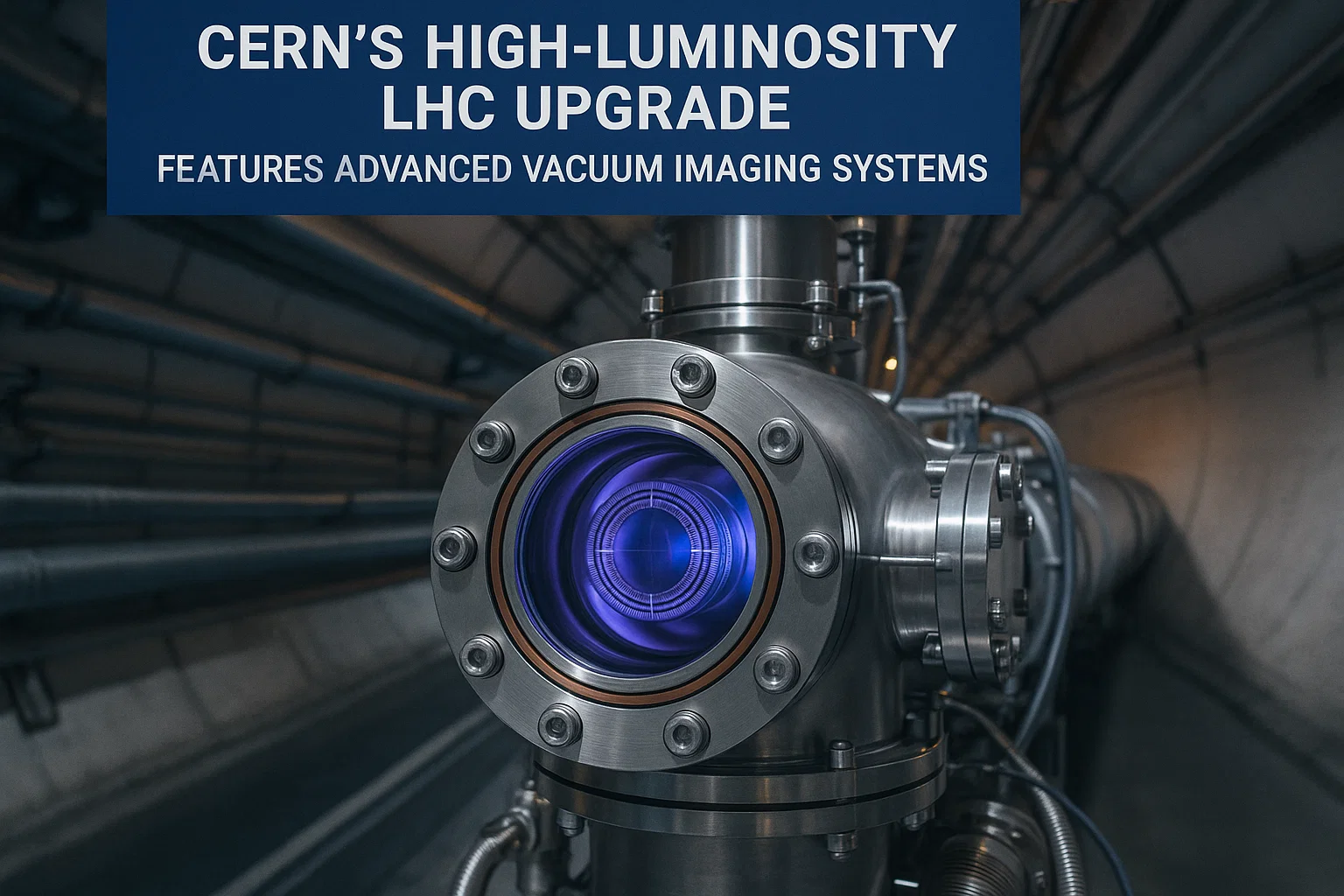
CERN’s High-Luminosity LHC Upgrade Features Advanced Vacuum Imaging Systems
When people think about space telescopes, particle accelerators, or the world’s most advanced semiconductor factories, they often imagine massive instruments and billion-dollar machinery. Yet hidden at the heart of these groundbreaking technologies lies a much less visible hero: the vacuum imaging detector.
In 2024, the global vacuum imaging detector market was valued at US$ 280 million. By 2032, it is projected to grow to US$ 440 million, reflecting a 5.8% compound annual growth rate (CAGR). This growth is not driven by hype but by necessity — as researchers, engineers, and innovators push the boundaries of what we can see, measure, and manufacture, detectors capable of operating in vacuum environments become indispensable.
Access Your Free Sample Report- Vacuum Imaging Detector Market
The Science Behind Vacuum Imaging Detectors
Vacuum imaging detectors are specialized devices that operate in ultra-low-pressure environments. Unlike conventional detectors exposed to atmospheric conditions, these systems must function without interference from gas molecules, dust, or thermal noise.
Key attributes include:
- High quantum efficiency for weak light detection.
- Radiation hardness, critical for space missions.
- Ultra-low noise performance, enabling precise imaging of faint signals.
- Cooling systems to stabilize performance.
They are most commonly used in:
- Astronomy and space exploration (infrared, ultraviolet, and X-ray telescopes).
- High-energy physics (particle detectors, synchrotrons).
- Semiconductor manufacturing (extreme ultraviolet lithography).
- Electron microscopy and spectroscopy.
Space Science: Detectors at the Edge of the Universe
NASA’s Roman Space Telescope
Slated for launch in 2027, NASA’s Nancy Grace Roman Space Telescope will employ cutting-edge HgCdTe vacuum imaging detectors. According to NASA and Scientific American (2024), these detectors have successfully completed radiation-hardness testing, ensuring they can survive the harsh cosmic environment.
Roman’s detectors will give astronomers the ability to conduct wide-field infrared surveys, expanding our understanding of dark energy, exoplanets, and galactic evolution. Each detector must remain stable in deep space vacuum while capturing incredibly faint signals billions of light-years away.
James Webb Space Telescope (JWST) Monitoring
The James Webb Space Telescope, launched in 2021, remains the flagship example of vacuum detector success. Nature (2024) reports that JWST’s near-infrared detectors continue to perform beyond expectations, though engineers are closely monitoring gradual radiation damage over time.
These detectors allow JWST to peer into the “cosmic dawn” — imaging the first galaxies formed after the Big Bang. The mission highlights the critical role of vacuum imaging detectors in unveiling the invisible.
Particle Physics: Imaging the Subatomic World
CERN’s High-Luminosity LHC Upgrade
At the European Organization for Nuclear Research (CERN), preparations for the High-Luminosity Large Hadron Collider (HL-LHC) are underway. CERN News (2024) confirms that new vacuum chamber detectors are being installed to withstand extreme particle fluxes.
These improvements reduce background noise and improve data fidelity, enabling researchers to probe deeper into Higgs boson interactions, supersymmetry, and dark matter candidates.
SLAC National Accelerator Laboratory
Across the Atlantic, SLAC (2024) unveiled progress in X-ray vacuum detectors at its Linac Coherent Light Source (LCLS). These detectors can capture atomic-scale reactions within femtoseconds (10^-15 seconds) — essentially producing “molecular movies.”
Applications include:
- Drug design and protein folding research.
- Energy storage and battery chemistry.
- Ultrafast materials science.
These breakthroughs depend on detector stability in ultra-high vacuum, without which the experiments would be impossible.
Download Sample Report PDF- Vacuum Imaging Detector Market
Semiconductor Industry: Detectors Behind Moore’s Law
ASML and EUV Lithography
One of the most commercially significant uses of vacuum detectors is in semiconductor manufacturing. ASML, the Dutch company leading extreme ultraviolet (EUV) lithography, has integrated highly sensitive vacuum-based detectors into its machines.
According to IEEE Spectrum (2024), recent updates involve improved cooling and stability mechanisms for detectors operating in vacuum chambers. This ensures consistency in 5nm and 3nm chip fabrication, the very technology powering AI, smartphones, and quantum computing hardware.
Hamamatsu Photonics Advancements
In 2024, Photonics Media reported that Hamamatsu Photonics released ultra-low-noise vacuum photodetectors designed for spectroscopy and electron microscopy. These detectors offer improved quantum efficiency in the near-infrared range, essential for applications such as:
- High-resolution biomedical imaging.
- Advanced spectroscopy for materials analysis.
- Cutting-edge industrial inspection.
Hamamatsu’s innovations bridge academic research with commercial and industrial adoption, widening the detector’s impact beyond laboratories.
Market Outlook: Growth Drivers and Challenges
Market Growth Trajectory
- 2024 valuation: US$ 280 million
- 2032 forecast: US$ 440 million
- CAGR (2025–2032): 5.8%
The steady growth of the vacuum imaging detector market reflects rising demand across multiple industries.
Growth Drivers
- Space Exploration: Expanding telescope missions by NASA, ESA, and private space companies.
- Particle Physics: LHC upgrades and new accelerator projects in Asia.
- Semiconductors: Demand for advanced chips driving EUV lithography expansion.
- Biomedical Imaging: High-resolution spectroscopy and microscopy.
Challenges
- High manufacturing costs due to specialized materials.
- Supply chain complexity for vacuum-compatible components.
- Radiation degradation in space-based detectors.
- Competition from alternative technologies (superconducting detectors, quantum sensors).
Looking Ahead: The Future of Vacuum Imaging Detectors
- Space: Expect detectors for next-gen telescopes like ESA’s Athena X-ray Observatory.
- Physics: Detector upgrades at Fermilab and KEK (Japan) will push particle discovery limits.
- Industry: As chip nodes shrink to 2nm and beyond, detector precision in EUV systems will be more critical than ever.
- Medical science: Ultra-fast vacuum detectors may revolutionize cancer imaging and drug development.
The technology is not static; researchers are exploring hybrid detectors combining vacuum imaging with quantum-enhanced techniques, potentially offering orders of magnitude improvements in sensitivity.
Click Here To Download Full Sample Report- Vacuum Imaging Detector Market
Small Devices, Big Impact
Vacuum imaging detectors rarely make headlines compared to billion-dollar telescopes or massive accelerators. Yet without them, our quest to explore the cosmos, unlock the mysteries of physics, and manufacture next-generation electronics would come to a grinding halt.
With the market projected to reach US$ 440 million by 2032, this once-niche technology is becoming a cornerstone of science, industry, and innovation. From capturing the light of the earliest galaxies to etching circuits smaller than a virus, vacuum imaging detectors are truly at the center of humanity’s technological journey.

Comments (0)