

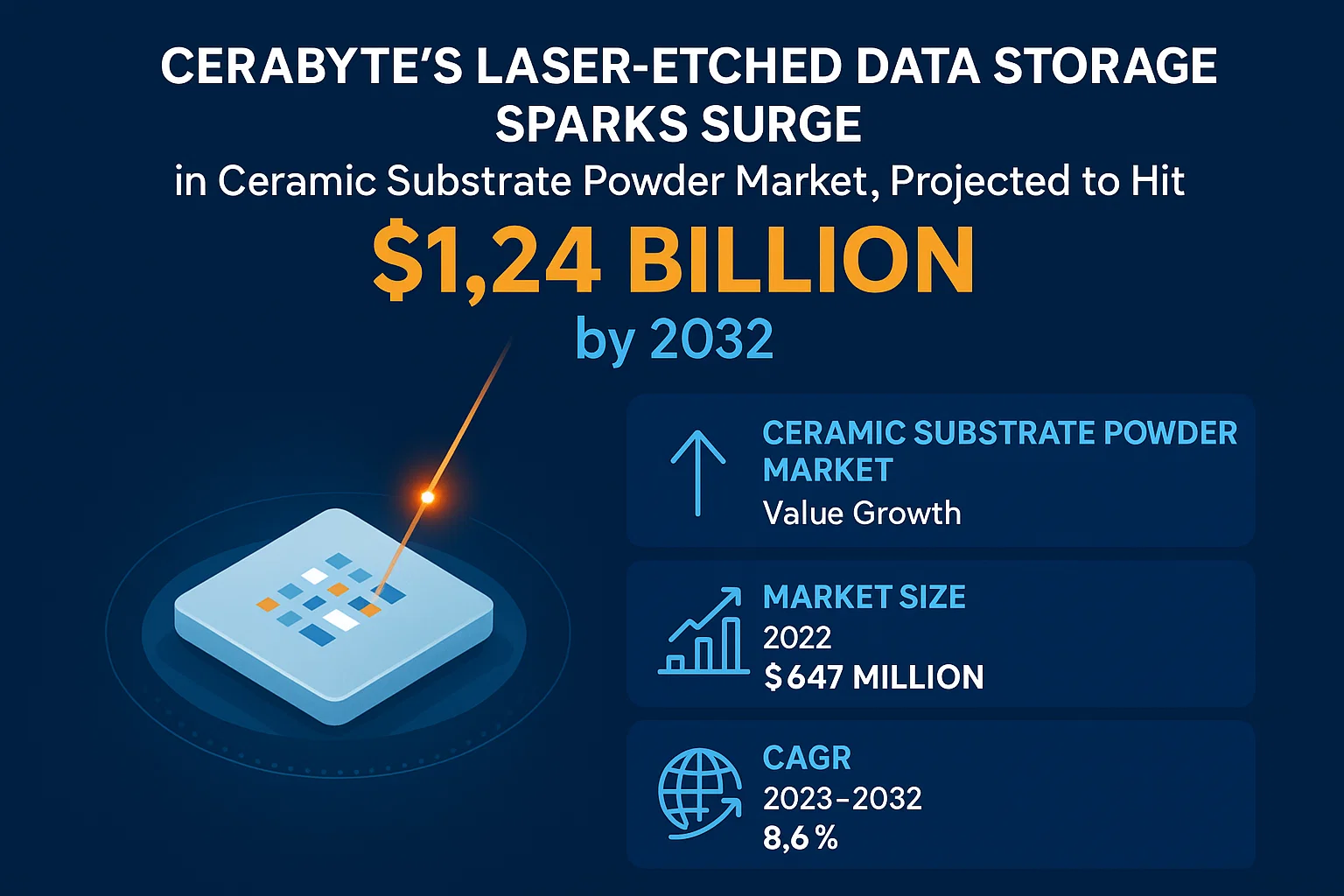
Cerabyte’s Laser-Etched Data Storage Sparks Surge in Ceramic Substrate Powder Market, Projected to Hit $1.24 Billion by 2032
In the constantly evolving world of advanced materials, ceramics have long been celebrated for their strength, stability, and versatility. But recent developments—especially in 2024—have brought the humble ceramic powder back into the spotlight. Spearheading this resurgence is a stunning innovation by Munich-based Cerabyte, which uses femtosecond lasers to etch data into ultra-durable ceramic layers. Beyond the tech buzz, this milestone aligns with a broader market shift: the global ceramic powder for ceramic substrates market, valued at US$ 743.8 million in 2024, is projected to reach US$ 1.24 billion by 2032, growing at a CAGR of 7.6% from 2025 to 2032.
Access Your Free Sample Report- Ceramic Powder for Ceramic Substrates Market
Cerabyte’s Disruptive Leap: Etching the Future of Data onto Ceramics
In what many are calling a revolutionary moment for the storage industry, Cerabyte—a Munich-based startup—has developed a ceramic-based data storage platform that promises to redefine long-term archival standards. Their technology involves embedding ultra-thin ceramic layers within glass plates, then using femtosecond lasers to etch nanoscale data patterns into the material.
Highlights of Cerabyte’s Technology:
- Longevity: Traditional data tapes last 7–15 years; ceramic-based data can last over 100 years.
- Density: The current goal is to fit 1 PB per 42U rack by 2026, and scale to 100,000 PB per rack by 2045.
- Speed: Targeted bandwidths exceed GB/s, with access times below 10 seconds.
- Cost: Projections show potential costs as low as $1 per TB, undercutting current storage solutions.
- Environmental Benefit: No need for refrigeration, moving parts, or magnetism-based degradation, reducing carbon footprint.
This breakthrough is much more than a tech curiosity. It has direct implications for the ceramic substrate ecosystem—especially around materials that can endure extreme stress, temperature, and time without losing structural integrity.
While Cerabyte is not (yet) a massive volume buyer of traditional alumina or aluminum nitride ceramic powders, their success opens doors for a wave of high-purity, laser-compatible ceramic powder development that could spill over into other electronics and data-heavy industries.
Global Market Outlook: A Promising Decade Ahead
The global market for ceramic powder used in ceramic substrates has matured considerably in the last decade. Once a specialized niche reserved for aerospace and high-voltage components, ceramic substrates are now found in electric vehicles, smartphones, 5G infrastructure, industrial robots, medical electronics, and even renewable energy systems.
Market Snapshot:
- 2024 Valuation: US$ 743.8 million
- 2032 Forecast: US$ 1.24 billion
- CAGR: 7.6% (2025–2032)
The demand growth is driven primarily by:
- Surging EV adoption
- 5G and AI chip expansion
- Miniaturization of electronics
- Thermal management needs in power electronics
Key Applications of Ceramic Substrate Powders
Power Electronics
Ceramic substrates like Al₂O₃ (alumina), AlN (aluminum nitride), and Si₃N₄ (silicon nitride) offer thermal conductivity, electrical insulation, and mechanical durability, making them ideal for power modules in EVs, railways, and industrial drives.
Telecommunication (5G Infrastructure)
High-frequency devices and base stations require ceramic substrates with low dielectric constants and high thermal dissipation, essential for 5G’s massive bandwidth and low latency.
Medical Devices
Ceramic powders are used to create compact, biocompatible, and sterile substrates for implantable and diagnostic electronics.
Consumer Electronics
Smartphones, tablets, and wearables use ceramic substrates for RF modules, LEDs, and microcircuits, with miniaturization requiring thinner, purer substrates.
Technological Trends Shaping Ceramic Powder Development
Additive Manufacturing (3D Printing)
Ceramic 3D printing using powder-based techniques is becoming more mainstream. The ability to produce complex ceramic substrates layer-by-layer is transforming product design and reducing waste.
Sol-Gel Processing
This technique allows for the synthesis of ultra-fine, highly uniform ceramic powders with precise stoichiometry, vital for laser-compatible ceramics as in Cerabyte’s case.
Spray-Drying & Freeze-Drying
To maintain flowability, purity, and low contamination, many manufacturers now use advanced spray-drying methods in cleanroom environments. This is especially important for aerospace and semiconductors.
Nano-Ceramic Powders
Ongoing research into nano-sized ceramic powders allows for thinner, more reactive layers in substrates, ideal for AI chips and micro-LEDs.
Download Sample Report PDF- Ceramic Powder for Ceramic Substrates Market
Supply Chain Realities & Environmental Pressures
Raw Material Availability
Most ceramic powders are derived from aluminum, silicon, and rare-earth elements. These supply chains are now under geopolitical stress, especially with rare earths concentrated in China.
Environmental Regulations
The rise of environmental standards—such as Europe’s REACH regulation or India’s push for zero discharge industries—is pushing manufacturers to adopt greener powder synthesis methods with closed-loop recycling.
Traceability and ISO Standards
In high-purity applications like aerospace and defense, ceramic powder producers are under pressure to provide full traceability, batch uniformity, and ISO 9001/14001 compliance.
Regional Dynamics: Who’s Leading the Ceramic Charge?
China
Still the largest manufacturer of alumina powder, China dominates volume production. Government investments in 5G, EVs, and semiconductors are boosting domestic consumption of ceramic substrates.
Japan
Home to major players like Kyocera and Murata, Japan continues to lead in ultra-high purity and precision powders for microelectronics.
United States
Ceramic powder innovation in the U.S. is often linked with defense, aerospace, and energy tech. Companies like 3M and startups like Cerabyte (via U.S. investors) highlight the push toward next-gen applications.
Germany
Germany remains a hub for specialty ceramics and advanced manufacturing. With companies like CeramTec and support from European sustainability mandates, Germany is investing heavily in greener and smarter powder synthesis.
Investment and Start-up Activity
Recent years have witnessed a surge in startup activity and funding in this domain. Here are a few highlights:
- Cerabyte raised approximately $14 million from institutional investors including Western Digital and Pure Storage.
- CeramSpeed, a Swiss startup, has developed ceramic-graphene hybrid powders for use in AI cooling systems.
- Indian manufacturer Rashi Ceramics announced plans for a new automated spray-drying plant in Gujarat to meet rising demand from EV exporters.
This influx of capital suggests that investors see ceramic substrate powders not as commodity inputs but as high-value, innovation-driven enablers.
Challenges the Industry Must Overcome
Despite all the promise, several hurdles still remain:
Cost Pressures
Producing high-purity ceramic powders at scale is expensive. Tight tolerances and cleanroom manufacturing add to the cost.
Thermal Expansion Mismatches
Substrates must match the expansion coefficients of components they host. Small mismatches in powder formulation can lead to cracks and product failure.
Lack of Standardization
While major players follow ISO and MIL-STD protocols, there’s no universal grading system for ceramic powder grades, which complicates cross-border trade.
Future Outlook: The Road to 2032
With a projected CAGR of 7.6%, the ceramic powder for ceramic substrate market is entering a new phase. The drivers are clear—EVs, 5G, IoT, and data infrastructure.
But what’s exciting is where this market is heading:
Anticipated Future Trends:
- Ultra-thin flexible ceramic substrates for foldable electronics
- Ceramic substrates with embedded passive components
- Multi-material substrates, combining ceramics with metal or polymer layers
- Circular economy strategies in ceramic powder usage and reclamation
- Digital twin modeling for powder behavior prediction and performance testing
Cerabyte’s development could very well be the “Apollo moment” for the ceramic substrate industry, inspiring a new wave of R&D and setting benchmarks for performance, durability, and sustainability.
Click Here To Download Full Sample Report- Ceramic Powder for Ceramic Substrates Market
A Quiet Material, a Loud Revolution
While it may not grab headlines like semiconductors or AI chips, ceramic powder is quietly becoming one of the most consequential materials in modern technology. From femtosecond-laser-etched memory systems to mission-critical EV components, the role of ceramics is expanding fast—and it’s doing so in the background of a market poised to cross US$ 1.24 billion by 2032.
The companies that succeed in this space will be those that can balance innovation with cost-efficiency, meet environmental mandates, and adapt fast to rapidly evolving electronics needs.
As Cerabyte shows, sometimes the next leap in digital infrastructure doesn’t come from silicon—but from a few grains of ultra-pure ceramic powder.

Comments (0)