
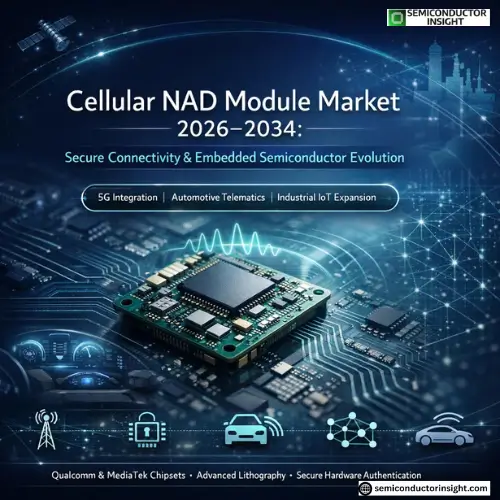
Cellular NAD Module Market Advancing Through Semiconductor Innovation and Embedded Connectivity
Semiconductor Foundations of Cellular NAD Architecture
Cellular NAD (Network Access Device) module market is rapidly expanding as industries increasingly require reliable and embedded communication systems for connected devices. Cellular NAD modules function as semiconductor-based communication components that enable secure network access, data transmission, and remote connectivity across industrial and consumer applications. These modules integrate advanced chipsets, radio frequency components, and processing units to ensure seamless wireless communication within modern electronic systems.
The market is experiencing strong momentum due to increasing deployment of connected infrastructure, autonomous systems, and industrial automation technologies. Semiconductor advancements have significantly improved the performance of cellular NAD modules by enabling faster data transmission, reduced latency, and optimized energy consumption. Modern semiconductor fabrication techniques allow the integration of multiple communication functions into compact modules, supporting growing demand for embedded connectivity across industries.
Chipset Engineering and Integrated Circuit Design Evolution
The evolution of semiconductor chipsets plays a critical role in shaping the cellular NAD module market. Advanced system-on-chip architectures combine baseband processors, memory components, and signal processing units within a single semiconductor structure. This integration improves processing efficiency while reducing system complexity.
Leading semiconductor manufacturers such as Qualcomm and MediaTek have introduced next-generation communication chipsets that support high-speed data transfer and low-power operation for cellular modules. These chipsets enable enhanced network access performance in automotive telematics, industrial equipment, and smart infrastructure.
Recent semiconductor developments include multi-band communication processors capable of supporting 5G and IoT networks simultaneously. Such innovations demonstrate how integrated circuit design continues to enhance communication reliability and system performance.
Role of Advanced Fabrication and Miniaturization
Semiconductor fabrication technologies are enabling continuous reduction in module size while improving functionality. Advanced lithography processes and nanoscale transistor design allow manufacturers to develop compact cellular NAD modules with high processing capability.
Companies such as TSMC are advancing semiconductor manufacturing through smaller process nodes, enabling higher transistor density and improved power efficiency. These developments support the trend toward miniaturization, allowing cellular NAD modules to be integrated into compact electronic devices such as wearable systems, smart sensors, and medical equipment.
Miniaturized modules also reduce energy consumption and heat generation, which enhances operational stability and expands application potential in space-constrained environments.
Cellular NAD Modules in Automotive Semiconductor Systems
The automotive sector represents a major application area for cellular NAD modules. Modern vehicles rely on embedded communication systems to support navigation, remote diagnostics, vehicle-to-infrastructure communication, and connected mobility services.
Automotive manufacturers increasingly integrate cellular NAD modules within telematics control units to enable real-time data transmission and over-the-air software updates. For example, connected vehicle platforms developed by Samsung Electronics incorporate advanced communication modules that support high-speed data exchange between vehicles and cloud networks.
Semiconductor advancements have enabled automotive-grade cellular modules with improved temperature tolerance, vibration resistance, and long operational lifespan. These characteristics are essential for ensuring performance in demanding automotive environments.
To Know More about the Report, You Can Freely Browse Our Latest Updated Report:
https://semiconductorinsight.com/report/cellular-nad-module-market/
Power Efficiency and Semiconductor Material Innovation
Energy efficiency remains a key priority in cellular NAD module development. Semiconductor manufacturers are focusing on advanced materials and low-power circuit design to optimize energy consumption without compromising performance.
Wide band gap semiconductor materials such as silicon carbide and gallium nitride are being explored to improve power efficiency and signal performance in communication modules. These materials provide enhanced electrical conductivity and thermal management compared to conventional silicon-based components.
Material innovation also contributes to improved reliability by reducing performance degradation under high-temperature and high-frequency operating conditions. Such advancements support long-term stability in industrial and mission-critical applications.
Embedded Security and Hardware-Level Authentication
As connected devices generate large volumes of data, security has become a fundamental requirement for cellular NAD modules. Semiconductor-based security mechanisms provide hardware-level encryption, authentication, and data protection.
Modern cellular NAD modules incorporate secure elements and cryptographic processors to prevent unauthorized network access and protect sensitive information. Hardware-based security solutions offer higher protection compared to software-only approaches by isolating critical processes within dedicated semiconductor structures.
Recent developments include tamper-resistant chip architectures and secure boot mechanisms that ensure system integrity throughout device operation.
Industrial IoT and Edge Computing Integration
- Cellular NAD modules play a central role in industrial IoT and edge computing systems. These modules enable machines, sensors, and industrial equipment to communicate with centralized networks and cloud platforms in real time.
- Manufacturing facilities are deploying semiconductor-enabled communication modules to support predictive maintenance, remote monitoring, and automated production processes.
- Cellular NAD modules also facilitate data processing at the network edge, reducing latency and improving operational efficiency.
- The growing adoption of industrial automation technologies continues to strengthen demand for advanced communication modules capable of handling complex data environments.
Multi-Network Support and Communication Integration
Modern cellular NAD modules are designed to support multiple communication standards within a single semiconductor platform. These modules enable seamless switching between network technologies such as 4G, 5G, and low-power IoT communication protocols.
This level of integration simplifies system architecture and improves device compatibility across various network environments. Semiconductor manufacturers are developing multi-mode communication chips that enable efficient spectrum utilization and consistent network performance.
Recent product developments include hybrid communication modules capable of combining cellular connectivity with satellite communication capabilities, expanding coverage in remote and challenging environments.
Thermal Management and Performance Optimization
Thermal management remains a critical factor in semiconductor module performance. Cellular NAD modules generate heat during continuous data transmission, requiring efficient heat dissipation mechanisms to maintain operational stability.
Later, advanced packaging technologies, improved heat spreaders, and optimized circuit layouts help control thermal output and enhance device performance. Semiconductor manufacturers are also implementing advanced testing procedures to ensure long-term stability under continuous operating conditions.
These innovations contribute to improved system efficiency and extended device lifespan across demanding industrial applications.

Comments (0)