
Catalytic Converter Market Boosts Chemical Technologies Powering Cleaner Transportation
In the intersection of chemical engineering and automotive sustainability, the catalytic converter market stands as a cornerstone of global emission-control infrastructure. These devices transform toxic exhaust components like carbon monoxide (CO), unburned hydrocarbons (HC), and nitrogen oxides (NOx) into less harmful gases such as carbon dioxide (CO₂), nitrogen (N₂), and water (H₂O). What’s especially exciting today is the convergence of advanced materials science, semiconductor-grade catalysts, and real-world demand for cleaner air.
The Chemistry That Makes It Work
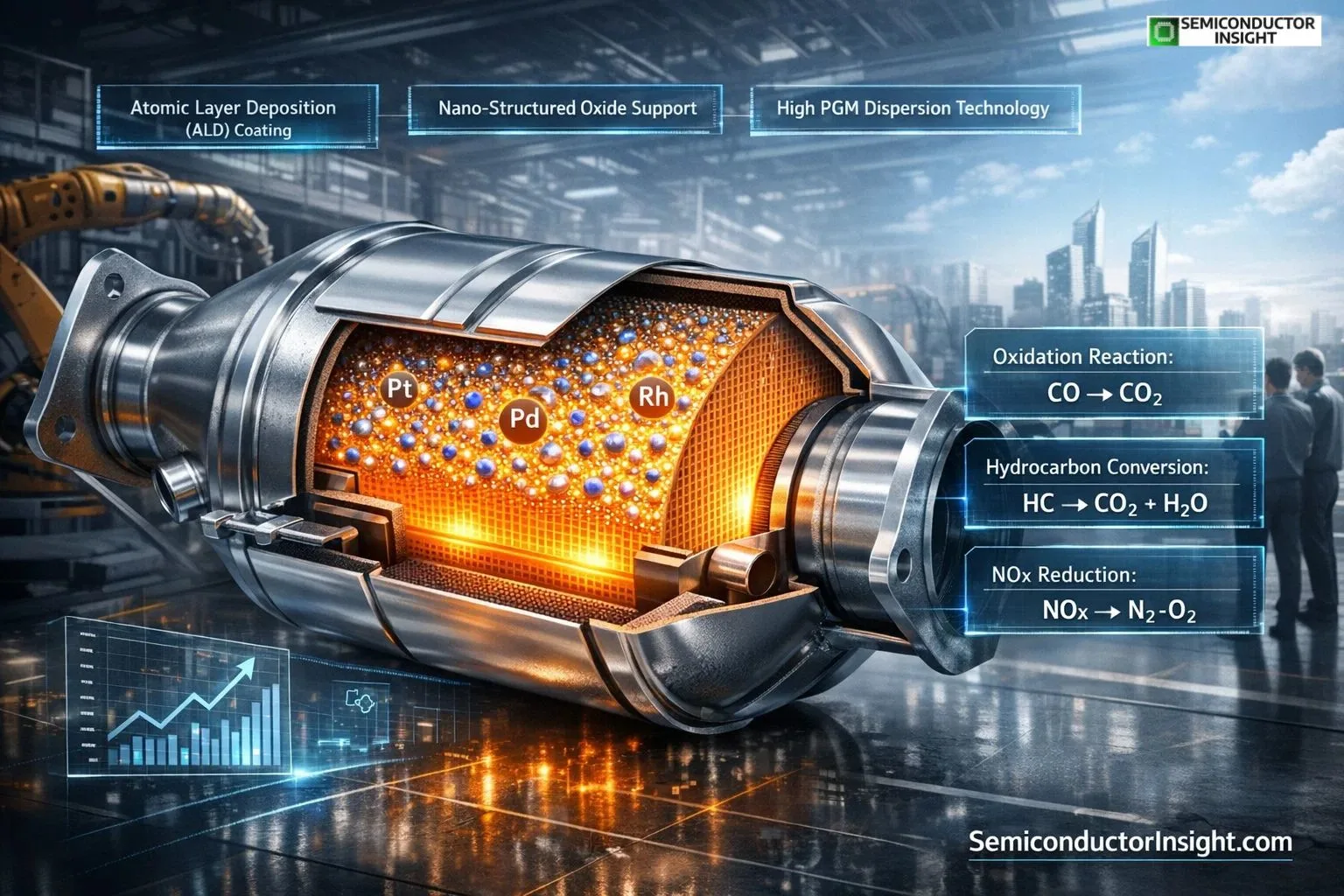
At its heart, a catalytic converter is a compact chemical reactor. It contains a ceramic or metallic substrate coated with a washcoat rich in platinum group metals (PGMs) typically platinum (Pt), palladium (Pd), and rhodium (Rh). These precious metals act as active catalytic sites where surface reactions occur rapidly at high temperatures (~400–800°C).
Three major reactions happen simultaneously:
- Oxidation of CO – CO₂
- Oxidation of HC – CO₂ + H₂O
- Reduction of NOx – N₂ + O₂
The synergistic interplay between these reactions is foundational in reducing tailpipe emissions to comply with stringent norms like Euro 6/VI standards and EPA Tier 3, which in turn drives market demand.
From Automobiles to Semiconductors, Why Materials Matter?
A surprising but increasingly important connection in this field is with semiconductor-grade materials. Recent research has shown that catalysts incorporating nano-structured oxide supports and techniques borrowed from semiconductor manufacturing can dramatically enhance activity and durability.
Take ceria-zirconia mixed oxides, for example. These function as oxygen storage components that help catalysts maintain performance during rapid changes in engine conditions. The ability to engineer surfaces at the atomic level a semiconductor principle is enabling:
- Higher dispersion of PGMs
- Lower precious metal loadings without sacrifice in performance
- Improved thermal stability (resistance to sintering)
Companies collaborating with semiconductor fabs are exploring novel oxide interfaces and core-shell nanoparticles that go beyond traditional washcoat chemistry. These incremental advancements could significantly lower cost and reduce dependency on scarce PGMs.
Deployment and Innovation
· OEM Integration of Nano-Engineered Catalysts: In late 2025, a major global OEM announced integration of a new converter design featuring nano-enhanced ceria coatings that improved NOx reduction efficiency by over 15% under urban driving cycles. This was a direct result of materials science advancements traditionally seen in semiconductor device fabrication.
· Retrofit Market Growth in Tier 2 Cities: Across India and Southeast Asia, cities like Pune, Chennai, and Jakarta are seeing increased demand for aftermarket converters that meet BS VI / Euro VI-equivalent standards. Small vehicle fleets and older commercial vehicles are being retrofitted with improved catalysts often sourced from regional chemical manufacturers who leverage local PGM alloys and optimized washcoat formulations.
· Platinum Group Metal Price Oscillation: A noteworthy trend in early 2026 was the volatility in palladium and rhodium prices, driven by supply constraints and investment demand. This has pushed converter designers to accelerate research into Pt-rich and Pt-free catalysts, often deploying ceramic supports with enhanced surface chemistry to compensate for lower PGM content.
At Last before Ending, Don’t Forget to Browse Our Recent Exclusive Related Report for Detailed Insights: https://semiconductorinsight.com/report/catalytic-flammable-gas-sensors-market/
What’s New in 2026?
- New regulatory tightening was introduced across several U.S. states requiring real-time emissions logging, pushing automotive suppliers to integrate advanced sensors and on-board diagnostics alongside converters.
- Research publications in high-impact journals demonstrated that additives like lanthanum and barium dopants in ceria support layers can reduce soot accumulation while preserving catalysis a breakthrough for diesel applications.
- A leading PGM recycler announced partnerships with automotive suppliers to create closed-loop recycling streams, which ensures that precious metals from old converters are efficiently reused reducing environmental impact and material cost.
How Catalytic Converters Tie to Broader Chemical & Tech Ecosystems?
What makes this topic particularly rich is the cross-disciplinary influence between chemical processing, automotive engineering, and semiconductor manufacturing principles. In 2026, the push towards energy transition, electric vehicles (EVs), and hydrogen combustion technologies further expands the relevance of catalytic chemistry even as EV adoption grows.
For example, hydrogen internal combustion engines still require advanced catalysts to manage water formation and NOx reduction another area where semiconductor-level surface engineering is essential.
Catalytic converter market is evolving far beyond a passive emissions device. It’s a chemical innovation frontier where materials science, clean mobility policy, and semiconductor-grade engineering converge. With ongoing advancements in nano-catalyst design, regulatory pressure, and real-world adoption, this sector continues to be vital in the global push toward cleaner air and sustainable transportation.

Comments (0)